Getting a quote for elevator service involves more than a phone call and a price. Elevator work is governed by federal safety codes, state licensing requirements, and local authority-having-jurisdiction (AHJ) rules that vary across Maryland, the District of Columbia, Pennsylvania, and Virginia. The information below answers the most common questions building owners, property managers, and facilities directors ask when seeking elevator service proposals in those markets.
How do I get a quote for elevator service?
Contact a licensed elevator contractor, share your building address, equipment details, and the type of service you need, and request a site visit so the contractor can assess actual conditions before quoting.
A telephone estimate for elevator work is rarely reliable because conditions inside the hoistway, machine room, and pit directly affect labor, parts, and compliance requirements. A reputable contractor will schedule a walkthrough, review the existing equipment data plates and maintenance records, confirm the applicable code edition for the jurisdiction, and then issue a written proposal that itemizes scope, parts, labor, permit fees, and inspection costs.
Quality Elevator Company serves building owners and property managers in Baltimore MD, Washington DC, Philadelphia PA, and Richmond VA. Their estimating process begins with a complimentary site assessment to verify equipment type, age, condition, and the regulatory requirements that apply to your specific installation.
What information should a building owner gather before requesting an elevator service quote?
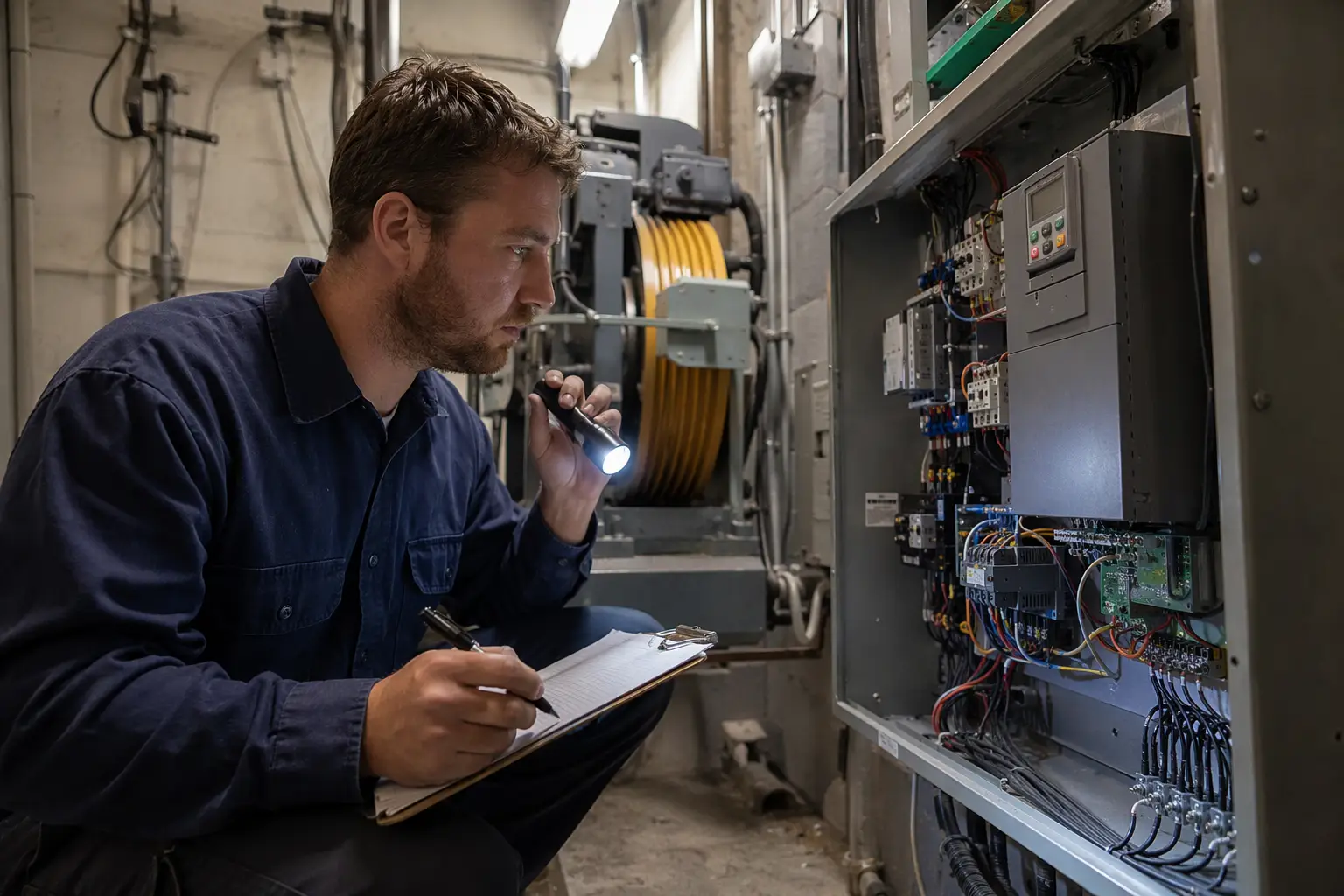
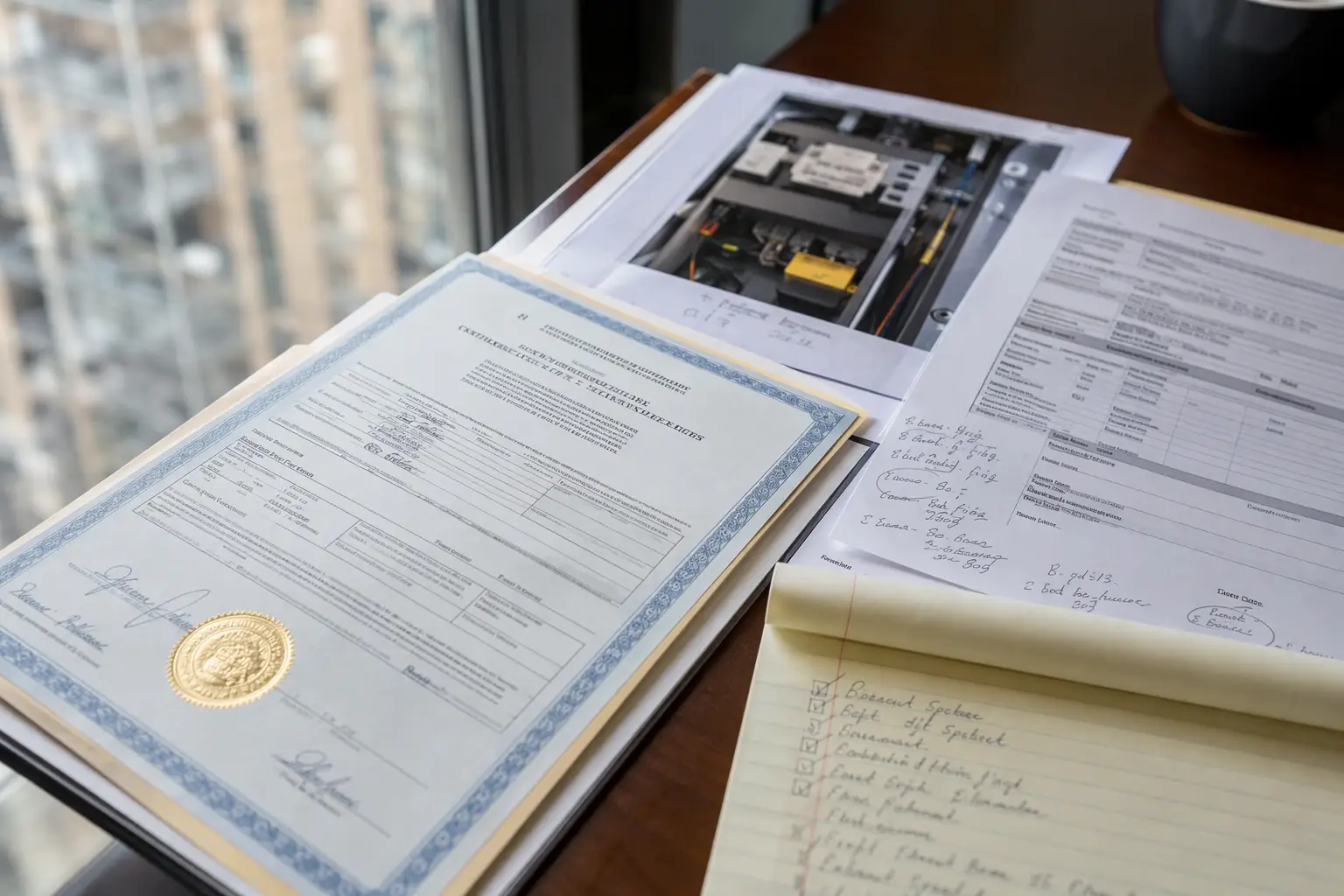
Prepare the equipment nameplate data, maintenance history, current inspection certificate, and a clear description of the problem or service goal before the contractor arrives.
The more information a building owner can provide, the faster a contractor can produce an accurate quote. Useful documents include:
- The elevator’s equipment identification number or unit number assigned by the state or local authority
- The make, model, and year of installation (found on the machine room controller or drive data plate)
- The current certificate of inspection and any notices of violation
- Recent maintenance or inspection reports, especially those noting deficiencies
- The building address and the number of floors and elevator units
- A description of symptoms—unusual noises, leveling problems, door faults, outage frequency
- Any upcoming code compliance deadlines communicated by the AHJ
Having this information ready allows a contractor to identify whether the work requires a permit, a licensed inspector witness, or expedited scheduling to avoid a certificate suspension.
What types of elevator services typically require a formal quote?
Modernization, major repairs, new installations, and planned maintenance agreements all require formal written quotes; minor adjustments covered under an existing maintenance contract typically do not.
The table below outlines the most common elevator service categories and what a formal quote typically covers for each.
| Service Category | Typical Scope Included in Quote | Permit Usually Required? | Inspector Witness Required? |
|---|---|---|---|
| New Installation | Equipment supply, hoistway construction coordination, electrical, final acceptance inspection | Yes | Yes (acceptance inspection) |
| Modernization | Controller, drive, fixtures, cab interior, door operator, code compliance upgrades | Yes | Yes (post-alteration inspection) |
| Major Repair | Hoist motor, sheave, hydraulic cylinder, ropes/belts, safety devices | Often yes | Often yes |
| Periodic Maintenance Agreement | Scheduled lubrication, adjustment, parts-on-call, emergency callback | No | No (but records must be kept) |
| Category 1 / Category 5 Testing | Mechanic labor to perform tests, inspector witness coordination, documentation | No (testing, not construction) | Yes (QEI or certified inspector) |
| Violation Correction | Parts, labor, documentation to close a notice of violation issued by the AHJ | Depends on scope | Depends on AHJ |
| ADA Accessibility Upgrade | Control height adjustments, Braille, audible signals, door timing | Often yes | Varies |
How does jurisdiction affect what a contractor must include in a service quote?
Each of the four jurisdictions Quality Elevator Company serves operates under distinct code editions, licensing rules, and inspection requirements, all of which affect the scope and cost included in a compliant proposal.
District of Columbia: The DC Department of Buildings (DOB) oversees elevator inspections and certificates under DC DOB Elevators and Conveyances. The 2017 DC Building Code references ASME A17.1-2013/CSA B44-13 with District amendments, effective May 29, 2020. Quotes for DC work must account for DOB permit requirements, the need for a DOB-approved third-party inspection agency using ASME QEI-certified inspectors, and the Category 1 (annual) and Category 5 (every 60 months) testing schedule. DOB elevator permits require copies of a master electrician license and an elevator contracting license. Certificates are valid for two years; submission is made through the DOB Citizen Access Portal.
Maryland: The Maryland Department of Labor, Division of Labor and Industry, Elevator and Escalator Safety oversees certificates and licensing under the Annotated Code of Maryland, Public Safety Article, Title 12, Subtitle 8, and COMAR 09.12.81. As of June 17, 2026, Maryland adopted ASME A17.1-2022/CSA B44:22. Quotes must reflect annual periodic inspections, five-year comprehensive inspections for traction elevators, annual re-registration, and the requirement that elevator contractors carry at least $1,000,000 in general liability insurance and at least $500,000 in property damage insurance. Only licensed Maryland elevator mechanics may perform test work.
Pennsylvania: The Pennsylvania Department of Labor and Industry, Bureau of Occupational and Industrial Safety, Elevator Section has statewide jurisdiction—including Philadelphia—under 34 Pa. Code Chapter 405. Until December 20, 2026, the applicable code is ASME A17.1-2000 with A17.1a-2002 addenda; permit applications from December 20, 2026 forward are governed by ASME A17.1-2016 with Pennsylvania modifications. Electric elevators, hydraulic elevators, and escalators require periodic inspections at intervals of no more than six months. Certificates of operation are valid for 24 months (six-month inspection cycle) or 48 months (twelve-month inspection cycle).
Virginia: Under the Virginia Uniform Statewide Building Code (13VAC5-63), local building departments enforce elevator requirements. The 2021 USBC, effective January 18, 2024, incorporates ASME A17.1/CSA B44-2019. In Richmond, the City of Richmond Department of Planning and Development Review, Bureau of Permits and Inspections, runs the elevator program including annual inspections and certificates. Virginia requires annual periodic inspections; localities may require six-month intervals. Quotes for Virginia work must include coordination with the local building department for acceptance inspections and periodic test witnessing.
What federal codes govern elevator service proposals regardless of state?
The ASME A17.1 Safety Code for Elevators and Escalators is the foundational national standard adopted by reference in every jurisdiction Quality Elevator Company serves, and the Americans with Disabilities Act (ADA) imposes accessibility requirements that apply to public accommodations and commercial facilities nationwide.
ASME A17.1 establishes minimum requirements for elevator design, construction, operation, inspection, testing, maintenance, and alteration. The edition in force depends on the jurisdiction and, in some cases, the date the original installation permit was issued. ASME A17.3, the Safety Code for Existing Elevators and Escalators, governs retroactive requirements for equipment already in service. Any contractor quoting modernization or major repair work should identify which edition applies to the specific unit.
The ADA requires that elevators serving public areas of multi-story buildings meet accessibility standards covering call button height and size, hall lanterns, cab dimensions, control panel layout, door timing, and audible and visual signals. These requirements are independent of state elevator codes and must be addressed in any quote involving cab alterations or control upgrades.
How should a building owner compare elevator service quotes from multiple contractors?
Compare quotes on a line-item basis covering scope of work, parts specifications, permit and inspection fees, warranty terms, insurance coverage, and licensing credentials—not on bottom-line price alone.
A lower total price may omit permit fees, use non-OEM parts of unspecified grade, exclude inspector witness costs, or be submitted by an unlicensed contractor. Useful comparison criteria include:
- Licensing verification: Confirm the contractor holds the required license for the jurisdiction. Maryland requires a licensed elevator contractor; DC requires an elevator contracting license; Virginia requires a contractor license with Elevator/Escalator Contracting (EEC) specialty under DPOR.
- Insurance: Maryland law sets explicit minimums ($1,000,000 general liability / $500,000 property damage). Confirm all contractors meet or exceed those levels.
- Parts sourcing: Quotes should specify OEM or approved equivalent parts with warranty duration.
- Permit and inspection coordination: Confirm whether the contractor pulls permits, coordinates the third-party inspection agency, and handles documentation submission to the AHJ.
- QEI-certified inspector access: DC and Maryland require ASME QEI-certified inspectors for certain tests. Confirm the contractor has access to qualified inspection personnel.
- Record-keeping commitments: Maryland requires maintenance, repair, test, and inspection records to be kept at a readily accessible central location in the building. The quote or contract should address who maintains those records.
What is the typical process for getting an elevator service quote step by step?
The quoting process follows a defined sequence from initial contact through written proposal delivery.
- Initial contact: Call or submit a service request online with the building address, number of elevator units, equipment type, and a brief description of the service need or problem.
- Preliminary scope discussion: A contractor representative asks qualifying questions to determine whether a site visit is required or whether the work is routine enough to quote from records (rarely the case for major work).
- Site assessment: A qualified technician visits the building to inspect the machine room, hoistway, pit, cab, and entrance equipment; photographs equipment data plates; and reviews existing inspection reports and violation notices.
- Jurisdiction verification: The contractor confirms the applicable AHJ, the code edition governing the installation, and any open permits, certificates, or deficiency notices.
- Scope development: The contractor identifies required parts, labor hours, permit applications, inspection coordination needs, and any ADA or retroactive code compliance items.
- Written proposal delivery: The contractor issues a detailed written quote itemizing all cost components with payment terms, warranty, and a proposed project schedule.
- Proposal review and clarification: The building owner reviews the quote, asks clarifying questions, and requests references or proof of licensing and insurance as appropriate.
- Contract execution: Upon acceptance, the parties execute a written contract before work begins. No licensed contractor should begin permitted work without a signed agreement.
How long does it take to receive an elevator service quote?
Simple maintenance agreement quotes can often be issued within a few business days after a site visit; major modernization or repair quotes involving extensive scope analysis and parts sourcing may take longer.
Timeline variables include the complexity of the work, the need to source pricing on specialized parts for older equipment, the time required to verify permit fee schedules with the AHJ, and the contractor’s current workload. Building owners with urgent compliance deadlines—such as a certificate of inspection that is about to lapse or a notice of violation with a correction deadline—should communicate that urgency at the time of the initial contact so the contractor can prioritize the site visit and proposal turnaround.
What should a quote for elevator maintenance specifically include?
A maintenance agreement quote should define the inspection frequency, the list of covered components, callback response terms, parts and oil inclusion, record-keeping deliverables, and the duration and renewal terms of the contract.
Preventive maintenance is distinct from emergency repair and from the statutory periodic inspections required by each jurisdiction’s AHJ. A maintenance contract supplements—but does not replace—the legally required periodic inspections performed or witnessed by certified inspectors. The quote should make clear which inspection and testing costs are included and which remain the building owner’s separate responsibility to arrange with an approved third-party inspection agency (as required in DC and Maryland) or through the local building department (as required in Virginia).
Maryland requires maintenance, repair, test, and inspection records to be kept at a readily accessible central location in the building. Any maintenance agreement from a contractor working in Maryland should specify how those records are delivered and stored.
What should a quote for elevator modernization include?
A modernization quote should itemize the new controller and drive system, cab and entrance upgrades, door operator and safety edge replacement, ADA compliance items, all permits, the post-alteration acceptance inspection, and a code compliance analysis confirming the applicable ASME A17.1 edition.
Modernization triggers acceptance inspections in every jurisdiction Quality Elevator Company serves. In DC, the existing building code and property maintenance code govern alterations. In Maryland, the State conducts a final acceptance inspection after modification, and the elevator may not be placed back in service until it passes. In Pennsylvania, an elevator may not return to service after a major alteration until the Department of Labor and Industry inspects and passes it. In Virginia, the local building department conducts the acceptance inspection.
A modernization quote that omits permit fees, inspection coordination, or the cost of correcting existing code deficiencies discovered during the project is an incomplete quote. Quality Elevator Company includes code compliance review and inspection coordination as part of its modernization scoping process.
Does getting an elevator quote obligate the building owner to any work?
A written quote or proposal does not obligate the building owner to proceed; the obligation arises only when both parties execute a written contract.
Building owners are encouraged to obtain multiple quotes for major work. During the quoting process, contractors may identify code deficiencies, open violations, or maintenance gaps the building owner was not aware of. That information is useful regardless of which contractor is ultimately selected. No reputable contractor will charge for a site assessment conducted solely for quoting purposes, though practices vary—confirm this in advance.
How do elevator inspection certificates affect the timing of a service quote?
An expiring or suspended inspection certificate creates a compliance urgency that should be disclosed to any contractor at the time of the quote request, because it affects the work sequence and may require immediate coordination with the AHJ.
In DC, certificates are valid for two years, and periodic inspections must continue during that period. In Maryland, elevator units may not be operated without a valid certificate, which must be posted conspicuously in or on the elevator. In Pennsylvania, certificates of operation are valid for 24 or 48 months depending on the inspection cycle. In Virginia, the current certificate of inspection must be displayed in the elevator or made available in an approved location.
If a certificate has been suspended due to a violation or an alteration permit, the contractor’s quote must address the specific corrective work needed to restore the certificate, not just the underlying mechanical or electrical repair.
What role does ADA compliance play in an elevator service quote?
ADA requirements under Title III of the Americans with Disabilities Act and Section 504 of the Rehabilitation Act apply to public accommodations and federally assisted buildings and must be evaluated whenever a quote involves cab renovation, control upgrades, or door system replacement.
ADA elevator requirements address car dimensions, door width and timing, control button height and marking, emergency communication systems, floor designations in Braille and raised characters, and audible and visual floor indicators. Contractors quoting cab interior or control panel work in commercial buildings must assess whether the proposed scope triggers an obligation to bring those elements into ADA compliance and include the necessary work in the proposal. Omitting ADA items from a modernization quote can expose a building owner to future complaints or litigation.
How do elevator violation notices affect the quote process?
An open notice of violation from the AHJ narrows the scope of the contractor’s work to what the AHJ has specified and sets a correction deadline that the quote timeline must accommodate.
Building owners should provide any violation notices to contractors at the time of the site visit. Violation notices typically cite the specific code section violated, the required corrective action, and the deadline for re-inspection. In DC, violations are issued by the Department of Buildings. In Maryland, they are issued by the Division of Labor and Industry’s Elevator and Escalator Safety unit. In Pennsylvania, they come from the Department of Labor and Industry. In Virginia, they come from the local building department—in Richmond, that is the Bureau of Permits and Inspections.
A contractor quote responding to a violation must address every cited item and include documentation confirming the correction so the building owner can submit it to the AHJ for the follow-up inspection.
Can a building owner get a quote for elevator service without an on-site visit?
Remote or phone-only quotes are generally appropriate only for routine maintenance renewals on equipment the contractor already services; any new work, major repair, or modernization warrants a site visit before a binding quote is issued.
Equipment that appears identical on paper can vary significantly in actual condition, accessibility, and remaining useful life. A site visit protects both the contractor and the building owner from scope gaps that lead to change orders or disputes. For building owners managing multiple properties, a contractor may be able to combine site visits to reduce scheduling time, but the visit itself should not be skipped for significant work.
What permits are required, and how do they affect the cost in a quote?
Permits are required for new installation, alteration, major repair, and in some jurisdictions for taking an elevator out of service, and their fees must be itemized in any honest service quote.
In DC, a DOB permit is required to take an elevator out of service under ASME A17.1 Section 8.11.1.4 or to place it in temporarily dormant status, in addition to permits for construction or alteration. DC elevator permits require copies of a master electrician license and an elevator contracting license. In Pennsylvania, construction, alteration, replacement, or repair of an elevator requires a permit application to the Department of Labor and Industry. In Maryland, the State conducts a final acceptance inspection after installation, modification, or alteration before the elevator is placed in service. In Virginia, the local building department issues permits and conducts acceptance inspections.
Permit fees vary by jurisdiction and by the value and scope of the work. A quote that excludes permit fees understates the true project cost. Building owners should confirm that any quote explicitly addresses permit applications and who is responsible for submitting them.
How does planned code adoption affect quotes for elevator work in 2026?
Pennsylvania’s updated elevator regulation takes effect December 20, 2026, shifting new permit applications to ASME A17.1-2016, which changes testing intervals and requirements—a factor that affects the scope and cost of quotes for projects straddling that date.
Pennsylvania’s Regulation #12-123, effective December 20, 2026, transitions new permit applications to ASME A17.1-2016 with Pennsylvania modifications. Under those rules, Category 1 tests become a stand-alone annual requirement, and periodic tests follow ASME A17.1-2016 Table N-1 intervals witnessed by a construction code official. Elevators whose permit application was made before December 20, 2026, remain under ASME A17.1-2000. Maryland adopted ASME A17.1-2022/CSA B44:22 effective June 17, 2026, with the applicable edition determined by when the installation contract was signed. DC’s DOB plans to adopt new construction codes based on the 2024 model codes by the end of 2027.
Building owners planning modernization or major repair projects in 2026 should discuss with their contractor how the applicable code edition affects permit strategy, testing obligations, and overall project scope, because a project straddling a code transition date may face different requirements depending on the permit submission date.
What questions should a building owner ask an elevator contractor before accepting a quote?
Ask about licensing and insurance, the specific code edition applied to the quote, whether permits are included, who coordinates the inspection, what the warranty covers, and how the contractor handles unexpected conditions discovered during the work.
Specific questions worth asking include:
- Is your company licensed as an elevator contractor in this jurisdiction, and can you provide proof?
- Which ASME A17.1 edition governs this installation, and is that reflected in the scope?
- Are permit fees and inspection coordination costs included in this quote?
- Who will serve as the ASME QEI-certified inspector for required testing (in DC and Maryland)?
- How are change orders handled if conditions in the hoistway differ from what was visible during the site visit?
- What parts warranty do you provide, and is it from the OEM or a third party?
- How will maintenance and test records be provided to me for my building file?
- What is your process if the AHJ rejects an inspection during or after the project?
What are the most common reasons an elevator service quote is inaccurate?
Inaccurate quotes most often result from no site visit, omitted permit and inspection fees, incorrect identification of the applicable code edition, underestimation of parts lead time, and failure to identify existing deficiencies that must be corrected as part of a permitted scope.
When an elevator is opened up for major work under a permit, the AHJ may require that existing non-compliant conditions be brought up to current code before the work passes inspection. A contractor who does not investigate existing conditions before quoting will almost always issue a quote that understates the final project cost. Engaging a contractor who conducts a thorough site assessment—and who clearly documents what is included and what is explicitly excluded—reduces the likelihood of change orders and disputes.
Why should building owners in Baltimore, Washington DC, Philadelphia, and Richmond work with a specialized elevator contractor rather than a general mechanical contractor?
Elevator work requires jurisdiction-specific licensing, ASME code expertise, AHJ relationships, and access to qualified inspection personnel that general mechanical contractors typically do not maintain.
In each of the four markets served by Quality Elevator Company, the regulatory environment is distinct. DC requires a DOB-approved third-party inspection agency and an elevator contracting license from the DC Board of Industrial Trades. Maryland requires a licensed elevator contractor under the Maryland Elevator Safety Review Board and a licensed elevator mechanic for all test work. Virginia requires a contractor license with the EEC specialty from DPOR and coordination with the local building department for all inspections. Pennsylvania’s statewide L&I jurisdiction means that even Philadelphia permits flow through the Department of Labor and Industry rather than the city.
A specialized elevator contractor maintains active licenses in each jurisdiction, tracks code edition transitions, and has established working relationships with the relevant AHJs. Quality Elevator Company focuses exclusively on the elevator markets in Baltimore, Washington DC, Philadelphia, and Richmond, bringing that jurisdictional depth to every quote and project.
Contact Quality Elevator Company for a free elevator assessment at 301-779-9116.
Need elevator service you can rely on? Quality Elevator Company is ready to help.