
When ownership of a building changes hands, elevator inspection certificates do not automatically transfer. The new owner inherits the legal obligation to ensure every elevator, escalator, and conveyance device holds a current, valid certificate issued by the appropriate authority. In Maryland, Washington DC, Pennsylvania, and Virginia, operating an elevator without a valid certificate exposes a property owner to fines, forced shutdowns, and liability. The process involves verifying existing certificate status, correcting any outstanding violations, scheduling inspections, and submitting documentation to the correct regulatory agency. This guide walks through every step, jurisdiction by jurisdiction, so that building owners can move quickly and confidently.
What Is an Elevator Inspection Certificate and Why Is It Legally Required?
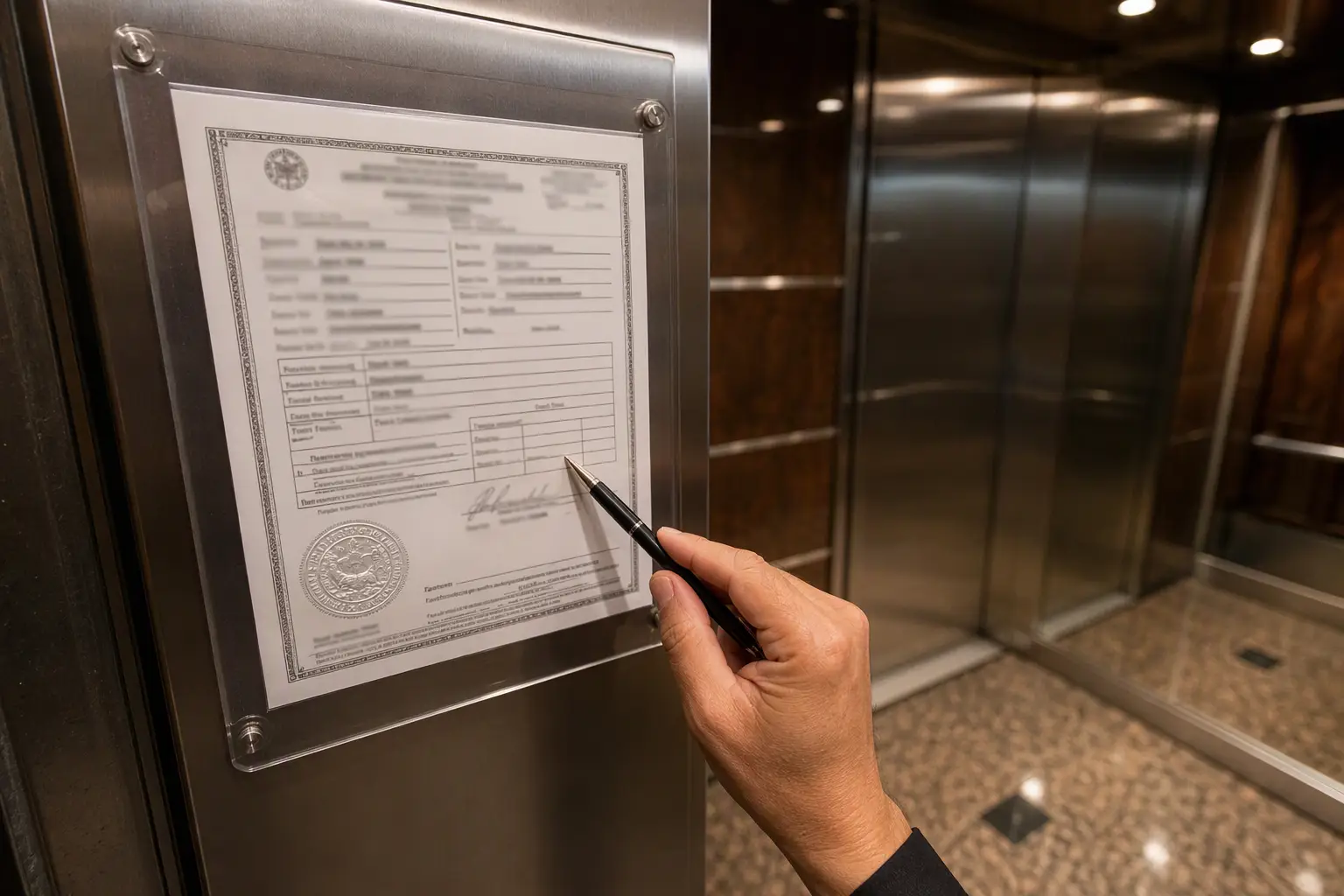
An elevator inspection certificate is an official document issued by the relevant authority confirming that an elevator or conveyance device has passed a periodic safety inspection and is legally permitted to operate.
Every jurisdiction in which Quality Elevator Company operates — the District of Columbia, Maryland, Pennsylvania, and Virginia — requires elevators to hold a current certificate before passengers may ride them. These requirements stem from state statutes and locally adopted editions of the ASME A17.1 Safety Code for Elevators and Escalators, the national model code that defines inspection categories, testing intervals, and equipment performance standards. Failure to maintain a valid certificate can result in the authority having jurisdiction ordering an immediate shutdown, which can disrupt building operations and trigger lease compliance issues with commercial tenants.
Beyond the legal requirement, certificates serve a practical safety function. They document that a trained, qualified inspector has verified that the elevator’s safeties, brakes, ropes, door systems, and controls meet the code edition applicable to that installation. For a new building owner, a certificate — or the absence of one — is one of the clearest indicators of the property’s deferred maintenance risk.
What Should a New Building Owner Do Immediately After Acquiring a Property With Elevators?
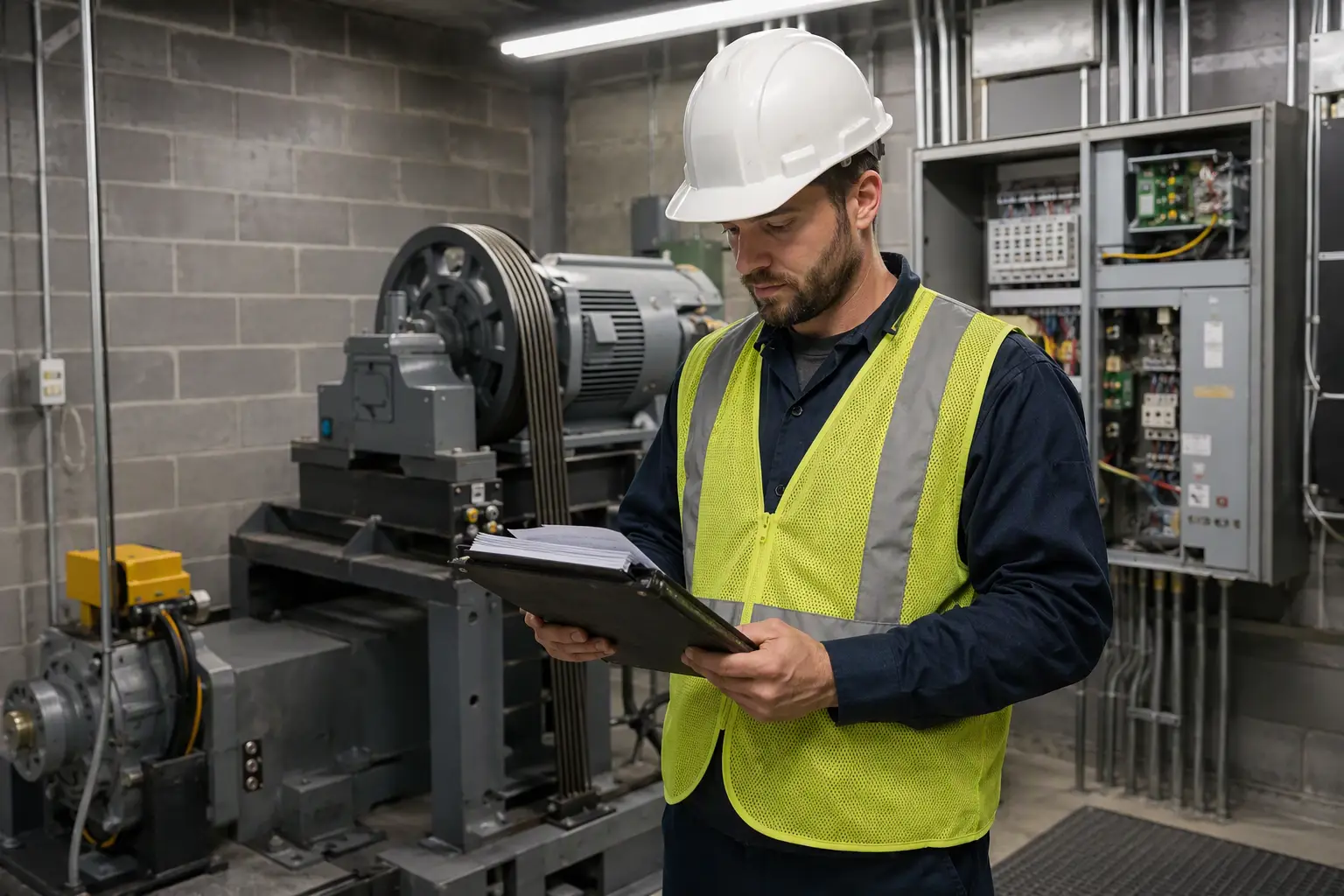
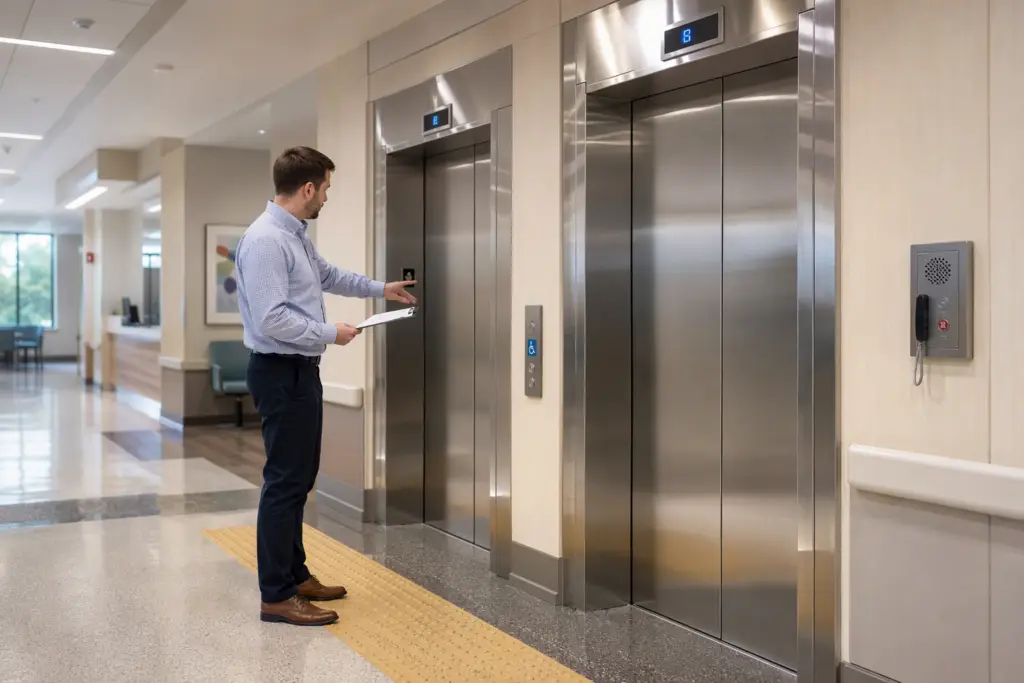
The first priority is to determine the current certificate status of every elevator, escalator, and lift in the building before resuming normal operations.
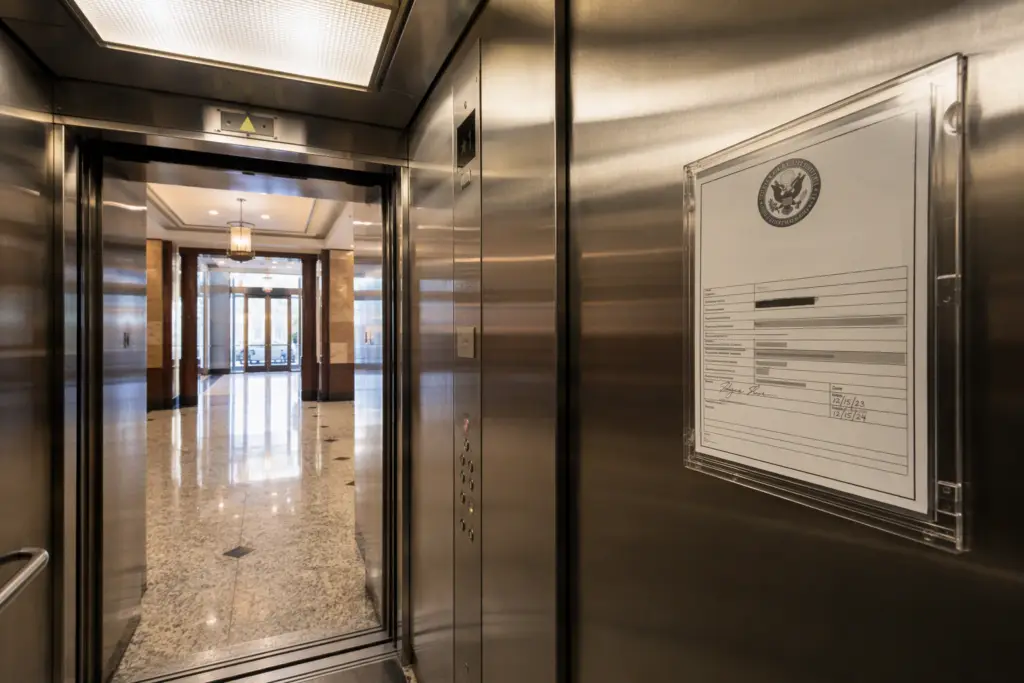
- Locate all existing certificates. Check inside each elevator car for a posted certificate of inspection. In some jurisdictions, certificates may instead be kept in the building operator’s office or attached to the controller in the machine room.
- Verify expiration dates. Note the expiration date on each certificate and compare it to today’s date. An expired certificate means the elevator is operating out of compliance.
- Request inspection and maintenance records. Ask the seller’s representative for all maintenance logs, inspection reports, test records, and permit histories. In Maryland, these records must be kept at a readily accessible central location in the building.
- Identify the authority having jurisdiction (AHJ). The AHJ differs by state — see the jurisdiction-specific questions below for exact agencies.
- Contact the AHJ to notify them of ownership change. Some jurisdictions require re-registration or updated ownership information before a new certificate can be issued.
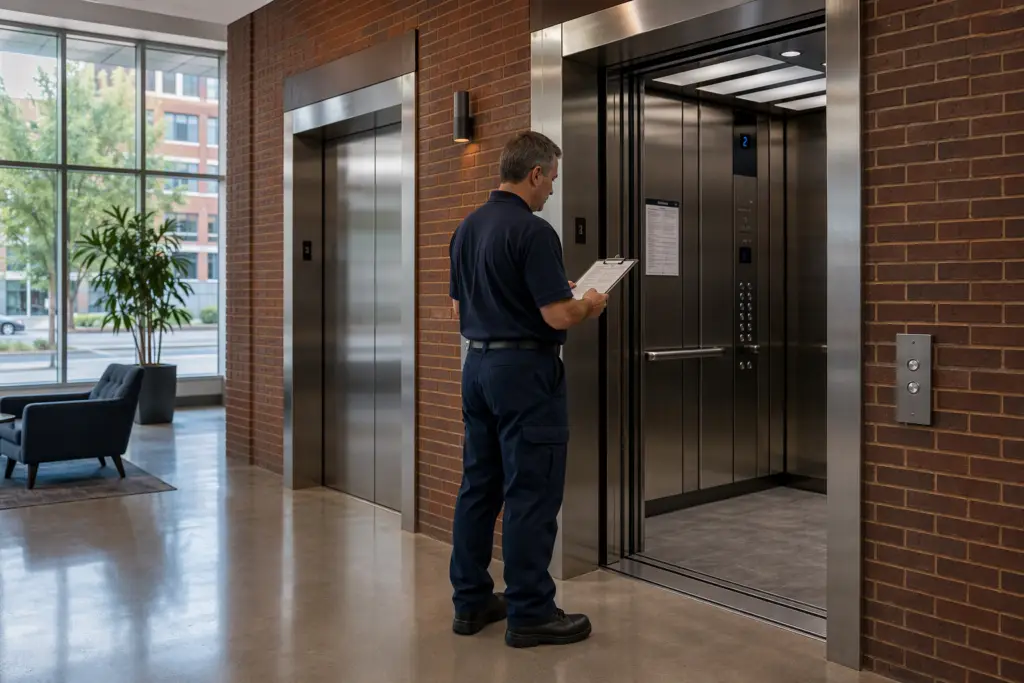
- Engage a licensed elevator contractor. Have a qualified contractor perform a condition assessment to identify any code violations, deferred maintenance, or outstanding permits before scheduling a formal inspection.
- Schedule required inspections and tests. Coordinate with the AHJ or an approved third-party inspection agency to arrange the periodic inspection and any required category tests.
- Submit documentation and fees. File the required inspection reports, registration forms, and applicable fees with the AHJ to receive updated certificates.
- Post certificates conspicuously. Once received, display each certificate in the elevator car or at the location required by the applicable jurisdiction’s rules.
How Does the Certificate Process Work in the District of Columbia?
In DC, the District of Columbia Department of Buildings (DOB) issues elevator certificates of inspection, and owners must use a DOB-approved third-party elevator inspection agency to conduct inspections on DOB’s behalf.
Under D.C. Official Code § 6-1409 and 12-A DCMR Chapter 30, all elevators and escalators in the District must be inspected and certified for operation. The DC building code references the ASME A17.1-2013/CSA B44-13 edition with District amendments, which took effect May 29, 2020. A DC certificate of inspection is valid for two years, and periodic inspections and tests continue during that validity period.
DC requires both a Category 1 inspection every 12 months and a Category 5 inspection every 60 months, each conducted by an ASME QEI-certified inspector. When a new owner acquires a building, they must submit third-party inspection reports for the prior two-year period to DOB through the Citizen Access Portal to obtain a certificate. If those records are unavailable, the owner will need to arrange fresh inspections to generate the required documentation.
The certificate must be conspicuously displayed in the elevator car or attached to the conveyance unless the building operator has an office in the same building, in which case it may be kept available for public inspection there. In buildings with passenger elevators, DC rules require that at least one elevator be kept in operation whenever the building is occupied, except in single-elevator buildings. Taking any elevator out of service requires a DOB permit under ASME A17.1 Section 8.11.1.4. The DC Board of Industrial Trades licenses elevator contractors, mechanics, and inspectors — all parties must hold current licenses before any permitted work may proceed.
How Does the Certificate Process Work in Maryland?
In Maryland, the Maryland Department of Labor, Division of Labor and Industry, Elevator and Escalator Safety unit administers elevator certificates, and an elevator unit may not be operated unless the Commissioner of Labor and Industry has issued a valid certificate for it.
Under the Annotated Code of Maryland, Public Safety Article, Title 12, Subtitle 8, and COMAR 09.12.81, each elevator unit must have a periodic annual inspection by a State inspector or a third-party qualified elevator inspector. Owners are required to hire a third-party qualified elevator inspector to conduct these periodic inspections. Maryland also requires a comprehensive five-year inspection for elevators suspended by wire ropes, belts, chains, or similar means, and for rack-and-pinion elevators.
A new building owner in Maryland must re-register elevator units with the Commissioner. Each elevator must be registered at least 60 days before its planned completion and before it is placed in service; re-registration is required annually at the time of the periodic inspection. Tests performed for any required inspection must be performed by a licensed elevator mechanic, and the qualified elevator inspector must be physically present for the entire test. Elevator contractors working in Maryland must be licensed by the Maryland Elevator Safety Review Board and must carry at least $1,000,000 in general liability insurance and at least $500,000 in property damage insurance. The certificate must be posted conspicuously in or on the elevator unit. Maintenance, repair, test, and inspection records must be kept at a readily accessible central location in the building.
As of June 17, 2026, Maryland has adopted the ASME A17.1-2022/CSA B44:22 edition with Maryland changes. The edition that applies to a specific elevator depends on when the installation contract was signed, and requirements in effect when an elevator was first certified remain in effect for that unit.
How Does the Certificate Process Work in Pennsylvania?
In Pennsylvania, the Pennsylvania Department of Labor and Industry (L&I), Bureau of Occupational and Industrial Safety, Elevator Section holds statewide jurisdiction — including Philadelphia — and no elevator may operate without an L&I-issued certificate of operation.
Under 34 Pa. Code Chapter 405 and the Pennsylvania Construction Code Act (35 P.S. § 7210.101 et seq.), electric elevators, hydraulic elevators, and escalators must have periodic inspections at intervals of no more than six months. A certificate of operation is valid for 24 months for equipment on a six-month inspection cycle and 48 months for equipment on a 12-month cycle. Any UCC-certified elevator inspector may conduct a periodic inspection, and third-party agencies that inspect elevators under the Uniform Construction Code must be certified by the Department.
For equipment with a machine room, the certificate of operation or a copy must be posted in the elevator car or attached to the controller in the machine room. After any major repair, replacement, or alteration, the elevator may not return to service until L&I inspects and passes it. Owners must submit an accident report to the Department when an elevator accident causes a fatality or requires professional medical care.
Pennsylvania’s updated elevator regulation (Regulation #12-123) takes effect December 20, 2026, at which point new permit applications will be evaluated under ASME A17.1-2016 with Pennsylvania modifications, and Category 1 tests will be required every year as a stand-alone requirement. Elevators certified before that date may remain in use if maintained under their prior permit and in compliance with ongoing inspection and testing requirements.
How Does the Certificate Process Work in Virginia?
In Virginia, elevator inspection authority rests with the local building department in each city or county under the Virginia Uniform Statewide Building Code (13VAC5-63), not with a state agency, and all elevators require an annual periodic inspection with the possibility of a six-month inspection if the locality so requires.
Under Code of Virginia § 36-97 et seq. and the 2021 USBC (effective January 18, 2024), periodic tests follow ASME A17.1/CSA B44-2019 Appendix N intervals and must be witnessed by the local code official. The code official may have inspections and test witnessing performed by an approved agency or by other local certified elevator inspectors. In Richmond, the City of Richmond Department of Planning and Development Review, Bureau of Permits and Inspections, runs the elevator program, including final acceptance inspections, annual elevator inspections with tests, and issuance of elevator certificates.
The current certificate of inspection must be displayed in the elevator, attached to the escalator, kept available in the building operator’s office, or posted in an approved conspicuous location. Third-party inspection reports must include the name and certification number of the elevator mechanic who performed the witnessed tests. No one may work as an elevator mechanic in Virginia without state certification issued by the Virginia Board for Contractors (DPOR) unless working under the direct and immediate supervision of a certified mechanic. Installing, repairing, improving, or removing elevators or escalators in Virginia requires a contractor license with the Elevator/Escalator Contracting (EEC) specialty.
What Is the Difference Between a Category 1 and a Category 5 Elevator Test?
Category 1 and Category 5 tests are defined by the ASME A17.1 Safety Code for Elevators and Escalators and represent progressively more comprehensive evaluations of an elevator’s safety systems.
A Category 1 test is a no-load safety test performed on a periodic basis — typically annually — that verifies the proper operation of safeties, governors, buffers, and other critical components without applying full-load conditions. It is the inspection most building owners encounter every year. A Category 5 test is a full-load, full-speed safety test that places real mechanical demand on the safety system, including governor and safety device actuation. DC, for example, requires a Category 5 test every 60 months. These tests require considerably more preparation, including coordination between the licensed elevator mechanic performing the test and the ASME QEI-certified inspector witnessing it. For a new building owner, understanding which category tests are due — and whether they have been performed on schedule — is essential to assessing the true compliance status of the property.
What Happens if the Previous Owner’s Elevator Certificates Have Expired?
Expired certificates mean the elevators are technically operating out of compliance, and the new owner bears full legal responsibility from the date of acquisition.
The correct response is not to continue operating the elevator while scheduling an inspection. Instead, the owner should immediately engage a licensed elevator contractor to assess current equipment condition and outstanding violations, then contact the AHJ to understand the reinstatement process. In some cases, the AHJ may require a violation correction period before a new inspection is even scheduled. Depending on the jurisdiction, fines may already have accrued or notice of violations may be on file. Quality Elevator Company routinely assists new building owners in navigating post-acquisition compliance gaps, including coordinating with the appropriate regulatory agency and arranging the inspections needed to restore valid certificate status.
Does ADA Compliance Affect Elevator Certification?
ADA compliance and elevator certification are separate legal requirements, but both apply to most commercial buildings and both can surface violations during a post-acquisition review.
The Americans with Disabilities Act requires that elevators in multi-story facilities covered by the Act meet accessibility standards, including door timing, cab dimensions, control panel requirements, and audible signals. ADA violations do not automatically invalidate an elevator inspection certificate, because the certificate addresses mechanical safety rather than accessibility. However, a building acquired with ADA-non-compliant elevators exposes the new owner to federal civil rights complaints and potential litigation. A thorough post-acquisition elevator assessment should cover both the mechanical inspection certificate status and an ADA accessibility audit.
How Long Does It Take to Get an Elevator Certificate After Acquiring a Building?
The timeline varies by jurisdiction and by the current condition of the equipment, but owners should plan for a process that may span several weeks to several months if violations exist.
In straightforward cases — where equipment is well-maintained, all prior inspections are on schedule, and only an updated ownership registration is needed — the process can move relatively quickly once the inspection is completed and documentation is submitted. Where violations must be corrected before inspection, or where major repairs require a permit, an acceptance inspection, and the issuance of a new certificate, the timeline extends accordingly. Jurisdiction-specific processing times at the AHJ also vary. New building owners are strongly advised to begin the process immediately after closing, not after receiving a violation notice.
What Records Should a New Building Owner Request at Closing?
Requesting comprehensive elevator documentation at closing is one of the most practical steps a buyer can take to protect themselves from inherited liability.
The records to request include: all current certificates of inspection for each elevator unit; the most recent periodic inspection report and any outstanding violation notices; the five-year test records where applicable; all maintenance logs for at least the preceding three years; records of any alteration or modernization permits, acceptance inspection reports, and approved drawings; elevator registration records with the state agency (Maryland and DC); and the service contract with the prior maintenance provider. In Maryland, these records are required by law to be kept at a readily accessible central location in the building, so they should be available. If a seller cannot produce them, that itself is a red flag warranting a more intensive pre-closing inspection.
What Is an Elevator Code Compliance Gap Analysis and When Is It Needed?
A code compliance gap analysis is a structured technical review comparing an elevator’s current condition against the requirements of the applicable edition of ASME A17.1 and any state or local amendments, used to identify what must be corrected before a certificate can be issued.
Gap analyses are particularly valuable for new building owners when equipment is old, when the building has changed use or occupancy, or when inspection records are incomplete. For older elevators, the analysis must account for the retroactive requirements of ASME A17.3, Safety Code for Existing Elevators and Escalators, which applies to equipment already in service and may require upgrades such as firefighters’ emergency operation, door reopening devices, and phase II emergency recall. Quality Elevator Company performs gap analyses as part of its comprehensive elevator assessment process, giving new building owners a clear picture of required expenditures before they commit to a compliance timeline.
Do Elevator Inspection Requirements Apply to All Types of Lifts and Conveyances?
Inspection and certification requirements in DC, Maryland, Pennsylvania, and Virginia apply broadly to passenger elevators, freight elevators, escalators, moving walks, and most other conveyance devices regulated under ASME A17.1, though specific exemptions exist for certain residential installations.
In Maryland, the elevator inspection and certificate law generally does not apply to units in privately owned single-family homes or in buildings under federal control. In Pennsylvania, the UCC elevator rules do not apply to lifting devices used only by the occupants of a single dwelling unit. In Virginia, local government inspection applies to all elevators except those in single-family homes, two-family homes, and townhouses. Platform lifts and inclined stairway chairlifts may be subject to separate inspection requirements depending on the jurisdiction. New building owners should identify every conveyance device in the building and confirm its regulatory status with the AHJ.
What Are the Inspection Frequency Requirements Across Quality Elevator Company’s Service Markets?
Inspection frequency requirements differ by jurisdiction and by equipment type, and understanding the schedule is essential for budgeting and compliance planning.
| Jurisdiction | Governing Agency | Periodic Inspection Frequency | 5-Year / Category 5 Test | Certificate Validity | Adopted Code Edition |
|---|---|---|---|---|---|
| District of Columbia | DC Department of Buildings (DOB) | Category 1 every 12 months | Category 5 every 60 months | 2 years | ASME A17.1-2013/CSA B44-13 |
| Maryland | MD Dept. of Labor, Division of Labor and Industry | Annual periodic inspection | Comprehensive 5-year inspection (wire rope/belt/chain elevators) | Annual re-registration | ASME A17.1-2022/CSA B44:22 (eff. June 17, 2026) |
| Pennsylvania | PA Dept. of Labor and Industry, Elevator Section | Every 6 months (electric, hydraulic, escalators) | Per ASME A17.1 Appendix N (Category 1 annual, standalone, eff. Dec. 20, 2026) | 24 months (6-mo. cycle); 48 months (12-mo. cycle) | ASME A17.1-2000/A17.1a-2002 (A17.1-2016 for new permits from Dec. 20, 2026) |
| Virginia (including Richmond) | Local Building Department (USBC) | Annual (locality may require 6-month) | Per ASME A17.1/CSA B44-2019 Appendix N intervals | Annual | ASME A17.1/CSA B44-2019 (eff. Jan. 18, 2024) |
Who Is Qualified to Inspect Elevators and Issue Certificates in These Jurisdictions?
Inspector qualifications vary by jurisdiction, but all four markets served by Quality Elevator Company require that inspectors hold recognized credentials aligned with ASME QEI-1 or state certification standards.
In DC, inspections must be performed by ASME QEI-certified inspectors working for a DOB-approved third-party agency; applicants for a DC elevator inspector license must meet ASME QEI-1 or an equivalent standard. In Maryland, the State conducts acceptance inspections, while periodic inspections are conducted by third-party qualified elevator inspectors; tests must be performed by a licensed elevator mechanic with the inspector physically present. In Pennsylvania, any UCC-certified elevator inspector may conduct a periodic inspection, and third-party agencies must be certified by the Department of Labor and Industry. In Virginia, the local code official, an approved agency, or other local certified elevator inspectors may conduct and witness periodic tests; third-party reports must include the name and certification number of the elevator mechanic who performed the tests. Virginia also requires that elevator mechanics hold state certification issued through the Virginia Board for Contractors (DPOR).
Can a New Building Owner Be Fined for Violations Found During a Post-Acquisition Inspection?
Yes — once title transfers, the new owner is legally responsible for compliance, and violations found during inspection become the new owner’s obligation regardless of when they originated.
This is why a pre-closing elevator inspection is strongly advisable. Buyers who discover violations after closing have limited recourse against sellers unless those violations were specifically addressed in the purchase agreement. Violations can range from minor documentation deficiencies to significant mechanical defects requiring immediate shutdown. In Pennsylvania, owners may appeal a code official’s decision or request a variance or extension of time by petitioning the Elevator Safety Board within 30 days of the decision. Understanding the appeals and variance process in the applicable jurisdiction is important for owners who inherit equipment with significant compliance gaps.
What Is the Role of the Elevator Contractor in the Certificate Process?
The elevator contractor is responsible for maintaining the equipment in compliance with applicable code, performing required tests using licensed mechanics, and coordinating with the inspector and AHJ throughout the inspection and certification cycle.
Contractors do not issue certificates — that authority rests with the AHJ or its approved inspection agencies — but the contractor’s work is the foundation of every successful inspection. A contractor assesses equipment condition, performs maintenance and repairs, provides the licensed mechanic to perform code-required tests, and may assist the owner in compiling the documentation needed for certificate applications. In Maryland, a business must be licensed by the Maryland Elevator Safety Review Board as an elevator contractor before performing any installation, alteration, maintenance, repair, or service work on elevator units. In Virginia, the Elevator/Escalator Contracting (EEC) specialty license is required. Quality Elevator Company holds the credentials required to operate across its DC, Maryland, Pennsylvania, and Virginia service markets, enabling seamless coordination with each jurisdiction’s AHJ.
What OSHA Requirements Apply to Elevators in Commercial Buildings?
OSHA’s general industry standards apply to elevator equipment in workplaces, addressing construction-phase safety and the protection of workers who maintain and service elevators.
The Occupational Safety and Health Administration enforces standards that protect elevator mechanics and maintenance workers from hazards associated with hoistways, electrical systems, and mechanical components. OSHA requirements are separate from state certificate-of-operation requirements, which focus on passenger safety. However, a building that lacks proper elevator maintenance programs may face OSHA exposure as well as state regulatory exposure. New building owners should ensure that their elevator service contract specifies compliance with applicable OSHA standards in addition to state certificate requirements.
How Should a New Building Owner Choose an Elevator Service and Inspection Partner?
Selecting an elevator service partner with demonstrated familiarity with local AHJ requirements, licensed mechanics and contractors in the applicable jurisdiction, and experience managing post-acquisition compliance is the most important decision a new building owner makes in the elevator compliance process.
Key criteria include: licensure and certification in the relevant jurisdiction (Maryland Elevator Safety Review Board, DC Board of Industrial Trades, Pennsylvania L&I-certified inspection agency, Virginia DPOR EEC contractor license); ASME QEI-certified inspection capacity where required; experience preparing and submitting certificate applications to the specific AHJ; and the ability to perform both periodic maintenance and the full range of category tests required by the applicable code edition. Quality Elevator Company serves building owners across Baltimore, Maryland; Washington, DC; Philadelphia, Pennsylvania; and Richmond, Virginia, providing a single point of accountability for compliance across multiple markets. For ownership groups managing portfolios spanning several of these jurisdictions, a regionally experienced partner eliminates the coordination overhead of managing separate contractors in each market.
What Happens to Elevator Certificates During a Modernization or Alteration Project?
An elevator’s certificate may be affected or temporarily suspended during permitted alteration or modernization work, and the elevator cannot return to service until the AHJ conducts and passes an acceptance inspection.
In DC, an elevator’s certificate of inspection may be temporarily suspended while it is under permit for alteration or modernization. In Pennsylvania, after a major repair, replacement, or alteration, an elevator may not return to service until the Department inspects and passes it. In Maryland, the State conducts a final acceptance inspection after an elevator unit is installed, modified, or altered and before it is placed in service. A DOB permit in DC requires a copy of the master electrician license and the elevator contracting license before work may begin. New building owners planning modernization projects should factor this shutdown period and the acceptance inspection timeline into their project schedules to avoid extended outages that affect tenants.
What Is the Impact of Building Occupancy Requirements on Elevator Certificate Obligations?
Building occupancy type and the number of elevators can affect which specific certificate obligations apply, including requirements to keep at least one elevator operational at all times.
In DC, buildings with passenger elevators must keep at least one elevator in operation whenever the building is occupied, except in buildings with only one elevator. This means a multi-elevator building cannot take all units out of service simultaneously without a DOB permit. Maryland’s statute requires that new buildings constructed after July 1, 1985, with at least one planned elevator must include a passenger elevator capable of carrying a six-foot-eight-inch rescue litter horizontally — a provision that affects design during renovation planning. Understanding how occupancy type interacts with certificate and operational requirements is essential for new owners managing occupied buildings throughout the compliance remediation process. Quality Elevator Company assists owners in developing compliance schedules that minimize disruption to building occupants while meeting regulatory deadlines.
Get Your Elevator Certificates in Order — Contact Quality Elevator Company Today
Navigating elevator inspection certificates after a building acquisition is a multi-step process with serious legal and safety consequences for delays. Quality Elevator Company provides comprehensive post-acquisition elevator assessments, code compliance gap analyses, licensed maintenance and testing services, and full coordination with the AHJ in Baltimore, Washington DC, Philadelphia, and Richmond. Whether equipment needs a straightforward inspection and certificate renewal or a complete modernization program to meet current code, Quality Elevator Company delivers the expertise and jurisdictional knowledge to move owners from acquisition to full compliance efficiently.
Contact Quality Elevator Company for a free elevator assessment: 301-779-9116
Need elevator service you can rely on? Quality Elevator Company is ready to help.