Top Rated Elevator Maintenance Company in Baltimore: Complete FAQ Guide
After more than 15 years working on elevator systems across Baltimore, Washington DC, Philadelphia, and Richmond, I’ve seen what separates a truly reliable elevator maintenance company from one that just shows up when something breaks. This guide answers the questions building owners, property managers, and facility directors ask most often — covering compliance codes, costs, timelines, equipment, and how to evaluate any elevator service provider before you sign a contract.
What makes an elevator maintenance company “top rated” in Baltimore?

A top rated elevator maintenance company in Baltimore holds current IUEC (International Union of Elevator Constructors) certification, maintains a Maryland elevator contractor license, responds to emergencies within two hours, and demonstrates a documented track record of passing Maryland Department of Labor inspection audits.
When I evaluate any elevator service provider — including benchmarking against our own standards at Quality Elevator Company — I look at five non-negotiable criteria: technician certification level, average emergency response time, first-visit fix rate, compliance pass rate on state-mandated inspections, and transparent contract terms with no hidden fees.
In Baltimore specifically, the Maryland Department of Labor’s Division of Labor and Industry regulates all elevator work. Any contractor operating without a valid Maryland elevator contractor license is operating illegally, regardless of how professional their website looks. Always verify licensing before signing any service agreement.
How often are elevators required to be inspected in Maryland?

Maryland law requires a full safety inspection of all conveyances — including elevators, escalators, and platform lifts — at least once every 12 months, with a witnessing inspection conducted by a Maryland-licensed elevator inspector.
Under Maryland Code, Business Regulation Article, all conveyances must be inspected annually. The inspection must be performed by or witnessed by a licensed inspector certified under the Maryland Department of Labor’s Elevator Safety Program. Additionally, ASME A17.1 Safety Code for Elevators and Escalators requires periodic tests depending on elevator type — Category 1 tests annually, Category 3 tests every three years, and Category 5 tests every five years.
In 2026, Maryland continues to enforce these intervals strictly. Building owners who miss inspection windows face fines, mandatory shutdowns, and potential liability exposure if an incident occurs on an out-of-compliance elevator. I recommend scheduling your annual inspection at least 60 days before your certificate expiration date to allow time for any corrective work.
What does a comprehensive elevator maintenance contract include?
A comprehensive elevator maintenance contract should include monthly lubrication and adjustment visits, 24/7 emergency callback service, all labor and parts for routine wear items, annual ASME-compliant safety inspections, and a written guarantee of regulatory compliance.
Contract tiers vary significantly in the industry. The three most common structures are:
- Examination Only (Oil & Grease): Covers labor for routine lubrication and minor adjustments. Parts and emergency callbacks are billed separately. Lowest monthly cost, highest long-term risk.
- Full Maintenance: Covers all labor, most parts, and emergency callbacks. Best value for mid-rise and high-rise commercial buildings with elevators running 8+ hours daily.
- Modernization-Inclusive: Covers everything in full maintenance plus planned component upgrades on a defined schedule. Ideal for older elevator systems with aging controllers or hydraulic units.
I always advise building owners to read the exclusions list as carefully as the inclusions. Look specifically for exclusions on cab interior components, door operators, and solid-state controllers — these are among the most expensive replacement items and the most commonly excluded in budget contracts.
How much does elevator maintenance cost in Baltimore in 2026?
Elevator maintenance costs in Baltimore typically range from $150 to $650 per month per unit depending on elevator type, usage intensity, building age, and contract tier selected.
The table below provides 2026 benchmark pricing for the Baltimore metro area based on contract type and elevator category:
| Elevator Type | Examination Only (Monthly) | Full Maintenance (Monthly) | Modernization-Inclusive (Monthly) |
|---|---|---|---|
| Hydraulic (2–4 story) | $150–$220 | $280–$380 | $420–$520 |
| Traction (5–10 story) | $200–$300 | $350–$480 | $500–$650 |
| MRL (Machine Room Less) | $180–$260 | $320–$430 | $460–$580 |
| Residential (Private) | $100–$160 | $200–$290 | $320–$400 |
| Platform Lift / LULA | $90–$140 | $175–$250 | $280–$360 |
These figures reflect standard single-unit pricing. Multi-unit discounts of 10–25% are typical for buildings with three or more elevators. Emergency repair labor rates in Baltimore average $185–$240 per hour for after-hours calls on examination-only contracts, which is why full maintenance coverage often delivers better total cost of ownership.
What is the ASME A17.1 code and why does it matter for my building?
ASME A17.1 is the Safety Code for Elevators and Escalators — the foundational technical standard adopted by Maryland and most U.S. jurisdictions that governs elevator design, installation, testing, inspection, and maintenance requirements.
The ASME A17.1 Safety Code for Elevators and Escalators is updated on a regular cycle. Maryland adopts updates with a lag, so your building may be governed by an earlier edition than the most current published version. Your elevator maintenance contractor must know which edition applies to your specific installation — this is not a detail to leave to guesswork.
Key ASME A17.1 requirements that directly affect Baltimore building owners include: governor and safety device testing, hydraulic pressure relief valve testing, door operation force limits (not to exceed 30 lbf), firefighter emergency operation (FEO) functionality, and Phase I and Phase II fire service operation testing. Non-compliance with any of these during a Maryland inspection results in a violation notice and potential shutdown order.
What ADA requirements apply to elevators in commercial buildings?
Under the Americans with Disabilities Act, elevators in multi-story commercial buildings must meet accessibility standards including minimum cab dimensions, specific control button heights, audible and visual floor indicators, and door timing requirements.
The ADA Standards for Accessible Design require that elevator cabs in commercial buildings provide a minimum clear floor area of 51 inches deep by 68 inches wide for automatic doors, control buttons no higher than 48 inches above the floor, raised and Braille characters on all floor buttons and jamb plates, and door reopening devices that remain effective for at least 20 seconds.
ADA compliance is not a one-time installation issue — it requires ongoing maintenance. Door timing that drifts, worn Braille plates, burned-out floor indicators, and misaligned leveling can all create ADA violations over time. During routine maintenance visits, a thorough technician should audit these elements at every visit, not just at annual inspection time.
What should I do immediately if someone is trapped in an elevator in my building?
If a person is trapped in an elevator in your building, do not attempt to open the doors manually — follow this protocol immediately to ensure occupant safety and proper rescue.
- Call 911 if the trapped occupant reports a medical emergency, distress, or the elevator is stopped in a position that does not allow safe exit.
- Establish voice communication with the trapped passenger using the in-cab emergency phone or intercom system.
- Instruct the occupant to remain calm, stay toward the center of the cab, and not attempt to force open the doors.
- Call your elevator maintenance contractor’s 24/7 emergency line immediately — do not wait to see if the elevator self-recovers.
- Note the exact time of entrapment, last known floor, direction of travel, and any unusual sounds or smells reported by the occupant.
- Do not allow unauthorized personnel to attempt manual door release or hoistway access.
- Keep a designated person stationed near the elevator to communicate with the occupant and provide information to arriving technicians or emergency responders.
- Once the occupant is safely released, document the incident and request a written incident report from your elevator service contractor.
Maryland OSHA guidelines and OSHA elevator safety standards both emphasize that building staff should never attempt self-rescue facilitation unless specifically trained and authorized. Untrained door forced-opening attempts are a leading cause of serious hoistway injuries.
How do I verify that an elevator maintenance company is licensed in Maryland?
You can verify Maryland elevator contractor licensing directly through the Maryland Department of Labor’s Division of Labor and Industry, which maintains a public database of all licensed elevator contractors and inspectors operating in the state.
Request the contractor’s Maryland Elevator Contractor License number before signing any contract. A legitimate contractor will provide this without hesitation. You should also verify individual technician certifications — IUEC journeyman or apprentice cards, and QEI (Qualified Elevator Inspector) credentials for any inspectors. Certifications should be current; IUEC journeyman cards require ongoing continuing education hours to remain valid.
Beyond state licensing, look for membership in the National Elevator Industry Inc. (NEII) or the Associated Builders and Contractors (ABC) Elevator Industry Division as indicators of professional standing. Quality Elevator Company maintains all required Maryland, DC, Pennsylvania, and Virginia contractor licenses and can provide verification on request.
What is the typical response time for elevator emergency service in Baltimore?
A top rated elevator maintenance company in Baltimore should guarantee emergency response on-site within two hours, 24 hours a day, 7 days a week, 365 days a year — including holidays.
Industry benchmarks vary widely. National elevator service chains often quote 4–6 hour response windows, particularly for non-entrapment emergencies after business hours. Regional specialists with technicians based in Baltimore can typically achieve 60–120 minute on-site response. When evaluating contracts, ask specifically: “What is your guaranteed on-site response time for an entrapment, and what is it for a non-entrapment mechanical failure?”
Get these commitments in writing with defined penalty provisions — if response time guarantees are not in the contract, they are not guarantees. For high-traffic commercial buildings in Baltimore’s Inner Harbor, Downtown, or medical districts, I strongly recommend requiring a maximum 90-minute entrapment response window as a contract term.
How long does a typical elevator maintenance visit take?
A routine monthly maintenance visit for a standard commercial elevator takes between 90 minutes and 3 hours depending on elevator type, age, and the scope of work required.
A properly performed maintenance visit is not a 20-minute oil-and-grease job. For a hydraulic elevator, the technician should check and adjust door operation, test safeties and buffers, inspect and lubricate the pump unit, check hydraulic fluid level and condition, test the lowering valve, verify leveling accuracy, test the emergency stop switch and pit lighting, and log all findings. For a traction elevator, add governor testing, sheave and rope condition inspection, controller cleaning and adjustment, and motor thermal performance checks.
If your elevator technician is completing a full-maintenance visit in under an hour, ask for their service log to verify what was actually performed. Rushed maintenance visits are one of the leading root causes of premature component failure and failed annual inspections.
What are the most common reasons elevators fail inspection in Maryland?
The most common Maryland elevator inspection failures involve door operation deficiencies, expired or failed safety tests, deteriorated pit conditions, non-functional firefighter emergency operation, and missing or illegible inspection certificates.
Based on 15+ years of inspection prep work in the Baltimore area, these are the top five violation categories I see repeatedly:
- Door closing force exceeding 30 lbf: Often caused by worn door closer springs or misadjusted operators — easily preventable with proper monthly maintenance.
- Pit water infiltration: Baltimore’s aging building stock and high water table make this a perennial problem. Water in the pit triggers immediate shutdown orders.
- Fire service operation (Phase I/II) failure: Key switches corrode, recall functions drift — these must be tested at every maintenance visit, not just annually.
- Overdue Category 3 or 5 tests: Building owners often lose track of the 3- and 5-year test cycles, especially when changing service contractors.
- Missing annual certificate: The current inspection certificate must be posted in the elevator cab. An expired or missing certificate is a violation even if the elevator is otherwise compliant.
When should an elevator be modernized rather than just maintained?
An elevator should be considered for modernization when repair costs exceed 50% of the modernization cost in any 24-month period, the system is more than 25 years old, or when code compliance requires upgrades that are not practical on the existing platform.
The 50% rule is an industry-standard threshold used by most experienced elevator consultants and endorsed by ASME guidance documents. In practice, I see buildings in Baltimore holding onto hydraulic systems from the late 1990s that are spending $8,000–$15,000 annually on repairs that a $35,000–$55,000 hydraulic modernization would eliminate. The math rarely favors continued repair beyond the 25-year mark.
Modernization triggers specific to Maryland and Baltimore include: the 2026 requirement for firefighter emergency operation compliance on all elevators, seismic bracing requirements for new controller installations, and energy efficiency mandates that increasingly affect commercial building certification ratings. Quality Elevator Company provides free modernization feasibility assessments that include a documented cost-benefit analysis — a critical document for building owners making capital planning decisions.
What elevator safety standards apply to workplace elevators under OSHA?
OSHA 29 CFR 1910.261 and related general industry standards require that workplace elevators used to transport employees meet ASME A17.1 safety requirements and that employers maintain equipment in safe operating condition at all times.
Under OSHA’s general industry elevator safety standards, employers have an obligation to ensure that elevators used by workers — including freight elevators, man-lifts, and service lifts — are inspected, maintained, and operated within their rated load capacity. OSHA can and does conduct elevator-related inspections in response to employee complaints or following incidents.
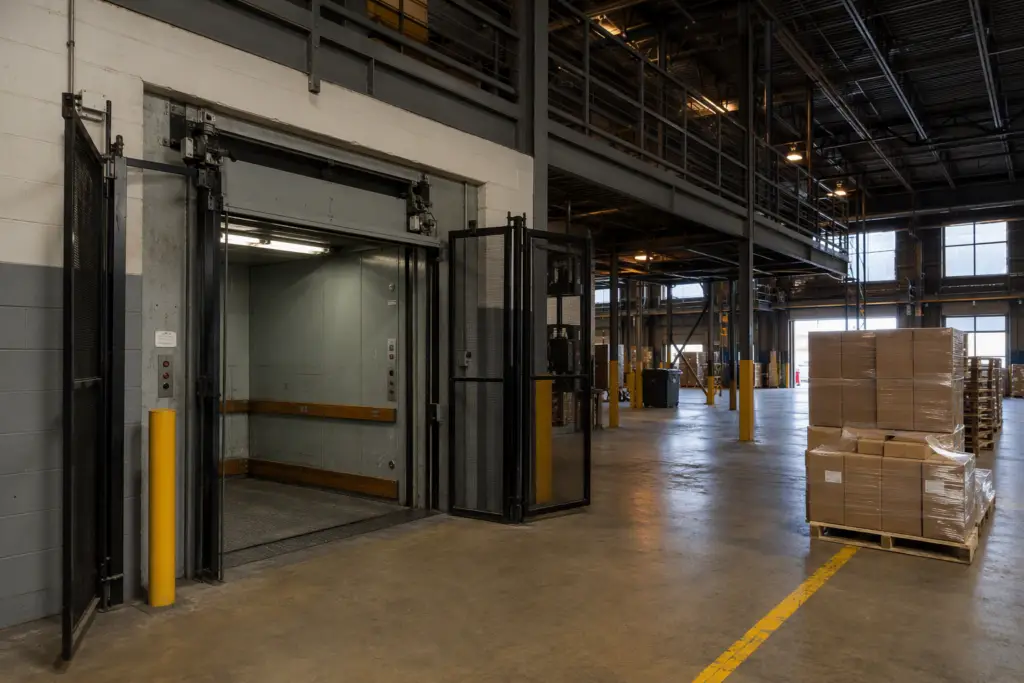
For Baltimore industrial and warehouse facilities, freight elevator compliance is a particular area of risk. Many older freight elevators were installed under now-superseded code editions and may require upgrades to remain compliant. An OSHA citation for elevator safety violations can result in fines ranging from $15,625 per violation up to $156,259 for willful violations in 2026.
How do I compare elevator maintenance companies before signing a contract?
Compare elevator maintenance companies on six criteria: contractor license verification, technician certification level, contract terms and exclusions, emergency response guarantees, local parts inventory, and verifiable customer references from similar building types in your market.
When requesting competing proposals, require each contractor to respond to the same written scope of work. This prevents apples-to-oranges pricing comparisons. The scope should specify: number of monthly visits, all included parts categories, emergency response time commitment, annual inspection coordination responsibility, and what happens to existing service records when you change contractors.
One underrated evaluation criterion is local parts inventory. A company with a stocked service van and a local warehouse can complete same-day repairs that a company relying on next-day freight cannot. For high-occupancy buildings, elevator downtime costs — lost productivity, tenant complaints, ADA compliance risk — can far exceed the price difference between contractors.
How does elevator maintenance differ for hydraulic versus traction elevators?
Hydraulic elevators require more frequent fluid and pump system monitoring, while traction elevators demand closer attention to wire ropes, sheaves, counterweights, and machine room equipment — both types follow ASME A17.1 periodic test requirements but with different component-specific protocols.
Hydraulic elevators, common in Baltimore’s 2–4 story commercial and multifamily buildings, require monthly checks of hydraulic fluid level, viscosity, and temperature performance. The jack and cylinder assembly requires inspection for leaks, and the hydraulic fluid must be changed on a schedule determined by usage and fluid condition — typically every 5–7 years. Underground single-bottom cylinders also require periodic leak detection testing in many jurisdictions.
Traction elevators — the standard for mid-rise and high-rise buildings — require wire rope inspections for broken wires, corrosion, and diameter reduction (replacement is required when broken wires exceed ASME A17.1 thresholds). Sheave groove wear, governor rope condition, and brake adjustment are monthly monitoring items. Machine room temperature must be maintained within manufacturer specifications, which is often overlooked in buildings with inadequate HVAC in the machine room.
What questions should I ask before hiring an elevator maintenance company in Baltimore?
Before hiring any elevator maintenance company in Baltimore, ask these seven critical questions to evaluate their qualifications, responsiveness, and contract transparency.
- Can you provide your Maryland Elevator Contractor License number for verification?
- What is your guaranteed on-site response time for an entrapment versus a non-entrapment emergency?
- Are your technicians IUEC-certified journeymen, apprentices, or non-union independents?
- What specific parts and components are excluded from your full maintenance contract?
- Do you carry the parts for my specific elevator make and model in your local inventory?
- Can you provide three references from similar buildings in Baltimore that you’ve serviced for at least two years?
- Who coordinates my annual Maryland state inspection, and what is your pass rate over the last three years?
A contractor who hesitates, deflects, or cannot answer these questions directly is a contractor to avoid. These are baseline professional standards, not unreasonable demands.
How long does elevator modernization take, and how much does it cost in Baltimore?
Elevator modernization in Baltimore typically takes 3–8 weeks per unit and costs between $35,000 and $120,000 depending on elevator type, scope of work, and building-specific requirements.
The table below provides 2026 cost and timeline benchmarks for common modernization scopes in the Baltimore metro area:
| Modernization Scope | Typical Cost Range | Estimated Timeline | Primary Driver |
|---|---|---|---|
| Hydraulic unit replacement | $35,000–$55,000 | 3–5 weeks | Aging pump/valve unit |
| Controller upgrade only | $18,000–$32,000 | 1–2 weeks | Obsolete relay logic |
| Full traction modernization | $75,000–$120,000 | 6–8 weeks | Age / code compliance |
| Door operator replacement | $8,000–$15,000 | 3–5 days | Reliability / ADA |
| Cab interior renovation | $12,000–$35,000 | 1–2 weeks | Aesthetics / tenant retention |
Most modernization projects in Baltimore require permitting through the Maryland Department of Labor, which adds 2–6 weeks to the pre-construction timeline. Budget this into your project schedule. Quality Elevator Company manages the full permitting and inspection coordination process for all modernization projects, reducing the administrative burden on building management teams.
Are there any Maryland-specific elevator regulations that differ from national standards?
Yes — Maryland has adopted ASME A17.1 with state-specific amendments, and the Maryland Department of Labor enforces additional requirements around contractor licensing, inspector credentials, and conveyance registration that go beyond the base national code.
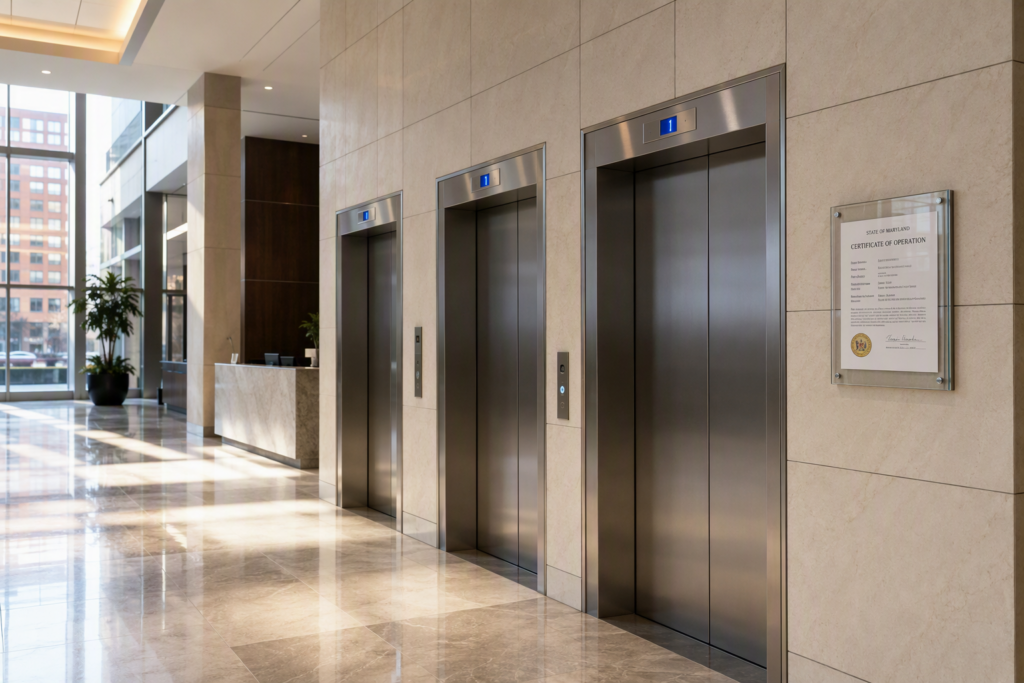
All elevators in Maryland must be registered with the Division of Labor and Industry, and each unit must carry a valid Certificate of Operation posted in the elevator cab. Maryland requires that all elevator inspections be either performed or witnessed by a Maryland-licensed elevator inspector — a credential separate from ASME QEI certification, though QEI is typically a prerequisite for obtaining the Maryland license.
Maryland also enforces specific provisions around elevator entrapment response protocols that building owners must post, bilingual requirements for buildings in certain jurisdictions, and annual reporting requirements for elevator incidents. Baltimore City additionally enforces requirements through the Baltimore City Department of Housing and Community Development for residential buildings, adding a layer of local oversight beyond state requirements.
What are the signs that my elevator needs immediate service, not just routine maintenance?
Call your elevator service contractor immediately — do not wait for your next scheduled visit — if you observe any of these warning signs, as they indicate a safety-critical condition that must be addressed before continued operation.
- Misleveling: The elevator floor is not flush with the landing floor by more than ¾ inch — a leading cause of trip-and-fall injuries and an ADA violation.
- Door nuisance: Doors repeatedly reopening, failing to close, or closing with excessive force against objects or people.
- Unusual sounds: Grinding, banging, screeching, or popping sounds during operation indicate mechanical contact that should not be occurring.
- Burning smell: Any odor of burning insulation, hot oil, or electrical components requires immediate shutdown and service.
- Hydraulic fluid on pit floor: Any visible oil in the pit indicates a leak that must be identified and corrected immediately — both for safety and environmental compliance.
- Slow or erratic operation: Sudden changes in speed, jerking motion, or failure to reach designated floors reliably.
- Non-functional emergency features: Emergency lighting, phone, or alarm button that does not work.
If you observe a burning smell or visible fire, evacuate the building, pull the nearest fire alarm, and call 911 immediately. Do not attempt to use the elevator.
Why should I choose Quality Elevator Company for elevator maintenance in Baltimore?
Quality Elevator Company brings IUEC-certified technicians, a proven compliance record, 24/7 emergency response, and deep regional expertise across Baltimore, Washington DC, Philadelphia, and Richmond — backed by transparent contracts with no hidden fees.
What distinguishes Quality Elevator Company in the Baltimore market is our combination of local presence and technical depth. Our technicians are permanently based in the Baltimore metro area — not dispatched from a regional hub three states away. We carry parts inventories for the most common elevator makes and models found in Baltimore’s building stock, which means same-day repairs on the majority of mechanical failures rather than multi-day waits for freight deliveries.
Our compliance pass rate on Maryland annual inspections has remained above 97% over the last five years — meaning buildings under our maintenance program almost never face surprise violations, shutdown orders, or emergency correction work. We coordinate all inspection scheduling, permitting, and documentation directly with the Maryland Department of Labor on behalf of our clients, removing that administrative burden from building management entirely.
Whether you manage a single hydraulic elevator in a Baltimore rowhouse conversion, a fleet of traction elevators in a downtown office tower, or a LULA lift in an ADA-compliance retrofit, Quality Elevator Company has the expertise and resources to keep your equipment running safely, compliantly, and reliably.
Get a Free Elevator Assessment from Quality Elevator Company
Don’t wait for a failed inspection or a breakdown to evaluate the condition of your elevator system. Quality Elevator Company offers a no-obligation elevator assessment for building owners and property managers in Baltimore, Washington DC, Philadelphia, and Richmond. Our certified technicians will review your current maintenance records, inspect key safety systems, identify any compliance gaps, and provide a written report with clear recommendations — at no cost to you.
Contact Quality Elevator Company for a free elevator assessment: 301-307-5363
Available 24/7 for emergency service. Serving Baltimore MD, Washington DC, Philadelphia PA, and Richmond VA.