What is the single most important factor when choosing an elevator service company?
The most important factor is verified compliance expertise — a company must demonstrate deep, current knowledge of applicable safety codes, local jurisdiction regulations, and inspection requirements specific to your building’s equipment and location.
Elevators are life-safety systems. Unlike HVAC or plumbing, a failure can strand passengers, injure occupants, or expose building owners to significant liability. The company you choose must be able to navigate the layered requirements of federal standards, state regulations, and local authority-having-jurisdiction (AHJ) mandates simultaneously. Technical competence is non-negotiable, but compliance knowledge is what protects you legally and operationally.
Commercial property managers in markets like Baltimore, Washington DC, Philadelphia, and Richmond will find that local regulatory nuances — from Maryland’s elevator inspection cycles to Virginia’s elevator safety program — differ enough that generalist vendors without regional expertise create real compliance risk.
What licenses and certifications should an elevator service company hold?
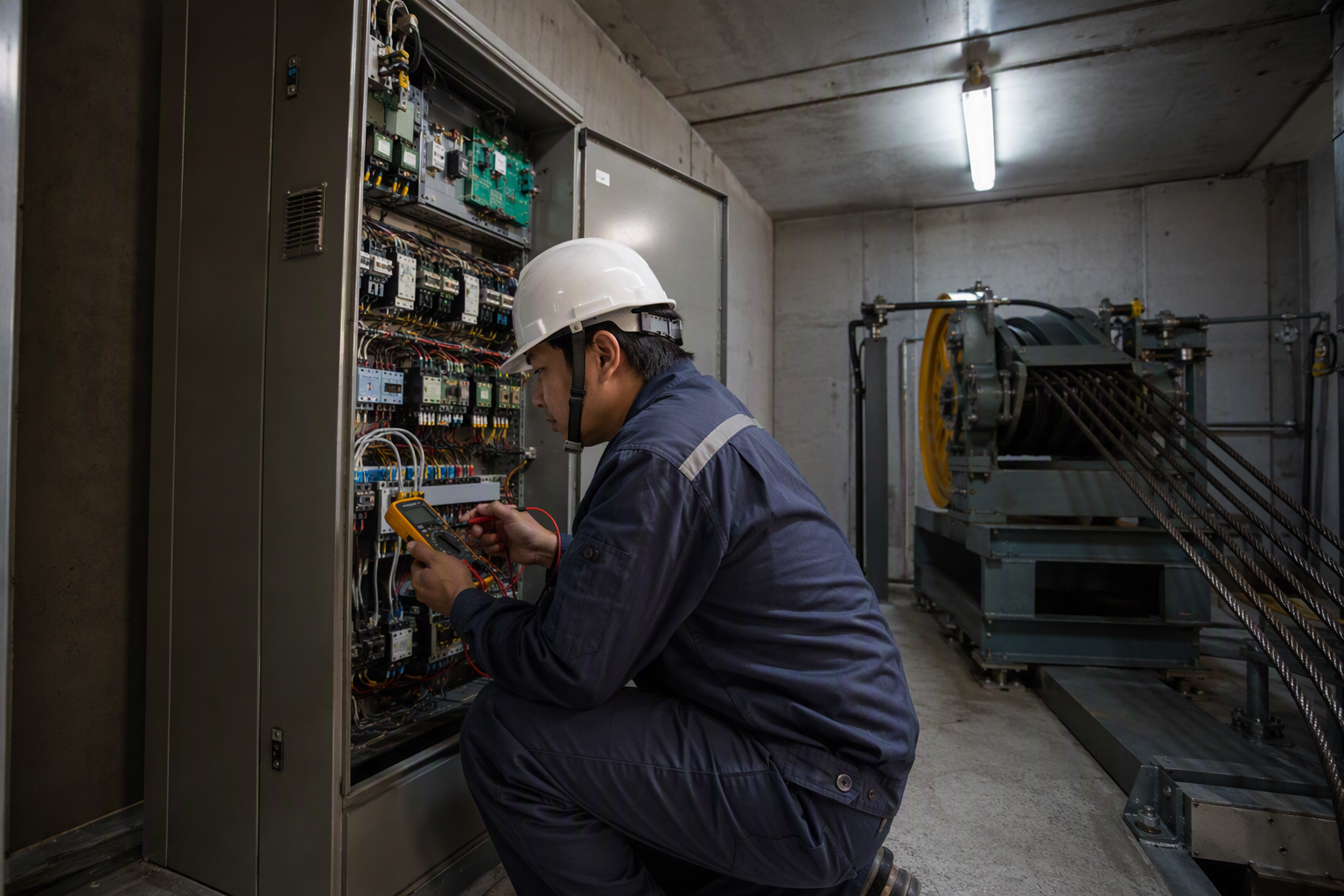
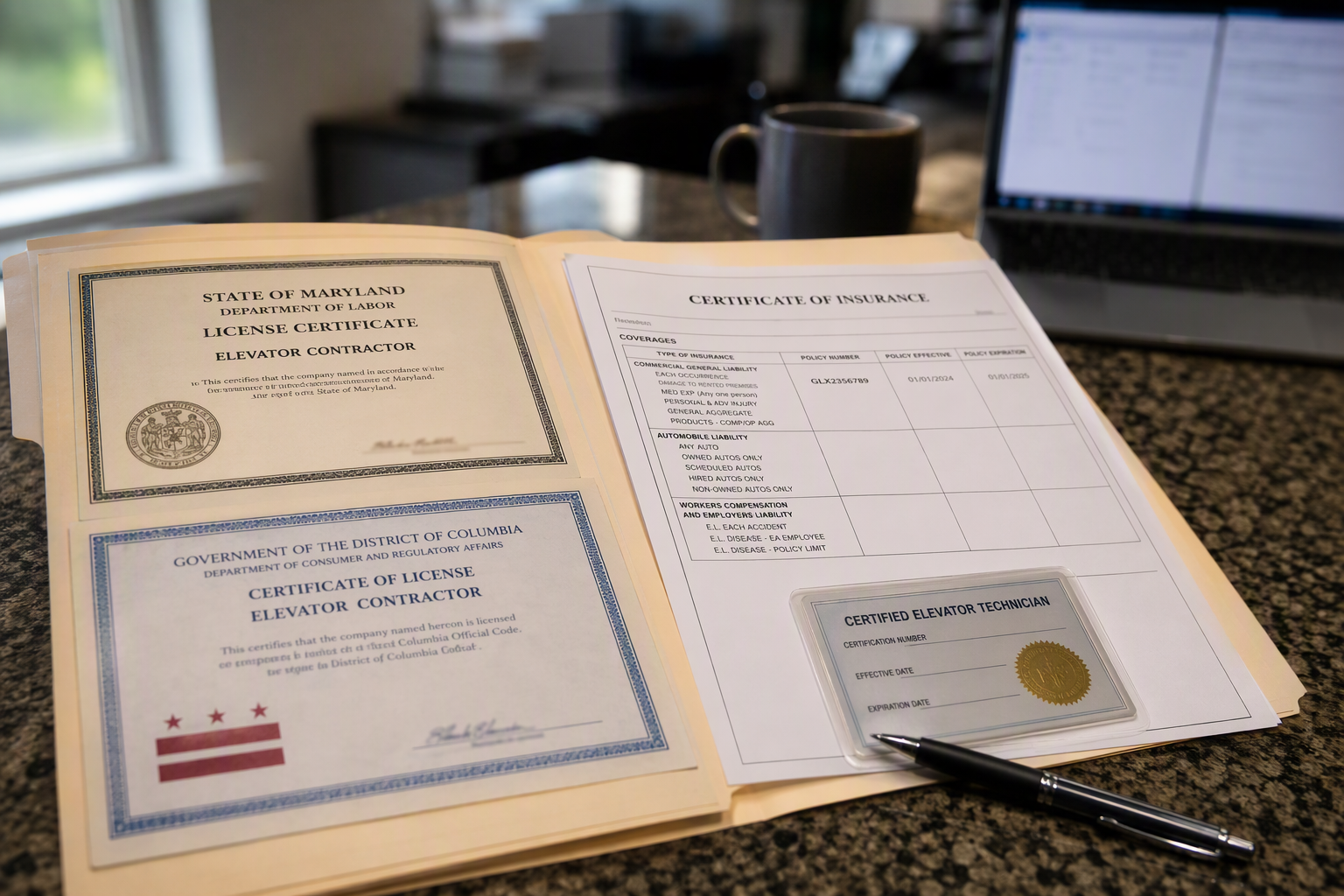
A qualified elevator service company should hold all applicable state contractor licenses, employ technicians certified under industry-recognized programs, and carry both general liability insurance and workers’ compensation coverage specific to elevator work.
Licensing requirements vary by jurisdiction. Maryland, Virginia, Pennsylvania, and the District of Columbia each maintain their own elevator contractor licensing frameworks. Before engaging any vendor, request proof of licensure in every jurisdiction where your buildings are located. Ask for a copy of their current certificate of insurance and confirm coverage limits are appropriate for commercial elevator work.
Beyond licensing, look for companies whose field personnel hold certifications through recognized industry organizations. While no single national credential is legally mandated everywhere, technicians trained to recognized industry standards demonstrate a baseline of technical competence. Ask vendors directly what training programs their technicians complete and how frequently they receive continuing education on code updates and new equipment technology.
Which elevator safety codes and standards govern commercial buildings in 2026?
The primary governing standard for commercial elevators in the United States is the ASME A17.1 Safety Code for Elevators and Escalators, which is adopted (sometimes with local amendments) by most state and local jurisdictions.
In addition to ASME A17.1, commercial elevator operations intersect with several other regulatory frameworks:
- ADA Accessibility Requirements: The Americans with Disabilities Act (ADA) mandates that elevators in multi-story commercial buildings be accessible to people with disabilities. This covers door timing, call button height, audible signals, Braille markings, and cab dimensions.
- OSHA Regulations: OSHA standards govern the safety of workers who perform elevator maintenance and repair, including lockout/tagout procedures and machine room safety.
- State-Specific Adoption: Maryland, Virginia, Pennsylvania, and DC each adopt ASME A17.1 by reference but may impose additional requirements around inspection frequency, permit timelines, and qualified inspector credentials. Your elevator service company must know which edition of ASME A17.1 each jurisdiction has adopted, as states often lag behind the most current published edition.
A vendor who cannot speak fluently to your jurisdiction’s adopted code edition is not positioned to keep your building compliant.
How do you compare elevator maintenance contract types before signing?
Elevator maintenance contracts generally fall into three categories — oil-and-grease, comprehensive, and full-service — and the differences in scope, cost exposure, and risk transfer are substantial enough that every building owner should understand them before committing.
| Contract Type | What Is Covered | What Is Excluded | Best Suited For |
|---|---|---|---|
| Oil & Grease (Basic) | Lubrication, minor adjustments, routine inspections | Parts, repairs, labor for breakdowns | New equipment still under manufacturer warranty |
| Comprehensive | Lubrication, adjustments, labor, most parts | Major modernization components (e.g., controllers, motors) | Mid-age equipment in stable condition |
| Full-Service / All-Inclusive | All of the above plus major parts and components | Typically damage caused by misuse or acts of God | Older equipment, high-traffic buildings, risk-averse owners |
Before selecting a contract tier, audit your equipment age, usage patterns, and maintenance history. A comprehensive or full-service contract may carry a higher monthly cost but can eliminate unpredictable repair invoices that far exceed the premium difference. Always request a detailed schedule of included and excluded components in writing — vague language like “major components” has been the source of significant billing disputes.
Quality Elevator Company offers maintenance agreements tailored to the specific equipment and risk tolerance of commercial property owners across Baltimore, Washington DC, Philadelphia, and Richmond.
What questions should you ask an elevator company during the vendor selection process?
Asking the right questions upfront separates qualified, transparent vendors from those who overpromise and underdeliver.
The following questions should be put to every elevator service company you are evaluating:
- Are you licensed to perform elevator work in every jurisdiction where my buildings are located?
- What edition of ASME A17.1 has been adopted by my local authority, and how does your maintenance program address it?
- Can you provide certificates of insurance, including general liability and workers’ compensation?
- Who performs the actual maintenance — your own employees or subcontractors?
- What is your process when a callback or emergency repair is needed?
- How do you document maintenance visits, and will I receive written reports after each visit?
- What is your process for scheduling and managing required periodic inspections with the AHJ?
- Can you provide references from commercial property owners with similar building types and equipment?
- How do you handle ADA compliance audits and what updates do you recommend to bring older cabs into conformance?
- What is your policy if a required part is on back-order and the elevator must remain out of service?
A reputable company will answer each of these questions with specificity. Vague or deflected answers are a red flag.
How do state-specific regulations in Maryland, Virginia, Pennsylvania, and DC affect elevator service requirements?
Each of the four jurisdictions served by Quality Elevator Company maintains its own elevator safety program with distinct requirements for permits, inspections, and contractor qualifications that go beyond the baseline ASME A17.1 standard.
Maryland: The Maryland Department of Labor oversees elevator safety. Elevator contractors must be licensed, and elevator inspectors must be licensed as well. Inspections are required on a periodic schedule set by the state.
Virginia: Virginia’s elevator safety program is administered through the Department of Labor and Industry (DOLI). Virginia adopts ASME A17.1 by reference, and elevator contractors must be licensed under the Virginia Board for Contractors. The state requires a permit for installation, alteration, and annual inspections for most elevator types.
Pennsylvania: The Pennsylvania Department of Labor and Industry, Bureau of Occupational and Industrial Safety, administers elevator safety. Pennsylvania has its own inspection schedules and requires licensed inspectors for periodic and acceptance inspections.
Washington DC: The DC Department of Consumer and Regulatory Affairs (DCRA) regulates elevators within the District. Contractors operating in DC must hold a DC elevator contractor license. The District’s dense commercial building stock and older equipment base makes compliance management particularly complex.
A service company operating across multiple jurisdictions must actively manage different permit timelines, inspection schedules, and documentation requirements for each location. Selecting a vendor already established in your specific markets significantly reduces administrative and compliance risk.
How do you verify an elevator company’s track record and reputation?
Reputation verification should be multi-layered, using formal references, public records, and independent review channels rather than relying solely on the vendor’s own marketing materials.
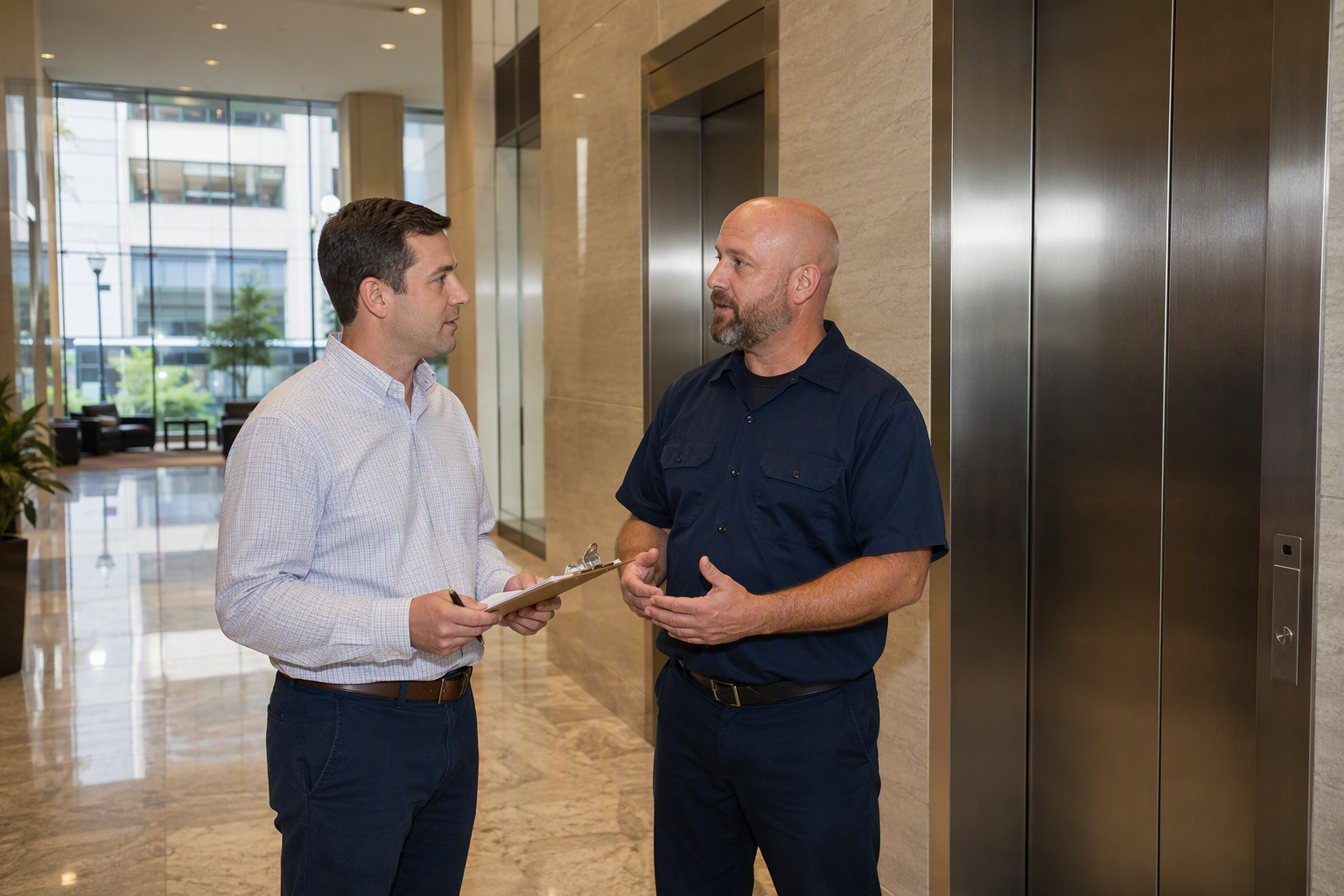
Start by requesting at least three references from commercial property owners with buildings comparable to yours in size, use type, and equipment age. Ask references specifically about documentation quality, how the company handles unexpected repairs, and whether inspection compliance was maintained without incidents. Peer feedback from property managers in the same city is particularly valuable because it reflects local regulatory conditions.
Supplement references with a check of the relevant state licensing board to confirm the company’s contractor license is active and free of disciplinary actions. In some jurisdictions, enforcement actions are publicly searchable. Also review the company’s standing with the Better Business Bureau and commercial real estate industry associations in your market.
What should be included in an elevator maintenance agreement to protect the building owner?
A well-drafted elevator maintenance agreement should explicitly define scope of work, response expectations, documentation obligations, parts and labor coverage, termination rights, and liability limitations to protect the building owner from ambiguity and cost surprises.
Key provisions every agreement should address include:
- Scope of Maintenance: A specific list of tasks performed at each visit, including lubrication points, safety test schedules, and adjustment procedures.
- Included vs. Excluded Parts: An itemized schedule, not general language, identifying which components are covered and which are billed separately.
- Documentation and Reporting: A requirement that the vendor provide written maintenance reports after every visit, including findings, corrections made, and items deferred.
- Inspection Coordination: Clarity on whether the vendor manages AHJ inspection scheduling and permit renewals or whether those responsibilities remain with the owner.
- Compliance Obligations: A statement that the vendor will notify the owner of any observed code deficiencies and recommend corrective action in writing.
- Termination for Cause: The owner’s right to terminate the contract if the vendor fails to perform, without unreasonable liquidated damages.
- Insurance Requirements: Minimum insurance limits the vendor must maintain for the duration of the contract.
Never sign a contract with auto-renewal clauses that extend for more than one year without your affirmative written consent, and negotiate the right to audit maintenance records at any time.
What does elevator modernization involve and when should a building owner consider it?
Elevator modernization involves upgrading the mechanical, electrical, or control systems of an existing elevator to improve safety, reliability, energy efficiency, ADA compliance, or passenger experience without replacing the entire hoistway structure.
Modernization is typically triggered by one or more of the following conditions:
- Equipment age that makes obtaining replacement parts difficult or impossible
- Code compliance deficiencies identified during inspection that cannot be economically addressed through repair
- ADA accessibility gaps in older cab configurations
- Chronic callback frequency that signals systemic mechanical decline rather than isolated failures
- Energy efficiency goals — older hydraulic and traction systems can consume significantly more power than modernized equipment
A qualified elevator service company will conduct an equipment assessment and present modernization options with projected cost, expected service life extension, and compliance benefits. Modernization projects require permits and acceptance inspections in all four jurisdictions served by Quality Elevator Company, and the company’s familiarity with local AHJ processes can significantly streamline project timelines.
How do you evaluate an elevator company’s technical capability for your specific equipment type?
Technical capability must be assessed relative to your specific equipment — a company expert in hydraulic elevators may have limited experience with gearless traction or machine-room-less (MRL) systems, and that gap matters when something fails.
Identify your elevator type before beginning vendor outreach. The primary commercial elevator categories are:
- Hydraulic elevators: Common in low-rise commercial buildings, typically two to six floors. Use a piston-and-fluid system.
- Geared traction elevators: Common in mid-rise buildings. Use a geared machine and steel ropes.
- Gearless traction elevators: Used in high-rise and high-speed applications. More complex drive systems.
- Machine-Room-Less (MRL) traction elevators: Increasingly common in new mid-rise construction. Equipment is located in the hoistway, requiring specialized access and diagnostic approaches.
Ask each vendor to describe, in technical terms, how they diagnose and repair the specific controller platform installed in your elevators. If the vendor cannot speak to your controller manufacturer’s diagnostic interface, that is a capability gap that will extend downtime during a breakdown.
What role does ADA compliance play in elevator service and maintenance?
ADA compliance is an ongoing obligation for commercial elevator owners, not a one-time installation checklist, and a qualified elevator service company should proactively identify and address accessibility deficiencies during every maintenance cycle.
Under the Americans with Disabilities Act (ADA), elevators in commercial buildings covered by the law must meet specific requirements including, but not limited to: call button dimensions and placement, door open timing, audible and visual floor signals, Braille and raised character markings, and leveling accuracy to ensure smooth entry and exit for wheelchair users.
Older equipment in particular may have original components that no longer meet current ADA technical standards. A service company that treats maintenance and ADA compliance as separate concerns leaves building owners exposed to discrimination complaints and potential litigation. The best vendors integrate ADA compliance checks into their standard maintenance documentation and flag deficiencies formally in writing.
How should you assess an elevator company’s approach to safety and workplace practices?
An elevator company’s internal safety culture is a direct indicator of how seriously they approach the protection of your building’s occupants, your equipment, and their own personnel working in hazardous environments.
Under OSHA regulations, elevator technicians work in confined spaces, at height, and around high-voltage electrical systems. Proper lockout/tagout procedures, fall protection, and pit entry protocols are legally required. Ask vendors directly how they enforce OSHA compliance on maintenance visits and what happens if a technician observes an unsafe condition in a machine room or pit.
Request a copy of the vendor’s safety policy or safety manual. A company that cannot produce one, or that dismisses the question, creates liability exposure for both their employees and for building owners who could be drawn into OSHA enforcement actions arising from incidents on their property.
What documentation and reporting should you expect from your elevator service company?
Expect written maintenance reports after every service visit, documented inspection certificates from AHJ inspections, written deficiency notices for any code or safety issues observed, and a complete maintenance log available for owner review at any time.
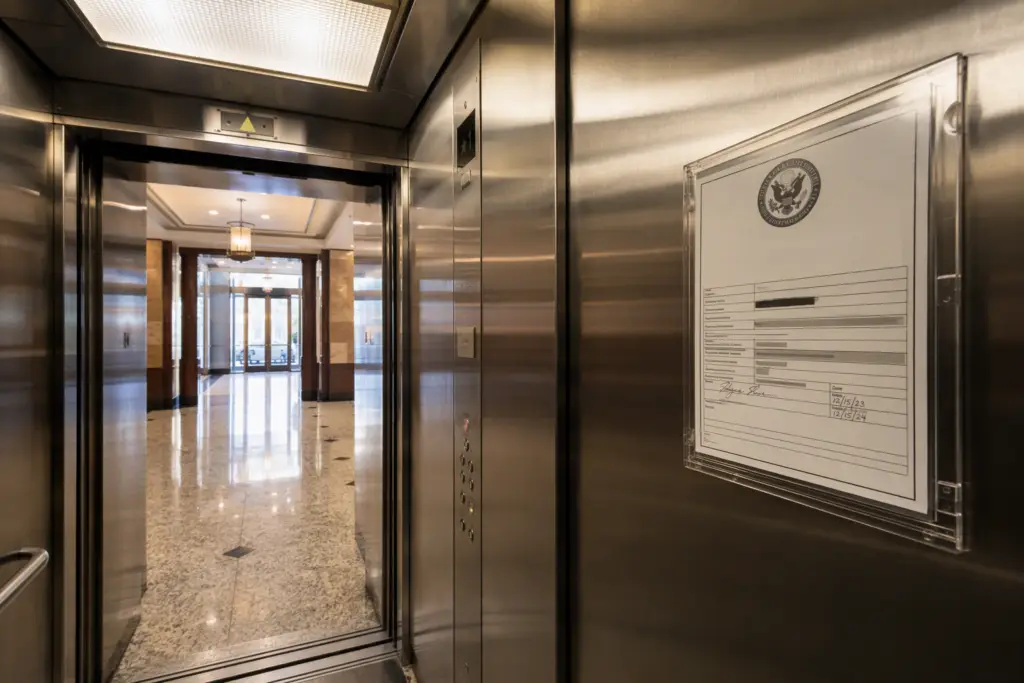
Thorough documentation serves multiple purposes. It creates a defensible maintenance record if a liability claim arises following an incident. It provides a factual basis for equipment condition assessments and modernization planning. It also satisfies requirements in many jurisdictions that a current inspection certificate be posted inside the elevator cab at all times.
Ask prospective vendors whether they use a digital maintenance management platform or paper-based records. Digital systems that provide owner-accessible portals with real-time maintenance history, upcoming inspection dates, and open deficiency tracking represent a higher standard of transparency and are increasingly the norm among quality commercial elevator service providers.
How do you evaluate an elevator company’s contract terms and exit provisions?
Contract terms and exit provisions should be reviewed with the same rigor as the technical scope, because unfavorable long-term lock-ins and punitive exit clauses are among the most common sources of commercial property owner frustration with elevator service vendors.
Watch for these specific contract provisions:
- Automatic multi-year renewals: Some contracts auto-renew for multiple years with limited notice windows. Negotiate for annual terms or explicit written consent requirements before renewal.
- Liquidated damages for early termination: Some contracts impose termination fees equivalent to the remaining contract value. Seek a cap or a performance-based exit right.
- Parts return restrictions: Proprietary parts programs can make switching vendors difficult if equipment-specific components are only available through the incumbent vendor.
- Price escalation clauses: Some contracts include uncapped annual price increases. Negotiate a cap tied to a published index if annual escalation is included.
Quality Elevator Company’s contracts are structured to reflect the interests of long-term service relationships rather than punitive lock-in mechanisms — a differentiator worth asking about explicitly when comparing vendors.
What should a building owner do when an elevator fails inspection?
When an elevator fails a required inspection, the building owner must act immediately and systematically to address the identified deficiencies, document all corrective actions, and coordinate re-inspection through the appropriate authority.
- Obtain a written copy of the inspection report identifying all failed items and the applicable code sections cited.
- Remove the elevator from service if the AHJ has issued a stop-use order or if the deficiency presents an immediate safety hazard.
- Contact your elevator service company to review the deficiency list and obtain a written scope and estimated timeline for each corrective action.
- Prioritize corrections in the order required by the AHJ, beginning with any items classified as imminent hazards.
- Ensure all replacement parts and repairs conform to the requirements of the ASME A17.1 Safety Code for Elevators and Escalators as adopted in your jurisdiction.
- Document all repairs with written records including parts used, technician performing work, and date completed.
- Contact the AHJ to schedule a re-inspection and confirm whether a new permit or temporary operating certificate is required before returning the elevator to service.
- Post the updated inspection certificate in the elevator cab once re-inspection is passed and the AHJ has issued the appropriate operating certificate.
Attempting to return an elevator to service before receiving AHJ clearance on a stop-use order can result in significant fines and additional enforcement action. A service company with established relationships in your local AHJ offices — as Quality Elevator Company maintains across its four-market service area — can often facilitate faster re-inspection scheduling.
How do you compare multiple elevator service companies objectively before making a decision?
Objective vendor comparison requires a structured scoring process that evaluates licensing, technical capability, contract terms, documentation practices, and references against a consistent set of criteria rather than relying on price alone.
Develop a vendor evaluation scorecard that assigns weight to each criterion based on your building’s specific risk profile. A high-traffic hospital or government building may weight compliance and documentation more heavily. A low-rise office building may prioritize contract flexibility. Price should be one factor but rarely the deciding one — the lowest bid in elevator service often correlates with reduced maintenance visit frequency, broader exclusions, or less experienced personnel.
Issue a written Request for Proposal (RFP) to each vendor under consideration. A structured RFP forces all bidders to respond to the same scope and terms, making comparison meaningful. Include a requirement for a sample maintenance agreement and at least three verifiable commercial references with similar equipment types.
What are the most common elevator maintenance mistakes commercial property owners make?
The most common mistakes include deferring maintenance to reduce costs, signing contracts without fully reading exclusion schedules, failing to retain maintenance records, and selecting vendors based on price alone without verifying licensing or technical competence.
Deferred maintenance is particularly costly because elevator systems are interdependent — a worn rope, unaddressed leveling issue, or degraded door operator contact will cascade into more expensive failures if not corrected on schedule. The perception of cost savings from skipping maintenance visits frequently reverses when a single breakdown requires emergency repair billing or results in extended downtime in a tenant-occupied building.
Another common error is assuming that the AHJ inspection represents a complete maintenance check. Jurisdictional inspections verify code compliance at a point in time — they are not a substitute for ongoing preventive maintenance. A building that passes its annual inspection in January can experience a significant mechanical failure in March if routine maintenance has been neglected in the interim.
How do energy efficiency and sustainability considerations factor into elevator service decisions?
Energy efficiency has become a meaningful factor in commercial elevator decisions, particularly for building owners pursuing LEED certification, Energy Star benchmarking, or local energy benchmarking ordinances that are now in effect in cities like Washington DC and Philadelphia.
Older hydraulic elevator systems, in particular, can be significant energy consumers compared to modern variable-frequency drive (VFD) traction systems or regenerative drive technology available in modernized equipment. A knowledgeable elevator service company should be able to provide a qualitative assessment of your current equipment’s efficiency profile and identify modernization paths that reduce energy consumption.
DC’s Building Energy Performance Standards and Philadelphia’s building energy benchmarking requirements mean that commercial property owners in those markets have regulatory as well as financial incentives to evaluate elevator energy performance as part of their broader building systems strategy.
How often should commercial elevators be inspected and maintained?
Commercial elevators must be inspected by a qualified inspector on a schedule set by the applicable jurisdiction’s adoption of the ASME A17.1 Safety Code for Elevators and Escalators, and should receive preventive maintenance visits on a frequency appropriate to the equipment type and usage intensity.
While inspection intervals vary by jurisdiction and elevator type, most commercial elevators in Maryland, Virginia, Pennsylvania, and DC are subject to annual or more frequent periodic inspections. In addition to jurisdictional inspections, preventive maintenance visits are typically scheduled monthly or quarterly depending on equipment age, usage volume, and contract type. High-traffic installations — such as those in medical buildings, government facilities, or multi-tenant commercial towers — generally require more frequent service intervals than low-traffic single-tenant buildings.
Maintenance frequency should be specified explicitly in your service contract. A contract that does not commit to a minimum number of maintenance visits per year provides no assurance that your equipment is actually being serviced on a protective schedule.
Why should commercial property owners in Baltimore, Washington DC, Philadelphia, and Richmond choose Quality Elevator Company?
Commercial property owners in those four markets benefit from selecting a service provider that maintains established working relationships with local authorities, understands the specific regulatory frameworks of each jurisdiction, and has direct experience with the equipment types and building stock common to those markets.
Quality Elevator Company serves commercial, institutional, and government properties across Baltimore MD, Washington DC, Philadelphia PA, and Richmond VA — providing elevator maintenance, repair, inspection coordination, and modernization services calibrated to the specific requirements of each jurisdiction. The company’s regional focus means that staff are familiar with local AHJ processes, inspection scheduling practices, and the nuances of each state’s adopted code edition.
Selecting a nationally uniform vendor with limited local presence can create gaps in regulatory knowledge and AHJ relationships that translate directly into compliance delays and extended downtime. For commercial property owners who need a service partner with demonstrated regional expertise, Quality Elevator Company is a proven resource across all four markets.
Ready to evaluate your current elevator service or select a new provider?
Contact Quality Elevator Company for a free elevator assessment. A qualified team member will review your equipment, current maintenance documentation, and compliance status — and provide a clear, written evaluation with no obligation.
Call Quality Elevator Company today: 301-779-9116
Serving commercial properties in Baltimore MD, Washington DC, Philadelphia PA, and Richmond VA.
Need elevator service you can rely on? Quality Elevator Company is ready to help.