What Should I Do If My Elevator Fails Inspection and the Inspector Issues a Violation or Shutdown Order?
Receiving a violation notice or shutdown order from an elevator inspector is serious — but it is a manageable situation when building owners and facility managers act quickly and methodically. The sections below address every question that commonly arises after a failed inspection, from immediate legal obligations to repair timelines, reinspection procedures, and cost considerations. Each answer is grounded in current code requirements under the ASME A17.1 Safety Code for Elevators and Escalators and applicable state and local regulations.
1. What does it legally mean when an elevator “fails inspection” and receives a shutdown order?
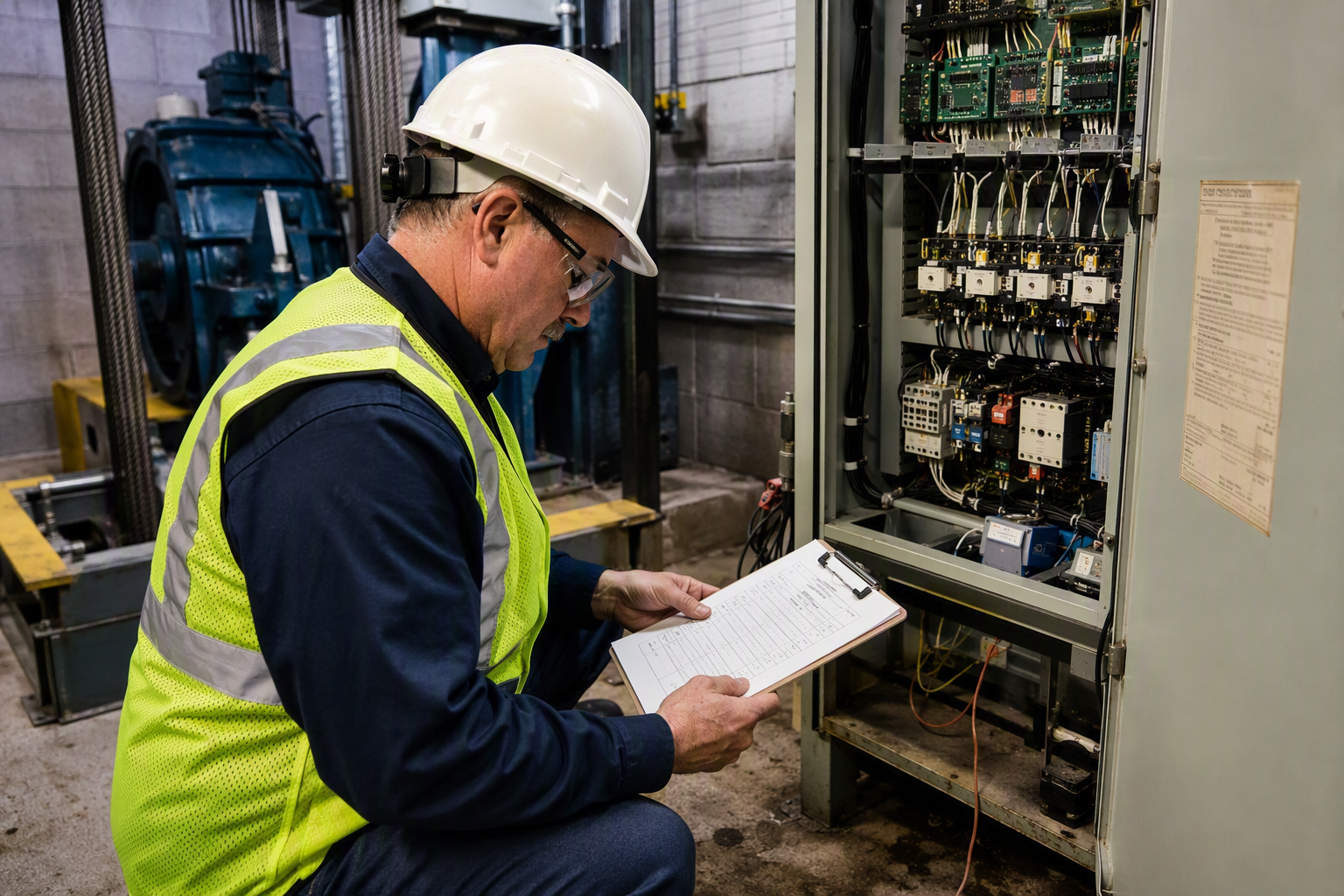
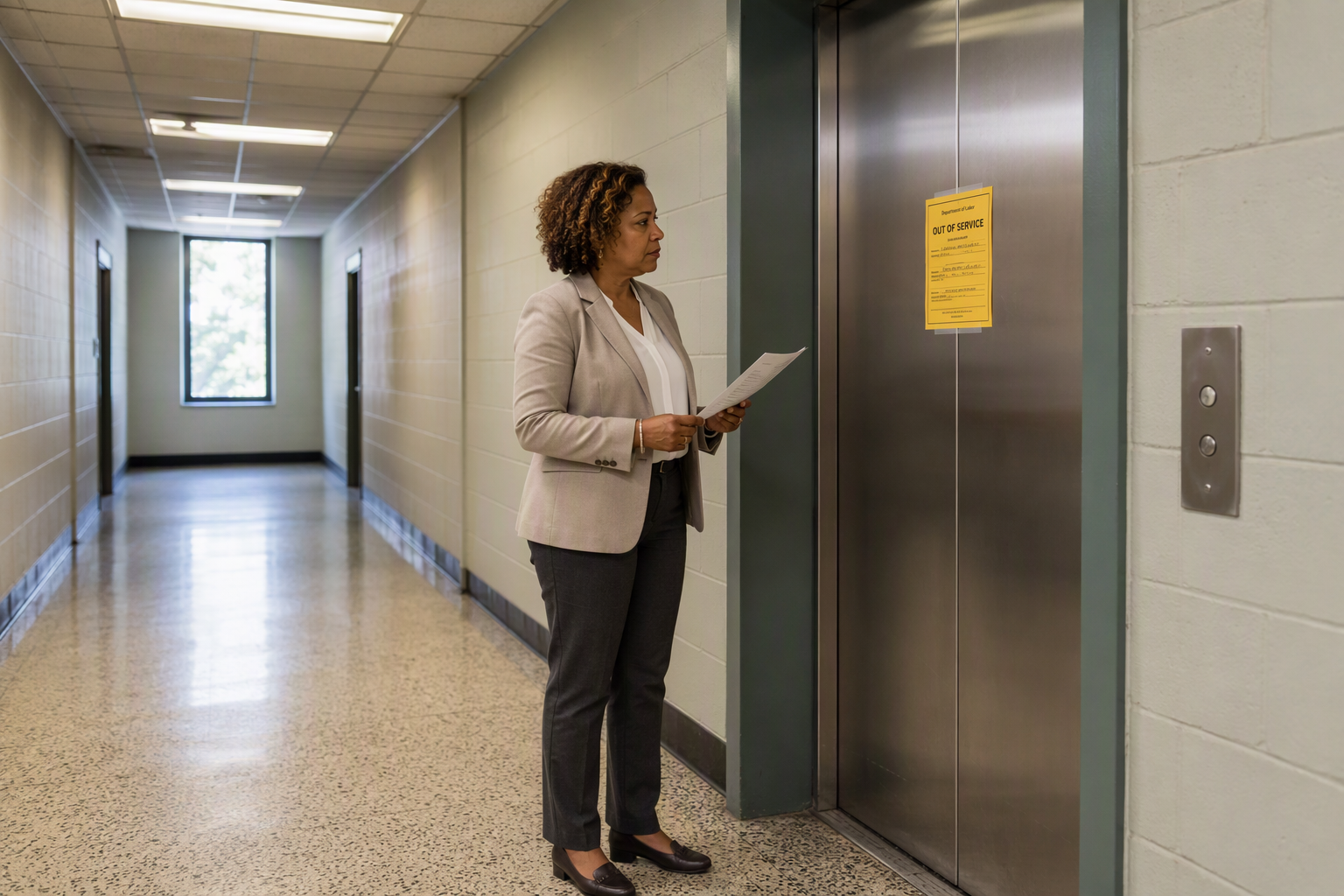
A shutdown order — sometimes called an “out-of-service order” or “order to seal” — is a legally binding directive that prohibits any passenger or freight use of the elevator until cited deficiencies are corrected and a reinspection is passed.
When a state or local elevator inspection authority determines that an elevator poses a safety hazard or violates the adopted edition of the ASME A17.1 Safety Code for Elevators and Escalators, the inspector has the authority to issue a written violation notice, post an out-of-service tag or placard on the equipment, and in some jurisdictions, physically lock or seal the car. Operating a sealed or posted elevator is a criminal or civil offense in every jurisdiction Quality Elevator Company serves — Baltimore MD, Washington DC, Philadelphia PA, and Richmond VA — and can result in fines, liability exposure, and in extreme cases, criminal prosecution of building management.
A violation notice without a full shutdown order means the elevator may remain in temporary service but must be brought into compliance by a stated deadline. The specific tier of enforcement depends on the severity of the deficiency as classified under the adopted code.
2. What should I do immediately after receiving a shutdown order?
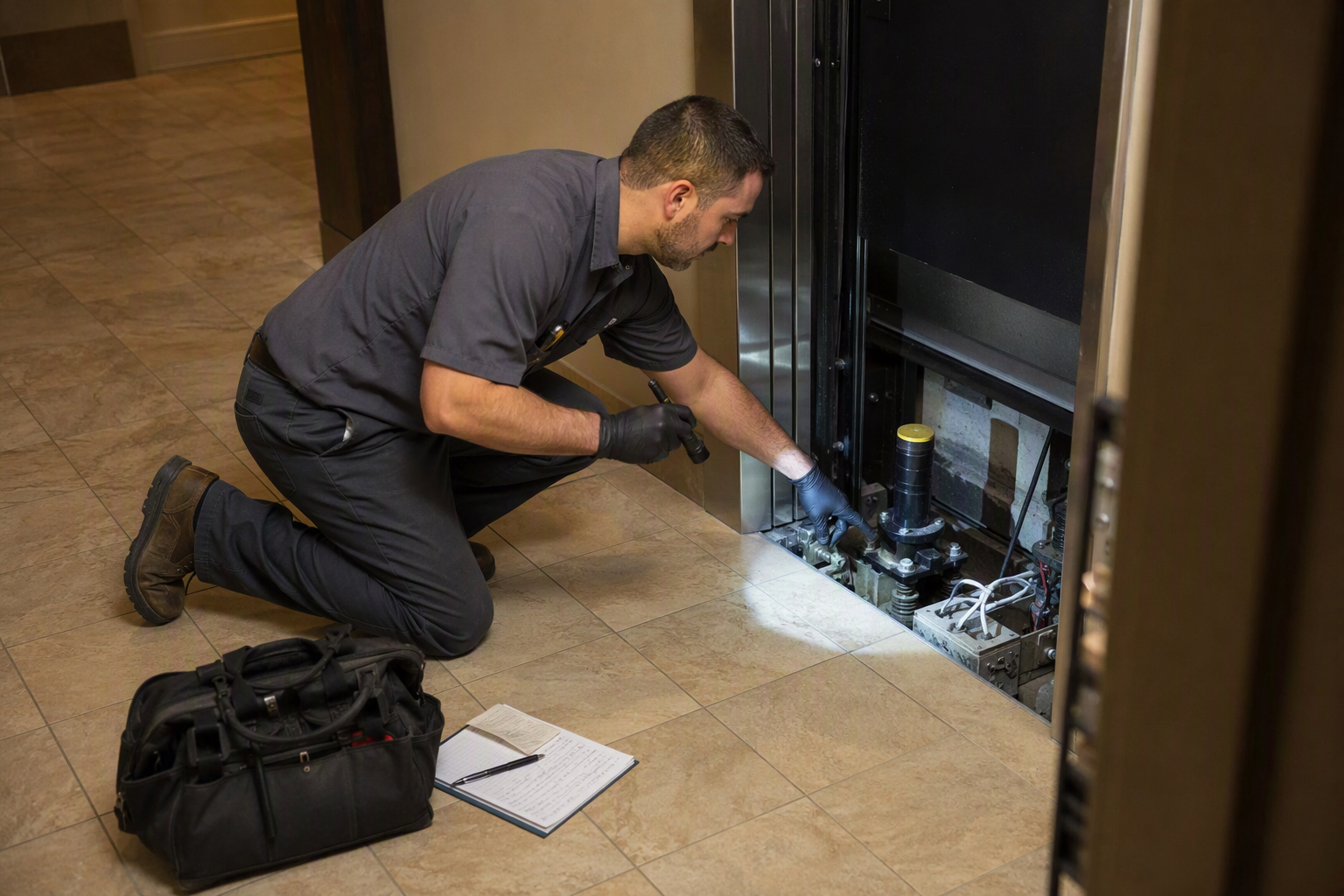
The first priority is to stop elevator operation, notify affected building occupants, and contact a licensed elevator service contractor without delay.
- Stop all elevator operation immediately. If the inspector has not already taken the unit out of service, do so yourself. Place physical barriers at every landing door and post clear “Elevator Out of Service” signage.
- Read the violation notice in full. Identify every cited deficiency, the applicable code section referenced, and any stated compliance deadline.
- Contact a licensed elevator service company. Share a copy of the violation notice so technicians can assess the cited items before arriving on site.
- Notify building ownership, management, and legal counsel. Document the timeline from the moment the order was received.
- Assess ADA obligations. If the elevator is the only accessible route for persons with disabilities under the Americans with Disabilities Act (ADA), notify affected tenants and document any reasonable accommodation measures.
- Do not attempt self-repair or remove posted tags. Only licensed elevator mechanics should perform correction work, and only the issuing authority can remove an official out-of-service tag.
- Request a reinspection date. Once repairs are complete, contact the issuing authority or its authorized third-party inspection agency to schedule a reinspection appointment.
3. What are the most common violations that trigger a shutdown order?
The deficiencies most frequently cited for immediate out-of-service orders involve conditions that create an imminent risk of injury, such as failed safeties, door malfunctions, and overloaded or failed control systems.
Common shutdown-level deficiencies under ASME A17.1 include: failed or missing governor or safety devices; non-functioning door reopening devices or door interlocks; broken or missing pit lighting and stop switches; leveling accuracy outside the required tolerance; oil or hydraulic fluid leaks near electrical components; inadequate hoistway clearances; and missing or non-compliant fire service recall features. Lower-severity violations — such as expired lubrication schedules, worn wire rope that has not yet reached discard criteria, or missing inspection certificates posted in the car — typically trigger a corrective notice with a compliance deadline rather than an immediate shutdown.
4. How long do I have to correct elevator violations before facing additional penalties?
Deadlines vary by jurisdiction and by the severity classification of the violation, but most states allow anywhere from 24 hours for imminent-hazard items to 30–90 days for lower-priority corrective notices.
In Maryland, the Department of Labor’s Division of Labor and Industry oversees elevator safety and issues compliance orders with specific deadline dates. Washington DC elevator enforcement falls under the DC Department of Consumer and Regulatory Affairs (DCRA) and similarly assigns deadlines by hazard tier. Pennsylvania elevator safety is administered by the Department of Labor and Industry, Bureau of Occupational and Industrial Safety, and typically provides a 30-day correction window for non-imminent violations. Virginia operates under the Department of Labor and Industry’s Elevator Safety Unit, with similar tiered deadlines. In all cases, an immediate shutdown order carries a much shorter window — often requiring proof of corrective action within days. Building owners should never assume a default timeline; the deadline on the written notice is controlling.
5. Can I appeal a shutdown order or dispute a violation finding?
Yes — every jurisdiction that regulates elevators provides a formal appeals or variance process, though filing an appeal does not automatically stay the shutdown order.
To appeal, building owners typically submit a written request to the enforcement authority within a specified number of days from the date of the order. Grounds for appeal may include demonstrating that the cited code section does not apply to the installation date of the equipment (equivalency or grandfather provisions), presenting engineering documentation that the condition does not constitute a hazard, or showing that the inspector misidentified the deficiency. Retaining a licensed elevator contractor to prepare technical documentation supporting the appeal significantly improves the likelihood of a favorable outcome. Quality Elevator Company assists building owners in the Baltimore, Washington DC, Philadelphia, and Richmond markets with gathering the technical documentation needed for variance and appeal filings.
6. What repair process must a licensed elevator contractor follow to address cited violations?
The contractor must perform only code-compliant repairs using approved methods and materials, document all work with a detailed repair log, and in many jurisdictions obtain a permit before beginning correction work on certain deficiency categories.
Under ASME A17.1, alteration work — which includes replacing major components such as controllers, safeties, or door operators — requires a permit and may trigger a full acceptance inspection. Maintenance-category repairs generally do not require a permit but must still be recorded in the required maintenance log. The repair log should include: the specific deficiency addressed, the parts replaced or adjusted, the ASME A17.1 rule number the repair brings the equipment into compliance with, the name and license number of the mechanic who performed the work, and the date of completion. This documentation package is submitted to the inspection authority when requesting reinspection.
7. What is a reinspection and how do I schedule one?
A reinspection is a formal follow-up examination by the same inspection authority that issued the violation, conducted after repairs are complete, to verify that cited deficiencies have been corrected before the elevator is returned to service.
Scheduling procedures vary by jurisdiction. In some markets, building owners contact the jurisdiction’s elevator safety office directly; in others, the jurisdiction contracts with third-party inspection agencies (such as insurance company inspectors or independent agencies). The licensed elevator contractor typically coordinates the reinspection scheduling as part of the service engagement. Upon passing reinspection, the inspector issues a new certificate of operation (or its local equivalent), and the out-of-service tag is officially removed. The elevator may then be returned to service.
8. What are the ADA implications of an elevator shutdown for buildings with accessibility requirements?
When an elevator is the only accessible means of vertical transportation for people with disabilities, a shutdown may constitute a barrier to access under the Americans with Disabilities Act, creating potential civil liability independent of the elevator code violation itself.
Title III of the ADA (commercial facilities and places of public accommodation) and Title II (state and local government entities) require that accessible features remain operational. The ADA does recognize a limited exception for “isolated or temporary” interruptions caused by maintenance or repair, but the exception is narrow and does not cover extended outages. Building owners should consult legal counsel, document all efforts to expedite repairs, and provide alternative reasonable accommodations — such as rescheduling services or providing staff assistance — during the shutdown period. Prompt repair is both the code-required and the ADA-protective course of action.
9. How much can violations and shutdown orders cost building owners if left unaddressed?
Unaddressed elevator violations can result in escalating daily fines, civil liability for injuries, loss of occupancy permits, and significantly increased repair costs as deferred deficiencies worsen over time.
While specific fine schedules vary by jurisdiction, elevator enforcement authorities in Maryland, DC, Pennsylvania, and Virginia all have statutory authority to assess per-day civil penalties for continued non-compliance after the violation deadline passes. Beyond regulatory fines, operating an elevator with a known deficiency — or failing to disclose a shutdown order to tenants — exposes building owners to substantial tort liability if an injury occurs. Additionally, components that are allowed to deteriorate beyond a violation notice often require more extensive (and expensive) replacement rather than the simpler repair that would have resolved the original citation. Early action is consistently the lowest-cost outcome.
10. Does a violation automatically mean my elevator maintenance company was negligent?
Not necessarily — violations can result from normal component wear-and-tear reaching a code threshold, regulatory code updates, or equipment age, rather than from failures in maintenance practice.
However, if a cited deficiency is something that should have been identified and corrected during routine maintenance visits — such as a worn door contact, deteriorated pit lighting, or out-of-tolerance leveling — it is reasonable to review the maintenance contract and service logs to assess whether the condition was documented and acted upon. Building owners should request complete maintenance records from their current service provider as part of any post-violation review. Quality Elevator Company performs maintenance audits and can help building owners evaluate whether the existing maintenance program meets the requirements of ASME A17.1 Rule 8.6 (Maintenance, Repair, and Replacement).
11. What documentation should I retain after a violation is corrected and reinspection is passed?
Building owners should permanently retain the original violation notice, all repair records, the reinspection report, and the new certificate of operation — these documents are critical for future inspections, insurance claims, and liability defense.
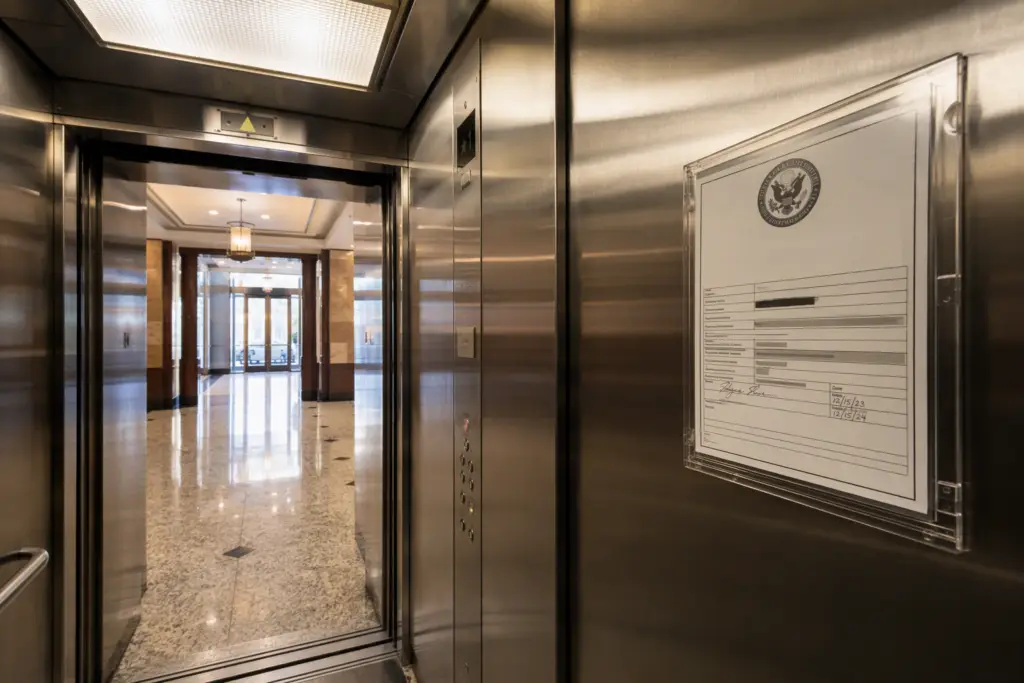
A well-organized post-violation documentation file should include: the original inspection report with cited code sections; correspondence with the enforcement authority regarding deadlines and appeal options; the contractor’s repair order and parts documentation; technician sign-off records including license numbers; the reinspection report confirming compliance; the updated certificate of operation; and any updated maintenance log entries. Many jurisdictions require the current certificate of operation to be posted inside the elevator car. Building owners should verify this requirement with their local authority having jurisdiction (AHJ).
12. How do violation and inspection requirements differ across Maryland, Washington DC, Pennsylvania, and Virginia?
Each state and the District of Columbia has its own adopted edition of the elevator safety code, inspection frequency requirements, licensing standards for mechanics, and enforcement procedures — making multi-property portfolio management particularly complex.
| Jurisdiction | Governing Authority | Adopted Code Basis | Typical Inspection Frequency | Reinspection Required After Shutdown? | Mechanic Licensing Required? |
|---|---|---|---|---|---|
| Maryland | MD Dept. of Labor, Division of Labor and Industry | ASME A17.1 (adopted edition) | Annual | Yes | Yes |
| Washington DC | DC Dept. of Consumer and Regulatory Affairs (DCRA) | ASME A17.1 (adopted edition) | Annual | Yes | Yes |
| Pennsylvania | PA Dept. of Labor and Industry, Bureau of Occupational and Industrial Safety | ASME A17.1 (adopted edition) | Annual (varies by category) | Yes | Yes |
| Virginia | VA Dept. of Labor and Industry, Elevator Safety Unit | ASME A17.1 (adopted edition) | Annual | Yes | Yes |
Note: Specific adopted code editions and inspection categories should be verified with the relevant AHJ, as adoption cycles vary. The table above reflects general program structures as of 2026.
13. Can my building lose its certificate of occupancy if an elevator shutdown order is not resolved?
In many jurisdictions, persistent non-compliance with elevator shutdown orders can trigger broader building code enforcement actions, including referral to the local building department and potential impact on the certificate of occupancy.
Elevator inspection authorities in the markets served by Quality Elevator Company have statutory authority to refer cases of continued non-compliance to other code enforcement agencies, including fire marshals and building departments. For buildings where the elevator is a required accessible egress or occupancy component — such as high-rise residential buildings, hospitals, or multi-tenant commercial properties — continued operation of the building itself may come into question when elevator safety orders go unresolved. This underscores the importance of treating shutdown orders as urgent, high-priority building management matters.
14. What happens if someone is injured on an elevator that had an unresolved violation or shutdown order?
If a person is injured while using an elevator that was under an active shutdown order or unresolved violation, the building owner faces severely heightened civil liability because the violation creates direct evidence of known, documented risk.
In tort law, a building owner’s knowledge of a dangerous condition — established beyond question by a government-issued violation notice — makes it extremely difficult to argue that the hazard was not foreseeable. Plaintiffs’ attorneys will request all inspection and violation records in discovery. OSHA may also become involved if the elevator is in a workplace and the injury involves a worker. Building owners should never allow business continuity considerations to override elevator safety compliance. The legal and financial consequences of an injury on a posted elevator far exceed any operational inconvenience caused by taking the unit out of service.
15. What is the difference between a “violation notice” and a “shutdown order,” and does it change what I need to do?
A violation notice identifies a code deficiency and sets a compliance deadline but may allow continued operation, while a shutdown order prohibits operation immediately and requires reinspection before the elevator can return to service.
Both require the building owner to engage a licensed elevator contractor, but the urgency and legal consequences differ. With a violation notice and a compliance deadline, there may be days or weeks to schedule and complete repairs. With a shutdown order, the elevator must be taken out of service immediately — regardless of operational inconvenience — and may not be returned to service until the issuing authority confirms in writing that the out-of-service condition has been resolved. Both types of enforcement action should be treated seriously; violation notices that are not corrected by the stated deadline typically escalate to shutdown orders and carry additional penalties.
16. How can a proactive maintenance program prevent elevator violations and shutdowns?
A properly structured preventive maintenance program — aligned with the requirements of ASME A17.1 Rule 8.6 — identifies and addresses developing deficiencies before they reach the threshold of a code violation.
Effective preventive maintenance includes scheduled lubrication of all moving components, testing of safety devices and interlocks, adjustment of door operators and door timing, inspection of wire rope or hydraulic systems, verification of pit conditions including lighting and stop switches, and review of all safety circuit functions. Maintenance records should be kept in a format that can be presented to an inspector on demand. Building owners who experience recurring violations often find that their maintenance contract is structured around minimal visit frequency rather than comprehensive scope — a mismatch that Quality Elevator Company evaluates during maintenance audits for properties in the Baltimore, Washington DC, Philadelphia, and Richmond markets.
17. What questions should I ask a prospective elevator service company after a shutdown order?
After a shutdown order, building owners should select a service company with demonstrated knowledge of local enforcement procedures, the technical capability to address the specific violations cited, and the ability to coordinate reinspection scheduling with the issuing authority.
Key questions to ask include: Is your company licensed to perform elevator work in this jurisdiction? Do you have experience working with the specific inspection authority that issued this order? Can you provide a written scope of work addressing every cited deficiency by code section? How do you coordinate reinspection scheduling? Can you provide documentation suitable for an appeal or variance filing if needed? Are your mechanics licensed under this state’s elevator mechanic licensing requirements? A reputable, established company will answer all of these questions clearly and in writing before work begins.
18. What are “Category 1” and “Category 5” tests, and can a failed required test trigger a shutdown order?
Category 1 and Category 5 tests are periodic, performance-based safety tests required by ASME A17.1 that go beyond the annual visual inspection, and failure of either test is grounds for a violation or shutdown order.
Under ASME A17.1, Category 1 tests for traction elevators must be performed annually and include a no-load safety test and a governor and safety system test. Category 5 tests — required every five years — are full-load, full-speed safety tests that comprehensively evaluate the governor, safeties, and buffers under actual operating conditions. If a Category 5 test reveals that a safety device fails to perform within code-specified parameters, the inspector will typically issue an immediate out-of-service order. Building owners should ensure their maintenance contracts explicitly include scheduling and completion of all required periodic tests — these are not optional and are tracked by inspection authorities.
19. How do I find out which specific code edition applies to my elevator?
The applicable edition of the ASME A17.1 Safety Code for Elevators and Escalators is determined by when the elevator was installed (installation date governs original compliance) and which edition the local jurisdiction has adopted for ongoing maintenance and enforcement.
Older elevators are generally not required to retroactively comply with every provision of newer code editions — a principle known as “grandfathering” or “equivalency.” However, certain provisions have been adopted as mandatory retroactive requirements in some jurisdictions, particularly those related to fire service recall, emergency lighting, and door reopening devices. The authority having jurisdiction (AHJ) — the state or local elevator enforcement office — maintains records of the adopted code edition and can clarify which requirements apply to a specific installation. A licensed elevator contractor familiar with local enforcement practices, such as Quality Elevator Company, can also assist in determining the applicable requirements for a specific unit.
20. What should I look for when choosing an elevator service company to resolve a shutdown order?
Choose a licensed, experienced elevator service company that understands the local regulatory environment in your jurisdiction, can address the specific technical violations cited, and has an established working relationship with the relevant inspection authority.
Key criteria include: state licensure in the applicable jurisdiction; demonstrated experience with the type of equipment involved (hydraulic, traction, MRL, etc.); the ability to provide a written scope of work tied to specific cited violations; capacity to coordinate permit applications where required; and the ability to prepare reinspection documentation. Quality Elevator Company serves building owners, property managers, and facility teams across Baltimore MD, Washington DC, Philadelphia PA, and Richmond VA — providing licensed, code-compliant elevator maintenance, repair, and compliance support. Selecting a service partner with deep regional familiarity reduces reinspection delays and helps ensure violations are resolved completely on the first attempt.
Get Expert Help After a Failed Inspection
A failed elevator inspection or shutdown order demands immediate, professional response. Quality Elevator Company provides licensed elevator compliance services — violation assessment, code-compliant repairs, reinspection coordination, and maintenance audits — across Baltimore MD, Washington DC, Philadelphia PA, and Richmond VA.
Contact Quality Elevator Company for a free elevator assessment. Call us today at 301-779-9116.
Need elevator service you can rely on? Quality Elevator Company is ready to help.