Repair or Modernize a Broken Elevator? How to Decide
A significant elevator breakdown forces building owners and facility managers into one of the most consequential maintenance decisions they will face: spend money fixing what is already there, or invest in a full or partial modernization? The answer is rarely obvious, and getting it wrong in either direction creates financial, operational, and legal exposure. This guide walks through every factor that should inform that decision — equipment age, compliance requirements under federal and regional codes, total cost of ownership, and what the modernization process actually involves in the District of Columbia, Maryland, Pennsylvania, and Virginia markets.
What Is the Difference Between an Elevator Repair and a Modernization?
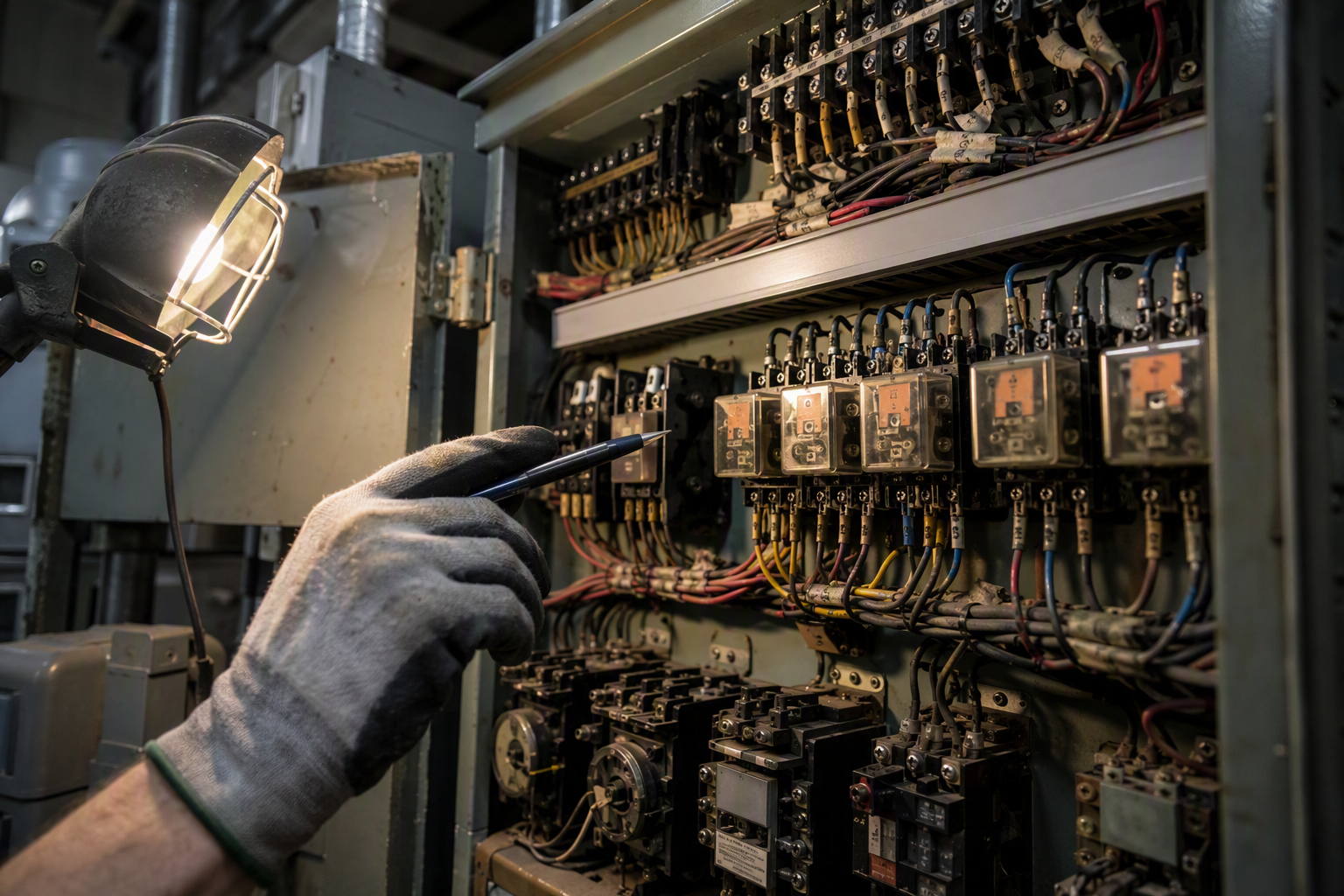
A repair restores a single failed component — a motor, relay, rope, door operator, or controller board — to working condition without altering the overall system design. A modernization replaces entire subsystems (controls, drive, cab interior, door systems, or sometimes the machine itself) and is treated by the Authority Having Jurisdiction (AHJ) as new work subject to current code. The practical boundary matters enormously: a repair keeps you on the existing permit; a modernization triggers a new permit, plan review, and inspection against current editions of ASME A17.1 Safety Code for Elevators and Escalators and, where applicable, ASME A17.3 Safety Code for Existing Elevators and Escalators.
How Does Elevator Age Factor Into the Repair-or-Modernize Decision?
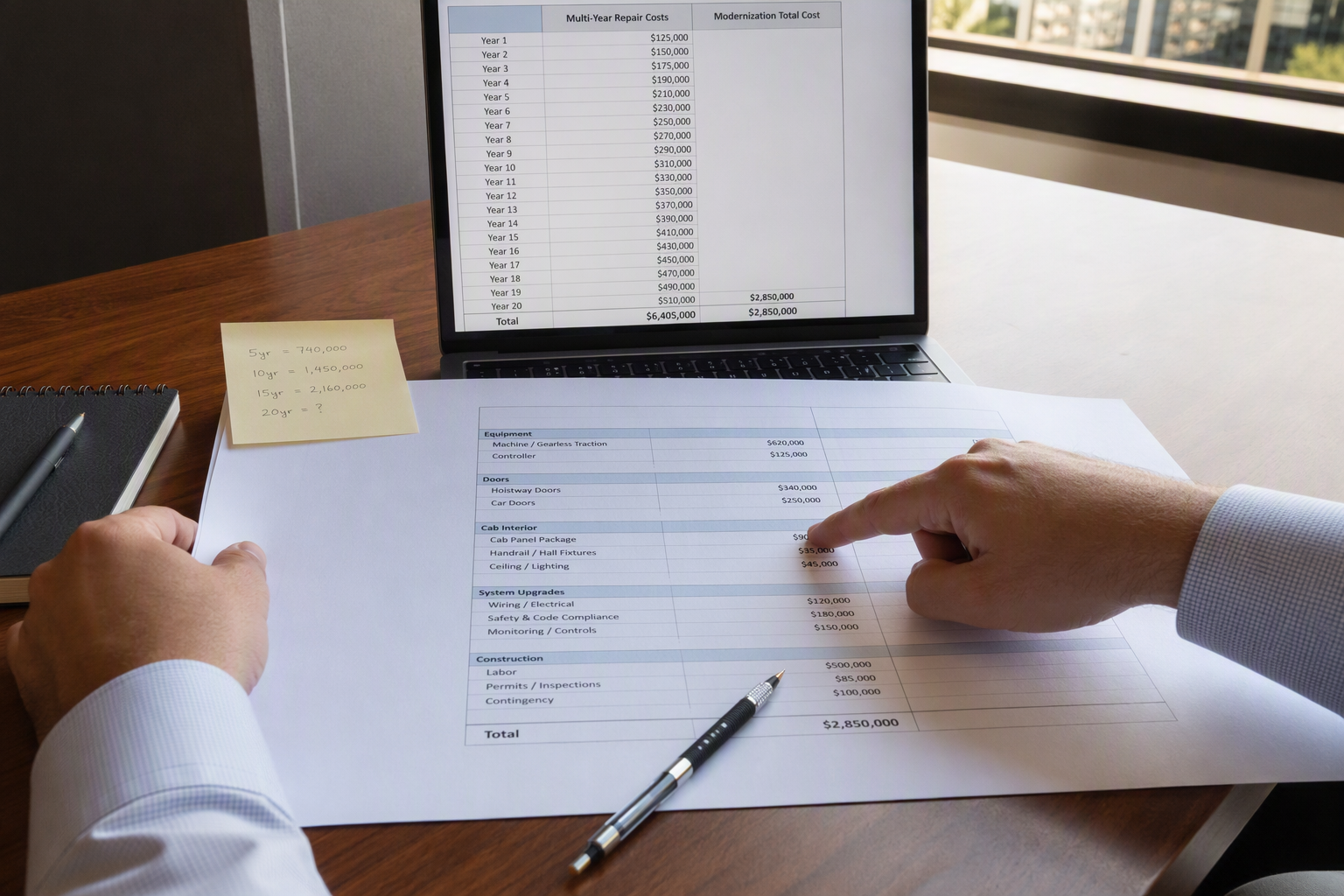
Elevator systems are engineered for a defined service life. When a system approaches or exceeds that design horizon, individual component failures tend to accelerate because interconnected mechanical and electrical parts age at similar rates. A failed controller on a system that is also running original ropes, an aging motor, and obsolete door operators signals a cascade risk: repairing one component today may simply expose the next weakest link within months.
Conversely, a relatively new system that experiences a single major failure — a freak hydraulic cylinder breach on a five-year-old unit, for example — is a strong candidate for repair rather than wholesale replacement. The system’s remaining service life justifies the investment in restoring it.
Key age-related questions to ask:
- Are replacement parts still manufactured for this controller generation, or are they sourced from shrinking secondary markets?
- Does the machine room use proprietary components tied to a vendor that has discontinued support?
- Has the building’s use changed since the elevator was installed (more traffic, heavier loads, extended operating hours)?
What Is the “50% Rule” and Does It Apply Here?
Facility managers frequently reference an informal industry benchmark — sometimes called the “50% rule” or the “repair-cost threshold” — under which the estimated repair cost is compared against the estimated cost of full modernization. When a single repair approaches or exceeds roughly half the cost of a comparable modernization scope, modernization generally delivers better value over a five-to-ten-year horizon.
This is a qualitative decision framework, not a codified standard, and its validity depends heavily on factors specific to each installation: remaining component life, local labor costs, the building’s operational requirements, and financing availability. Quality Elevator Company conducts structured cost-benefit analyses as part of its elevator assessments to help building owners apply this logic to their specific equipment and budget.
What Does Federal Code Require When a Major Component Is Replaced?
Under ASME A17.3 Safety Code for Existing Elevators and Escalators, alterations to existing equipment must bring the altered portions into compliance with the code edition in effect at the time of the alteration. This means that replacing a hydraulic unit, a traction machine, a controller, or a car enclosure is not simply a swap — it constitutes an alteration that carries compliance obligations.
Additionally, the Americans with Disabilities Act (ADA) requires that when alterations are made to areas of a building, those alterations must, to the maximum extent feasible, make the altered areas readily accessible to and usable by people with disabilities. An elevator alteration is therefore an opportunity — and in some cases an obligation — to evaluate ADA-related features such as call button height, cab signage, audible signals, and leveling accuracy.
OSHA standards govern the safety of workers performing the repair or modernization work itself, including lockout/tagout procedures and machine room safety requirements that the contractor must observe throughout the project.
What Are the Regional Code and Inspection Requirements in DC, Maryland, Pennsylvania, and Virginia?
Each jurisdiction in Quality Elevator Company’s service area administers its own elevator inspection and permitting program, and each AHJ interprets ASME A17.1 and A17.3 through its own adoption cycle. While specific section numbers and local statutory citations should always be confirmed with the AHJ before project commencement, the general framework is consistent:
- District of Columbia: The DC Department of Buildings oversees elevator permits and inspections. Any alteration or modernization requires a permit and a final inspection before return to service.
- Maryland: The Maryland Department of Labor, Licensing and Regulation administers the elevator safety program. Alterations trigger plan review and inspection requirements.
- Pennsylvania: The Pennsylvania Department of Labor and Industry oversees the elevator inspection program through its Bureau of Occupational and Industrial Safety. Permits are required for alterations.
- Virginia: The Virginia Department of Labor and Industry administers elevator safety under the Virginia Uniform Statewide Building Code framework. Alterations must be permitted and inspected.
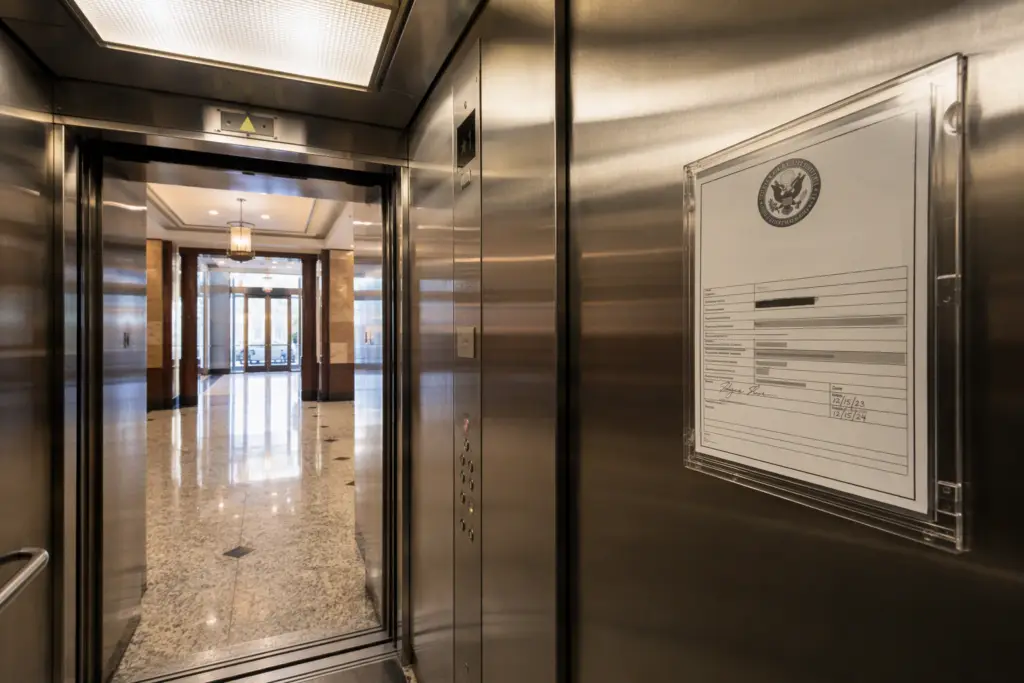
In all four jurisdictions, a qualified elevator contractor must pull the appropriate permit before beginning alteration work. Operating an elevator that has undergone an unpermitted alteration exposes the building owner to liability and potential shutdown by the AHJ.
What Are the Main Cost Drivers for Each Option?
Cost comparisons between repair and modernization must account for both direct and indirect factors:
Repair Cost Drivers
- Parts availability and lead time for the specific component generation
- Labor hours for diagnosis, disassembly, component replacement, and recommissioning
- Permit and inspection fees if the repair constitutes a code-defined alteration
- Downtime cost to the building (lost revenue, tenant dissatisfaction, accessibility disruption)
- Risk of subsequent failures in adjacent aging components
Modernization Cost Drivers
- Scope: partial modernization (controls only, for example) versus full modernization
- Machine type: hydraulic versus traction systems have different modernization pathways
- Permit, plan review, and inspection fees
- Downtime duration, which is typically longer than for a single repair
- ADA upgrades triggered by the alteration scope
- Long-term reduction in maintenance costs and energy consumption with modern equipment
How Long Does Each Option Typically Take?
Timelines vary significantly by project scope, parts availability, AHJ permit processing times, and building-specific conditions. Qualitatively:
- A single major component repair — such as a motor or controller replacement — can often be completed within days to a few weeks once parts are secured.
- A partial modernization (controls and door operators, for example) typically requires several weeks to a few months, including permitting and final inspection.
- A full modernization involving machine, controls, cab, and door systems can extend to several months, particularly when permit review queues are long at the local AHJ.
Building managers should request a detailed project schedule from their elevator contractor before committing, including milestones for permit submission, parts delivery, installation, and inspection.
What Is a Step-by-Step Process for Evaluating the Repair-vs.-Modernize Decision?
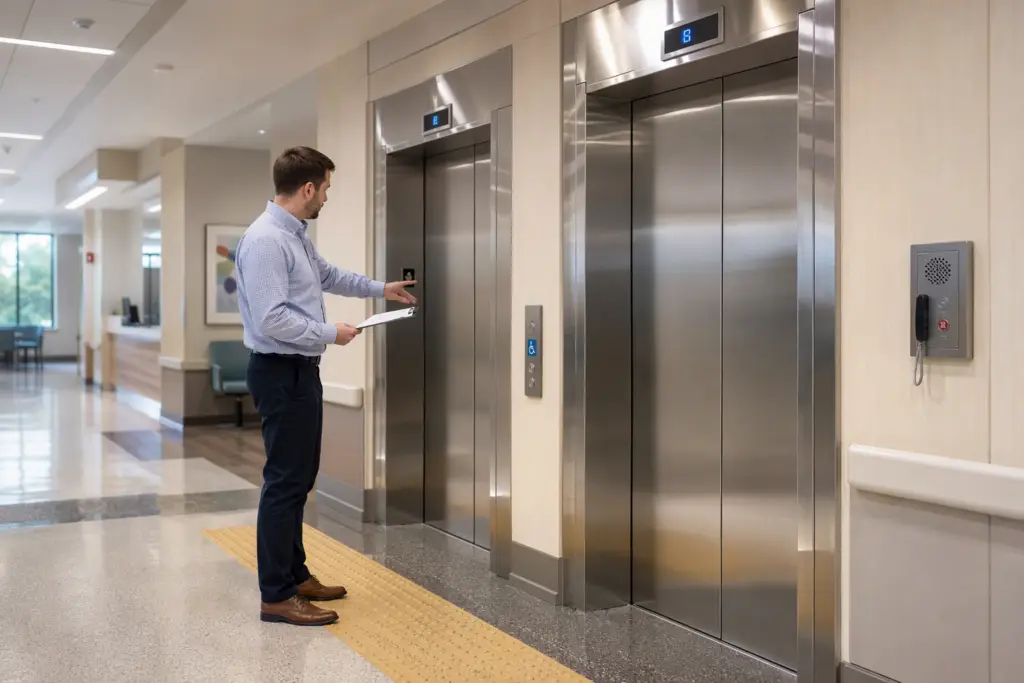
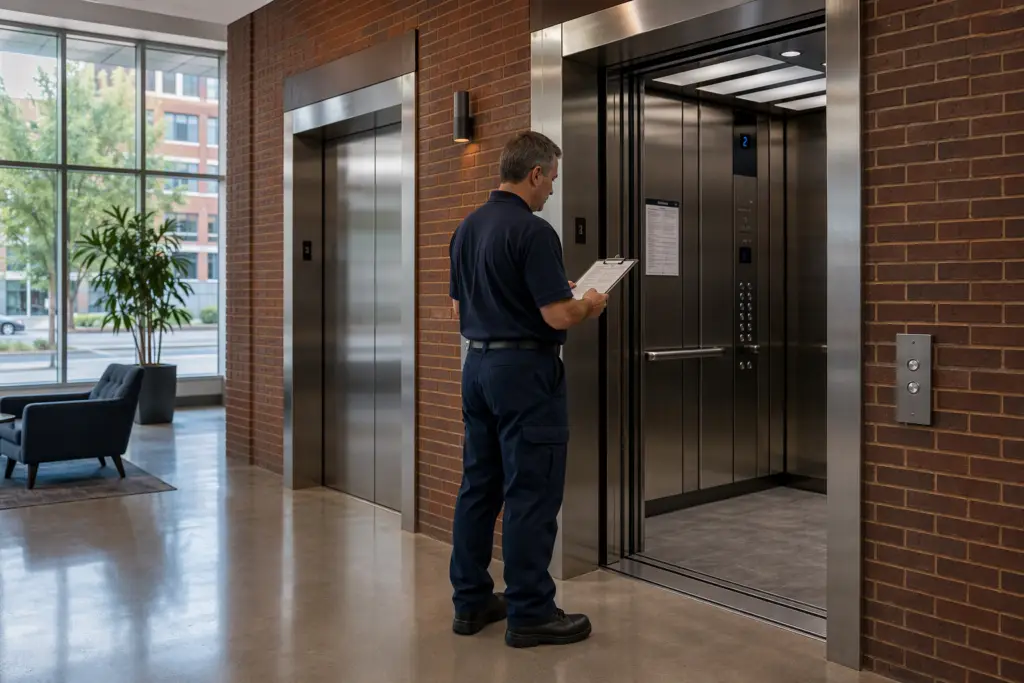
- Document the failure. Obtain a written diagnosis from a licensed elevator contractor identifying the specific failed component, its cause, and any related components showing wear.
- Pull the maintenance history. Review service records for the past three to five years to identify patterns of recurring failures or accelerating repair frequency.
- Assess equipment age and parts availability. Determine whether replacement parts for the current generation of equipment are readily available or whether sourcing delays create unacceptable downtime risk.
- Request a compliance review. Ask the contractor to identify any outstanding code deficiencies under ASME A17.3 and any ADA gaps under the Americans with Disabilities Act.
- Obtain itemized estimates for both options. A credible contractor should be able to provide a repair estimate and a modernization estimate for equivalent scopes so that the comparison is apples-to-apples.
- Calculate total cost of ownership. Factor in projected maintenance costs, energy costs, and downtime risk over a five-to-ten-year window for each option — not just the immediate out-of-pocket cost.
- Consult with the AHJ if scope is ambiguous. If the repair scope is large enough that it may constitute an alteration under local code, confirm permit requirements before proceeding.
- Make the decision and document it. Record the rationale for the chosen approach, the contractor selected, and the scope of work authorized. This documentation is valuable for insurance, liability, and future capital planning purposes.
What Components Most Commonly Drive Major Breakdown Decisions?
Certain failures are more likely to trigger the repair-versus-modernize analysis because of their cost, complexity, or downstream compliance implications:
- Hydraulic cylinders: A leaking or corroded single-bottom cylinder is a major repair event. Depending on installation depth and environmental conditions, cylinder replacement is often comparable in cost to a full hydraulic modernization, making the modernization case strong.
- Traction machine and motor: Failure of the traction machine on an older geared unit may prompt evaluation of a gearless machine upgrade for energy efficiency and reduced long-term maintenance.
- Relay-logic controllers: When a relay-based controller fails and replacement relay boards are no longer manufactured, repair becomes functionally impossible, and modernization to a solid-state or microprocessor-based controller is the only path forward.
- Wire ropes and suspension means: Rope replacement is a routine maintenance event on traction elevators, but rope failure on an aging system that is also due for controller or machine work often tips the economics toward full modernization.
- Door operators: Frequent door-related service calls are a leading cause of elevator downtime and a common catalyst for modernization conversations, particularly when parts for older door operator generations are scarce.
How Do Energy Efficiency and Building Sustainability Goals Affect This Decision?
Modern elevator drive technology — variable voltage variable frequency (VVVF) drives in particular — operates substantially more efficiently than older single-speed or two-speed systems. For buildings pursuing LEED certification, green building benchmarks, or energy cost reduction targets, a modernization that replaces an older drive system can contribute meaningfully to sustainability goals.
In the DC, Maryland, Pennsylvania, and Virginia markets, building energy benchmarking and disclosure requirements are increasingly influencing capital planning cycles, making the energy performance argument for modernization more tangible than it was in earlier years. While specific energy savings projections depend on usage patterns and equipment specifics, the directional case for efficiency improvement through modernization is well-established in the industry.
What Questions Should Building Owners Ask a Contractor Before Deciding?
- Is this repair a permanent fix, or does it address only one symptom of a broader aging system?
- Are parts for the current controller and drive generation still in production, or are we sourcing from secondary markets?
- Will this repair trigger a permit and inspection requirement under the local AHJ’s interpretation?
- What compliance gaps does the current system have under ASME A17.3 and the ADA, and will those gaps be addressed or exposed by this repair?
- What is the total cost of ownership comparison over five and ten years for repair versus modernization?
- What is the modernization timeline, and what interim arrangements are available during the outage?
- Does the contractor have experience working with the AHJ in this jurisdiction and managing the permit process?
What Industry Trends Are Shaping the Repair-vs.-Modernize Landscape in 2025 and 2026?
Several converging trends are influencing how building owners and elevator contractors approach this decision in the current environment:
- Parts obsolescence acceleration: The electronics supply chain disruptions of recent years have shortened the effective support life of many relay-based and early solid-state controller generations, making the repair-only path less viable for older systems.
- Connected and predictive maintenance: Modern elevator controllers increasingly support remote monitoring and predictive analytics, giving building managers data-driven visibility into emerging failures before they become emergencies. This capability is only available through modernization to compatible platforms.
- Accessibility enforcement: ADA compliance scrutiny in commercial buildings has intensified, and elevator alteration projects are a natural trigger point for addressing accessibility gaps that may otherwise create legal exposure.
- Energy and carbon benchmarking: As building energy benchmarking requirements expand in the DC-Maryland-Virginia region, elevator modernization is increasingly evaluated as part of a broader building decarbonization strategy rather than in isolation.
- Labor market dynamics: Technician expertise in legacy relay-logic and older hydraulic systems is contracting as the workforce that trained on those platforms retires, making complex repairs on older equipment harder to staff and schedule.
How Does Quality Elevator Company Approach This Decision for Clients?
Quality Elevator Company serves building owners and facility managers across the District of Columbia, Maryland, Pennsylvania, and Virginia with a structured, data-driven approach to the repair-versus-modernize question. Rather than defaulting to either option, the company’s assessments evaluate equipment condition, maintenance history, compliance posture, parts availability, and total cost of ownership to produce a documented recommendation that building decision-makers can present to ownership and finance teams.
The process is transparent: clients receive itemized estimates for both pathways, a compliance gap analysis referencing applicable federal codes, and project timeline documentation that reflects the specific AHJ requirements in their jurisdiction. The goal is to give building owners the information they need to make a defensible, well-informed capital decision — not simply to generate the largest scope of work.
What Should Building Owners Do Immediately After a Major Elevator Breakdown?
- Take the elevator out of service. Do not attempt to restore operation until a licensed elevator technician has assessed the failure. Operating a compromised elevator creates liability under OSHA general duty obligations and may violate the applicable AHJ’s requirements.
- Notify the AHJ if required. Some jurisdictions require notification of the elevator inspection authority within a defined timeframe following a shutdown. Confirm this obligation with your contractor or directly with the AHJ.
- Secure the machine room. Restrict access to authorized personnel only to prevent unauthorized restart attempts.
- Communicate with building occupants. Provide clear, timely information about the outage, expected duration, and available alternatives (stair access, temporary accommodations for individuals with disabilities).
- Request a written diagnostic report. Before authorizing any repair work, obtain a written assessment that documents the failure, its cause, and the recommended corrective action — this is the foundation of the repair-versus-modernize analysis.
- Initiate the repair-vs.-modernize evaluation. Use the diagnostic report as the starting point for the structured evaluation described in this guide before committing to a repair scope.
Does the Type of Building Affect the Decision?
Building type and use significantly influence the calculus. A hospital or healthcare facility with a single elevator serving patient transport has near-zero tolerance for downtime and strong incentive to modernize to a more reliable, maintainable platform. A multi-unit residential building with multiple elevators may be able to absorb a longer modernization timeline on one unit while others remain in service. A historic commercial building may face constraints on machine room modifications that limit modernization options.
Accessibility obligations also vary by building type under the ADA. Public accommodations, commercial facilities, and state and local government facilities each carry distinct obligations, and an elevator alteration is a natural trigger point for evaluating whether existing conditions meet current accessibility requirements.
Is Partial Modernization Ever the Right Answer?
Yes. A phased or partial modernization — replacing controls and door operators while retaining a mechanically sound machine, for example — can be the most cost-effective path when the mechanical components have meaningful remaining life but the electrical and control systems are obsolete. Partial modernization allows a building to address the most failure-prone and parts-scarce components while deferring the capital cost of mechanical replacement.
The key discipline is ensuring that the scope of the partial modernization is compatible with the eventual full modernization plan, so that work done today does not need to be undone or duplicated when the remaining components reach end of life.
Get a Data-Driven Repair-or-Modernize Assessment
The repair-versus-modernize decision is too consequential to make without complete information. Quality Elevator Company provides free elevator assessments for building owners and facility managers in the District of Columbia, Maryland, Pennsylvania, and Virginia — delivering documented findings, compliance gap analysis, and total-cost-of-ownership comparisons for both pathways so decision-makers can act with confidence.
Contact Quality Elevator Company for a free elevator assessment: 301-779-9116
Need elevator service you can rely on? Quality Elevator Company is ready to help.