ADA Elevator Compliance: How to Know If Your Elevator Qualifies for Upgrades and What Is Required
Whether you own a commercial office building in Baltimore, a mixed-use property in Washington DC, a healthcare facility in Philadelphia, or a residential tower in Richmond, understanding your elevator’s ADA compliance status is both a legal obligation and a practical necessity. The requirements are detailed, the enforcement consequences are real, and the technical scope of a qualifying upgrade can range from a simple controls replacement to a full cab renovation. This FAQ hub covers every dimension of the topic — from initial qualification tests to jurisdiction-specific inspection requirements across Maryland, the District of Columbia, Pennsylvania, and Virginia.
1. What is the ADA’s basic requirement for elevators, and which buildings must comply?
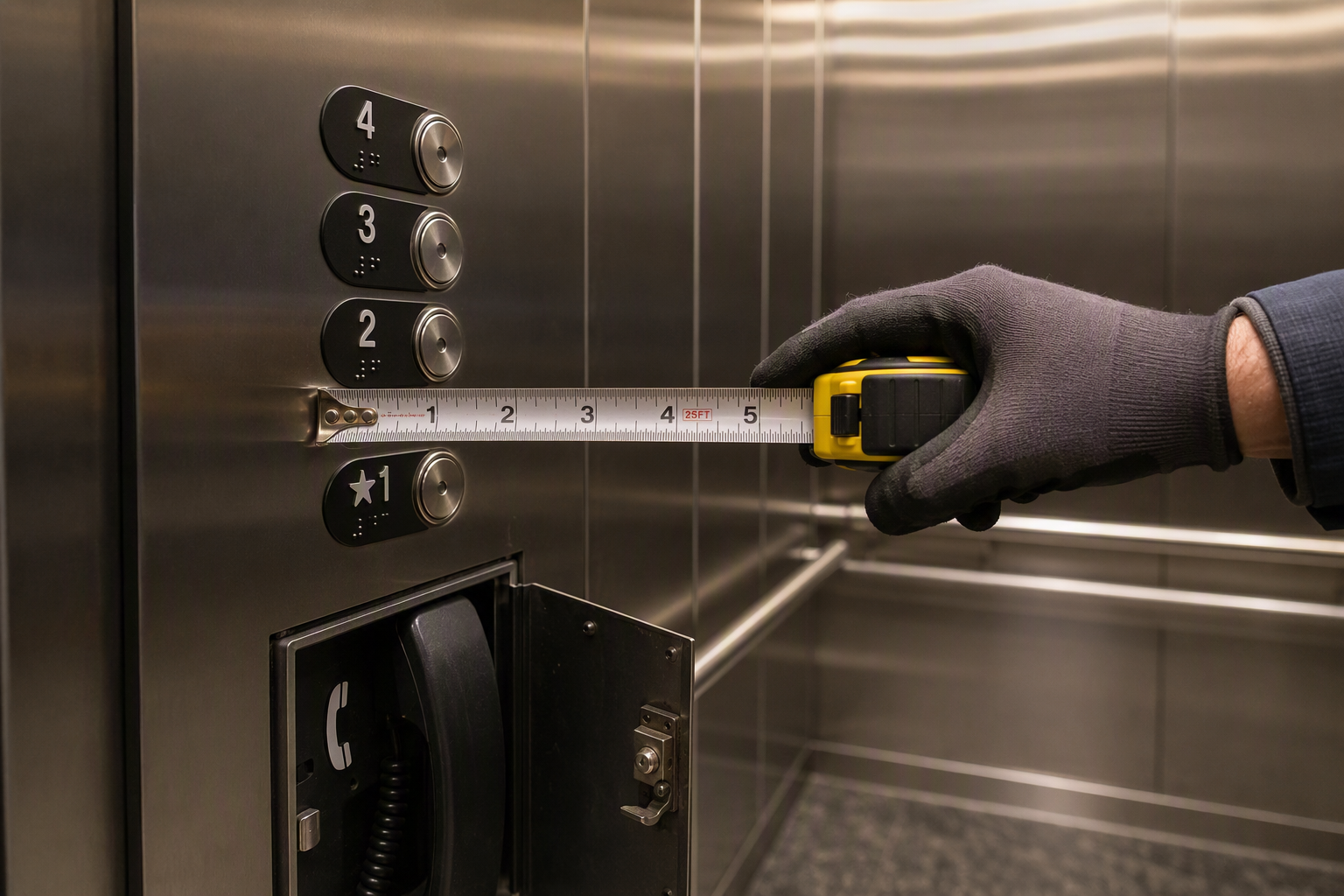
The Americans with Disabilities Act (ADA) generally requires that elevators in newly constructed or altered facilities with more than one story be accessible to people with disabilities, with limited exemptions for small buildings.
Under Title III of the ADA, places of public accommodation and commercial facilities that are newly constructed after January 26, 1992, must include accessible elevators unless the building has fewer than three stories or fewer than 3,000 square feet per story — and is not a shopping center, shopping mall, professional office of a health care provider, or transportation terminal. Title II applies to state and local government facilities with no small-building exemption. Title I covers employment-related elevator access for employers with 15 or more employees. Buildings that undergo alterations affecting elevator lobbies, hoistways, or primary function areas trigger path-of-travel obligations that can require bringing related elevator features into compliance.
2. Does the ADA elevator exemption apply to my building?
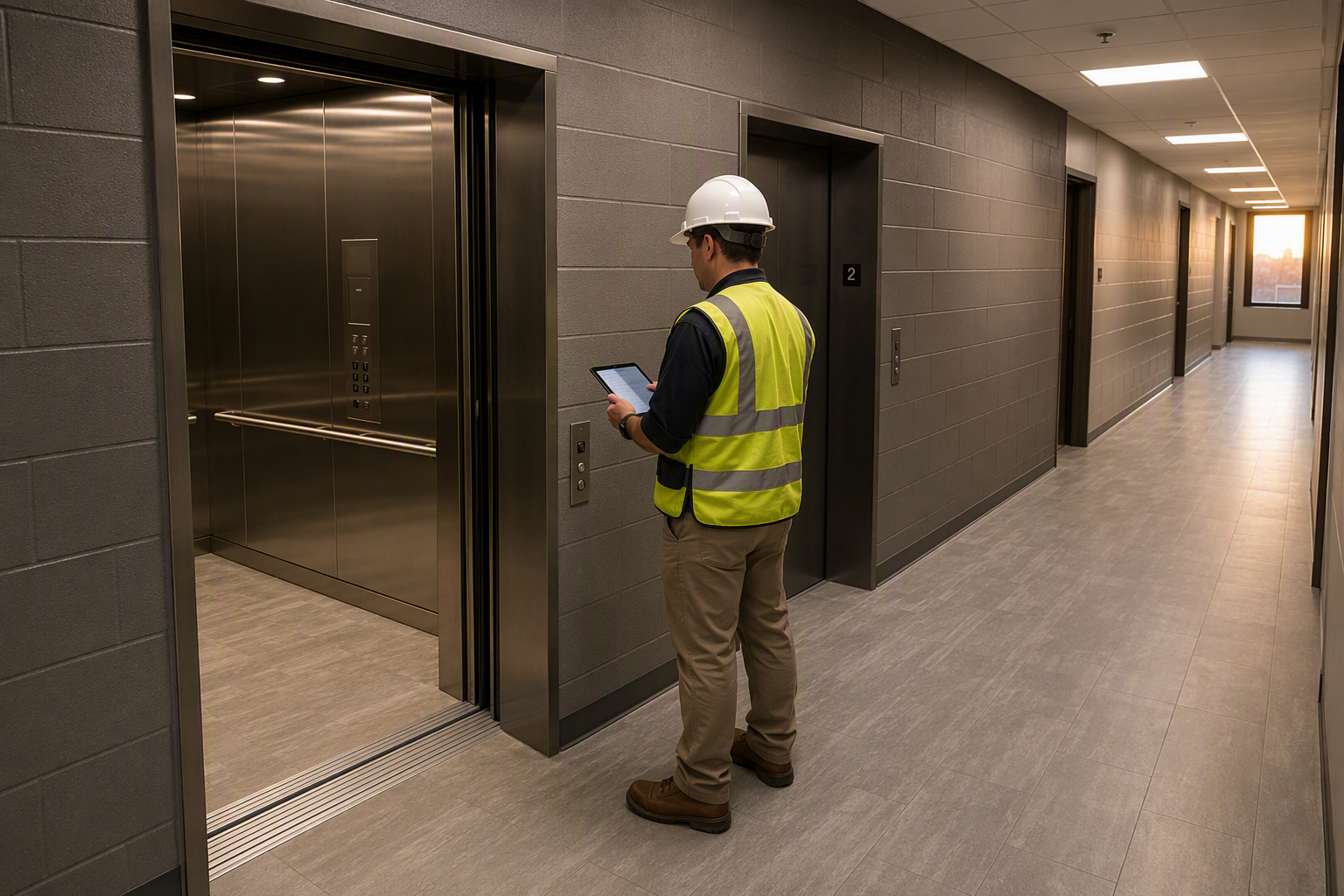
The elevator exemption applies only to privately owned facilities with fewer than three stories and fewer than 3,000 square feet per story that are not health care offices, shopping centers, or transit facilities — all other covered buildings must provide an accessible elevator or equivalent accessible route.
Many property owners in Baltimore or Philadelphia mistakenly believe a two-story building is automatically exempt. Both conditions — story count and per-floor square footage — must be satisfied simultaneously, and the building type exclusions override both. A two-story medical clinic, for example, is never exempt regardless of square footage. When in doubt, a qualified elevator contractor can review the building’s certificate of occupancy, use classification, and floor plan against ADA standards before any compliance determination is made.
3. Which technical standard governs ADA-compliant elevator design and dimensions?
ADA elevator technical requirements are set by the ADA Standards for Accessible Design, which incorporate the accessibility guidelines published by the U.S. Access Board, while mechanical safety is governed by the ASME A17.1 Safety Code for Elevators and Escalators.
The ADA Standards specify minimum cab inside clear dimensions, door clear width, floor leveling tolerances, control height and reach ranges, Braille and tactile signage, audible and visual signals, and door timing. ASME A17.1 governs the mechanical, electrical, and structural safety of the elevator as a machine. Both sets of requirements must be satisfied simultaneously — an elevator that is mechanically compliant but inaccessible fails ADA, and an elevator that meets ADA dimensions but has lapsed ASME-required safety devices fails state inspection. In 2026, the applicable mechanical code across Maryland, DC, Pennsylvania, and Virginia references ASME A17.1 and its companion existing-installations standard, ASME A17.3.
4. What are the specific ADA dimension and feature requirements an elevator must meet?
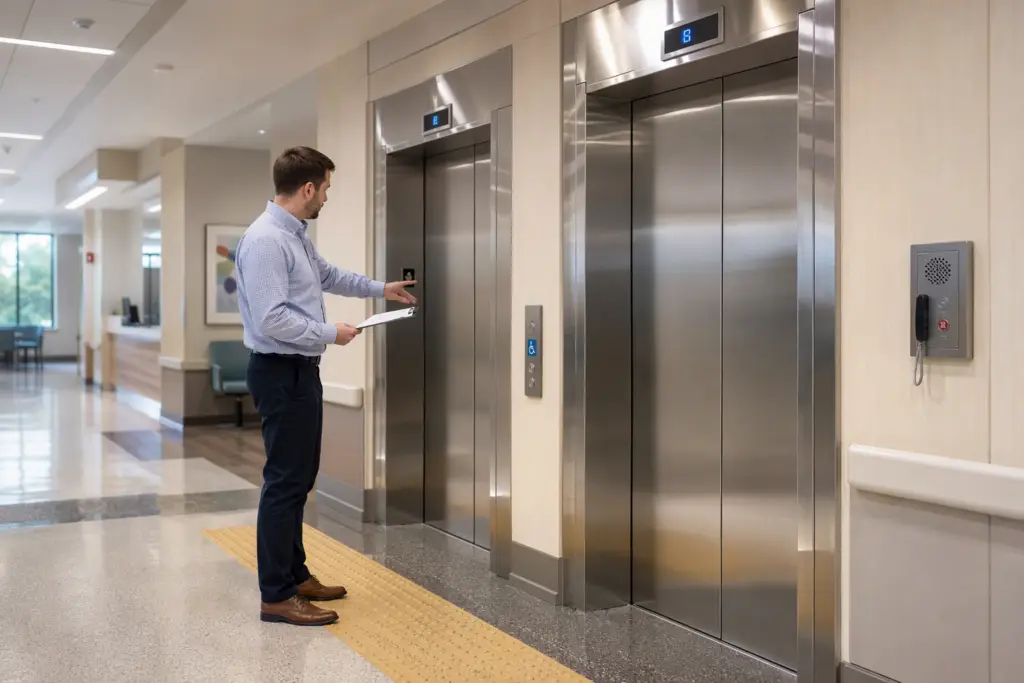
A compliant elevator must provide a minimum cab inside clear floor area of 51 inches deep by 68 inches wide for center-opening doors, a door clear opening width of at least 36 inches, floor-to-floor leveling within one-half inch, and controls mounted within ADA reach ranges.
The full technical checklist includes the following key requirements drawn from the ADA Standards for Accessible Design:
| Feature | ADA Minimum Requirement | Common Non-Compliant Condition |
|---|---|---|
| Cab inside clear depth | 51 inches (center-opening doors) | Older cabs often 48 inches or less |
| Cab inside clear width | 68 inches (center-opening doors) | Narrow hoistway limits expansion |
| Door clear opening width | 36 inches minimum | Legacy 32-inch door frames |
| Floor leveling tolerance | ±½ inch | Worn hydraulic or traction systems |
| Control button height (side approach) | 15–48 inches AFF | Controls above 54 inches AFF |
| Control button height (forward approach) | 15–48 inches AFF | Single-panel layouts violate reach range |
| Tactile/Braille floor designations | Required on jamb, 60 in. AFF centerline | Missing or incorrect character height |
| Audible floor announcement | Required at each landing | No voice synthesizer installed |
| Visual floor indicator | Required in cab and at landings | Inoperative or absent digital display |
| Door reopening device | Detects obstruction at 5 in. and 29 in. AFF | Single-beam edge sensor only |
| Door hold-open time | Minimum 3 seconds (main entry) / 5 seconds adjustable | Timed-close set too fast |
| Cab illumination | 5 foot-candles minimum at controls | Failed cab lighting not replaced |
| Emergency two-way communication | Hands-free, ADA-compliant phone or intercom | TTY-incompatible or voice-only system |
5. How do I determine whether my existing elevator was installed before or after the ADA compliance date?
The relevant threshold date is January 26, 1992 — the date ADA Title III took effect — and the elevator’s installation date can be confirmed through the original permit, the manufacturer’s data plate inside the machine room, or state inspection records.
Pre-1992 elevators are not automatically grandfathered. For existing facilities, the ADA requires removal of accessibility barriers when doing so is “readily achievable” — meaning accomplishable without much difficulty or expense, evaluated based on overall financial resources of the entity. For alterations made after January 26, 1992, the altered elements must comply to the maximum extent feasible. Property owners in Maryland, DC, Pennsylvania, and Virginia should obtain copies of all historical permits from the relevant Authority Having Jurisdiction (AHJ) to establish an accurate compliance timeline. Quality Elevator Company can assist in pulling machine room data and correlating it with local permit histories during a compliance assessment.
6. What is the “readily achievable” standard, and how does it affect upgrade obligations for older buildings?
The “readily achievable” standard under the ADA requires that barrier removal be undertaken when it can be accomplished without significant difficulty or expense relative to the resources of the covered entity — meaning cost alone is not an automatic defense.
The U.S. Department of Justice considers factors including the overall financial resources of the facility, the type of operation, and the impact of the modification on operations. For elevator compliance, this typically means that a large commercial landlord cannot claim a control panel upgrade is too costly, while a small nonprofit with a single-story accessible alternative might have a stronger case. Importantly, “readily achievable” is not a permanent status — what was not readily achievable five years ago may be so today as the entity’s financial position changes. A documented audit trail showing annual barrier-removal assessments is considered best practice.
7. What triggers a mandatory ADA elevator upgrade even in an older building?
Any alteration to a primary function area of a building — such as renovating a lobby, leasing space to a new tenant, or modifying the elevator hoistway — triggers path-of-travel requirements under the ADA that can mandate bringing the elevator into compliance.
Common triggers encountered by building owners in Washington DC and Philadelphia include lobby renovations, tenant fit-outs on upper floors, fire alarm system replacements tied to elevator recall, and roof or mechanical upgrades that require hoistway access. When alteration costs are incurred, up to 20 percent of the total alteration budget may need to be spent on path-of-travel accessibility improvements, including elevator features. This is why engaging an elevator contractor with ADA expertise before finalizing any renovation scope is essential — surprises discovered mid-project are significantly more expensive than planned compliance work.
8. How do state inspection requirements in Maryland, DC, Pennsylvania, and Virginia interact with ADA compliance?
State elevator inspection programs enforce mechanical safety under ASME A17.1 and A17.3 but do not independently certify ADA compliance — the two regulatory tracks run in parallel and must both be satisfied.
Each jurisdiction has its own AHJ and inspection interval requirements:
- Maryland: The Maryland Department of Labor oversees elevator inspections under the Maryland Elevator Safety Law. Annual inspections are required for most passenger elevators.
- District of Columbia: DCRA (Department of Consumer and Regulatory Affairs) administers elevator safety. Periodic inspections are required under DC’s elevator regulations.
- Pennsylvania: The Pennsylvania Department of Labor and Industry, Bureau of Occupational and Industrial Safety, oversees elevator inspections statewide. Many localities also have their own elevator inspection offices (Philadelphia, for example, uses its Department of Licenses and Inspections).
- Virginia: The Virginia Department of Labor and Industry (DOLI) regulates elevator safety under the Virginia Uniform Statewide Building Code, with inspections required for public-use elevators.
Passing a state inspection means the elevator is mechanically safe — it does not mean the elevator satisfies ADA. A building owner in Richmond can hold a valid state certificate of operation while still having multiple ADA violations subject to DOJ complaint. Working with Quality Elevator Company ensures that both mechanical compliance and accessibility compliance are addressed in a coordinated scope of work.
9. What is ASME A17.3 and how does it affect existing elevator upgrade requirements?
The ASME A17.3 Safety Code for Existing Elevators and Escalators establishes minimum safety requirements for elevators already in service, providing a retroactive safety baseline distinct from the new-installation requirements of ASME A17.1.
State authorities in Maryland, DC, Pennsylvania, and Virginia adopt editions of A17.3 by reference in their elevator safety regulations, with adoption cycles varying by jurisdiction. A17.3 covers items such as retroactive car door interlock requirements, governor overspeed settings, and buffer requirements — all of which may need to be addressed simultaneously with ADA upgrades when a modernization project is undertaken. Property owners planning a cab renovation should request a combined A17.3 and ADA gap analysis so that all required improvements are scoped together, avoiding the cost of mobilizing a modernization crew twice.
10. What is the step-by-step process for bringing a non-compliant elevator into ADA compliance?
The process for achieving ADA elevator compliance follows a defined sequence that moves from assessment through permitting, installation, inspection, and documentation.
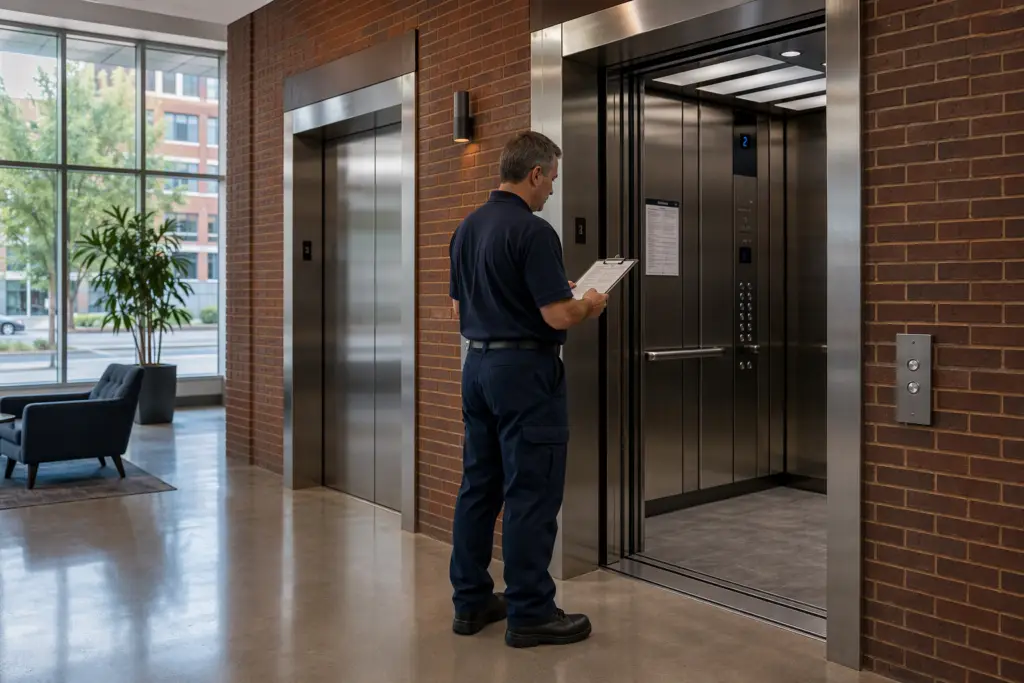
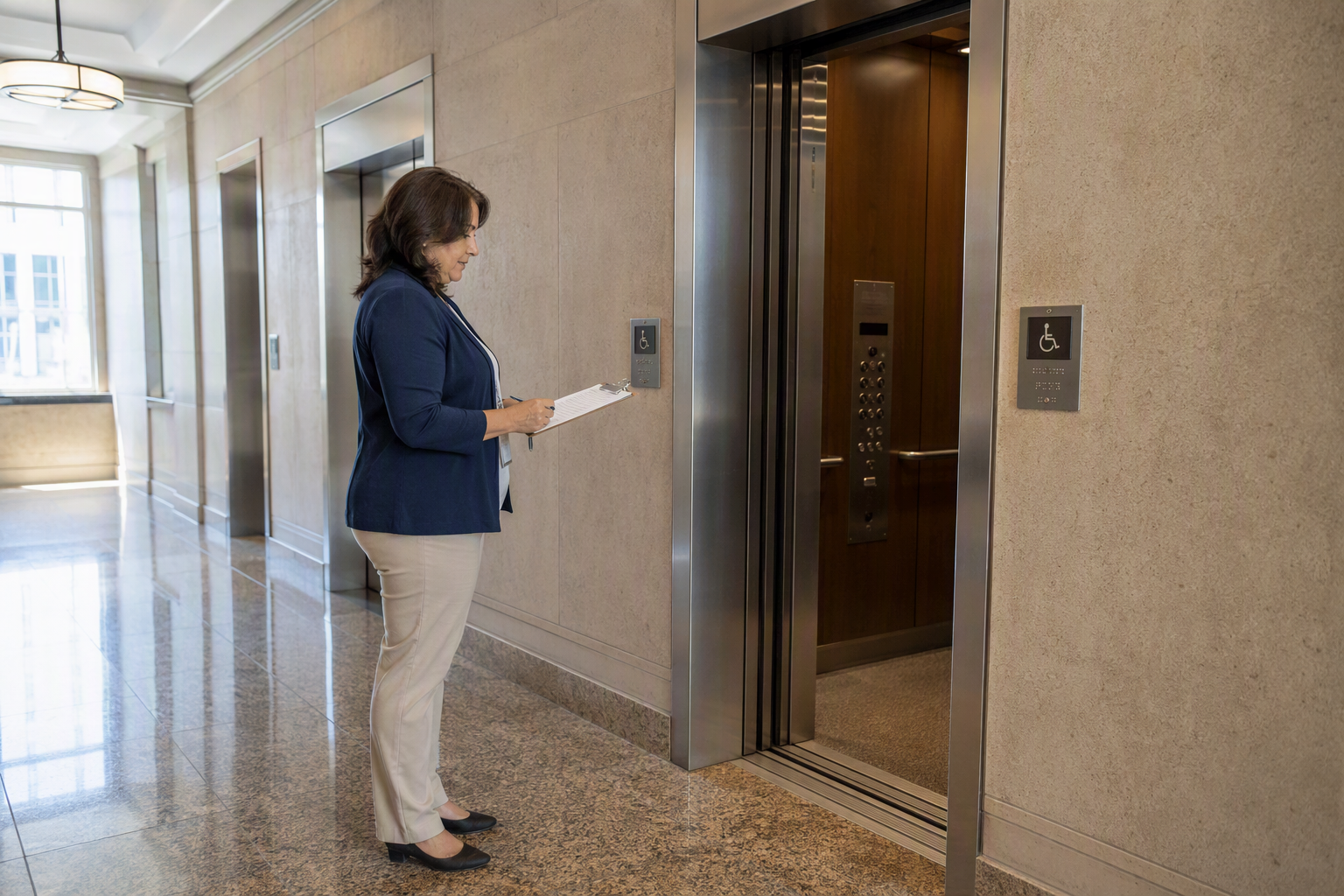
- Commission a formal ADA and ASME gap assessment from a licensed elevator contractor who will measure cab dimensions, test door timing and reopening devices, audit controls and signage, and compare findings against current ADA Standards and applicable ASME editions.
- Obtain building and equipment documentation including original permits, machine room data plates, prior inspection reports, and any existing modernization records from the AHJ.
- Develop a remediation scope of work that addresses every identified deficiency, prioritized by compliance obligation (alteration-triggered vs. readily achievable barrier removal) and coordinated with any concurrent building renovation.
- Submit permit applications to the applicable AHJ — DCRA in DC, Maryland Department of Labor for Maryland, Philadelphia L&I or Pennsylvania BOIS for Pennsylvania installations, or Virginia DOLI — including engineered drawings where required.
- Execute the upgrade work with licensed elevator mechanics, following manufacturer specifications and ASME A17.1 installation requirements for all new components.
- Schedule third-party inspection and witnessing by the AHJ upon completion of the modernization work.
- Obtain updated certificate of operation and update the facility’s ADA transition plan or barrier removal log to reflect completed work.
- Retain all documentation — permits, inspection reports, contractor certifications, and manufacturer cut sheets — in the facility’s permanent compliance file.
11. Which elevator components most commonly require replacement or modification during an ADA upgrade?
The most frequently replaced or modified components during ADA elevator upgrades are the operating panel, door operator and safety edges, cab interior finishes affecting dimensions, audible and visual signal fixtures, and the emergency communication system.
Operating panel replacements address button height, Braille designations, and illuminated indicators. Door operator upgrades typically involve replacing single-beam safety edges with two-beam or light-curtain systems that detect obstructions at both 5 inches and 29 inches above the floor, as required. Where cab interiors have been built out with added paneling that reduced clear dimensions, the interior must be stripped back. Audible signal upgrades add voice synthesizers for floor announcements. Emergency communication upgrades replace legacy telephone systems with hands-free, ADA-compliant intercoms that can serve users who are deaf or hard of hearing. Quality Elevator Company evaluates each component category during the assessment phase to produce an accurate, itemized remediation plan.
12. Can a hydraulic elevator be brought into ADA compliance, or is a full replacement required?
Most hydraulic elevators can be brought into ADA compliance through targeted modernization without full replacement, provided the hoistway dimensions can accommodate the required cab clear floor area.
The limiting factor for hydraulic systems is typically cab size — if the existing hoistway cannot physically accommodate the minimum 51-inch-deep by 68-inch-wide clear floor area for a center-opening door arrangement, structural hoistway expansion or a different door configuration must be evaluated. Hydraulic systems also periodically require environmental upgrades (tank replacement, biodegradable fluid conversion) under state environmental regulations, which can be coordinated with ADA modernization work to reduce overall project cost and downtime. The mechanical components of a hydraulic elevator — pump unit, valve, cylinder — are independent of ADA compliance and may or may not need replacement depending on age and condition.
13. How long does an ADA elevator upgrade project typically take from assessment to completion?
Timeline varies significantly based on the scope of deficiencies identified, permit processing times at the applicable AHJ, and parts lead times, but most targeted ADA upgrade projects — excluding full cab replacements — progress from assessment to final inspection within a matter of weeks to several months.
Permit processing at jurisdictions like Philadelphia’s Department of Licenses and Inspections or DC’s DCRA can add several weeks to the schedule, particularly for projects requiring engineered drawings. Full modernization projects — which combine ADA, A17.3 retroactive safety, and cosmetic cab renovation — typically require a longer timeline due to the volume of components involved. Building owners should plan for temporary elevator outage periods and, where feasible, arrange accessible alternative access for building occupants during the modernization window. Scheduling an assessment early — before renovations trigger compliance obligations — provides maximum lead time for planning and procurement.
14. Are there federal tax incentives available to help offset the cost of ADA elevator upgrades?
The IRS provides two federal tax incentives for qualifying ADA barrier removal: the Disabled Access Credit (IRS Form 8826) for eligible small businesses, and a deduction under Section 190 of the Internal Revenue Code for barrier removal expenditures.
The Disabled Access Credit is available to businesses with gross receipts of one million dollars or less or with 30 or fewer full-time employees, and covers 50 percent of eligible access expenditures between $250 and $10,250 in a tax year — producing a maximum annual credit of $5,000. The Section 190 deduction allows a deduction of up to $15,000 per year for qualified architectural and transportation barrier removal. These incentives can meaningfully reduce the net cost of elevator ADA upgrades for qualifying property owners. Consultation with a tax professional familiar with commercial real estate is recommended before claiming either benefit. Neither incentive eliminates the legal obligation to comply.
15. What are the risks of operating a non-ADA-compliant elevator in Maryland, DC, Pennsylvania, or Virginia?
Operating a non-ADA-compliant elevator exposes a building owner to DOJ enforcement actions, private civil lawsuits, injunctive relief requiring immediate remediation, and — in cases involving alterations — potential construction stop-work orders.
Under the ADA, the DOJ can file suit directly against non-compliant facilities and may seek civil penalties. Private plaintiffs can also file suit in federal court without first filing an administrative complaint. Courts can order injunctive relief — mandatory compliance work — on very short timelines, which removes the property owner’s ability to plan and schedule work cost-effectively. Additionally, non-compliance can affect insurance coverage, leasing negotiations with accessibility-conscious tenants, and the facility’s standing in federal contracting relationships. The reputational and financial exposure from reactive compliance is consistently greater than the cost of proactive assessment and upgrade.
16. Does ADA compliance apply to residential elevators in apartment buildings?
ADA Title III elevator requirements apply to the common-use and public-use areas of multifamily residential buildings covered by the Act — such as apartment buildings with places of public accommodation on site — but private residential units are primarily governed by the Fair Housing Act rather than ADA.
For apartment buildings in Baltimore, Washington DC, Philadelphia, and Richmond where the building includes commercial tenants, a management office open to the public, or other public-use spaces, the elevator serving those areas is subject to ADA. Buildings subject to the Fair Housing Act’s design and construction requirements (generally those with four or more units built after March 13, 1991) must provide accessible routes into and through covered units, which typically includes elevator requirements. The two frameworks have overlapping but distinct requirements, and a compliance assessment should address both where applicable.
17. What documentation should a building owner maintain to demonstrate ADA elevator compliance?
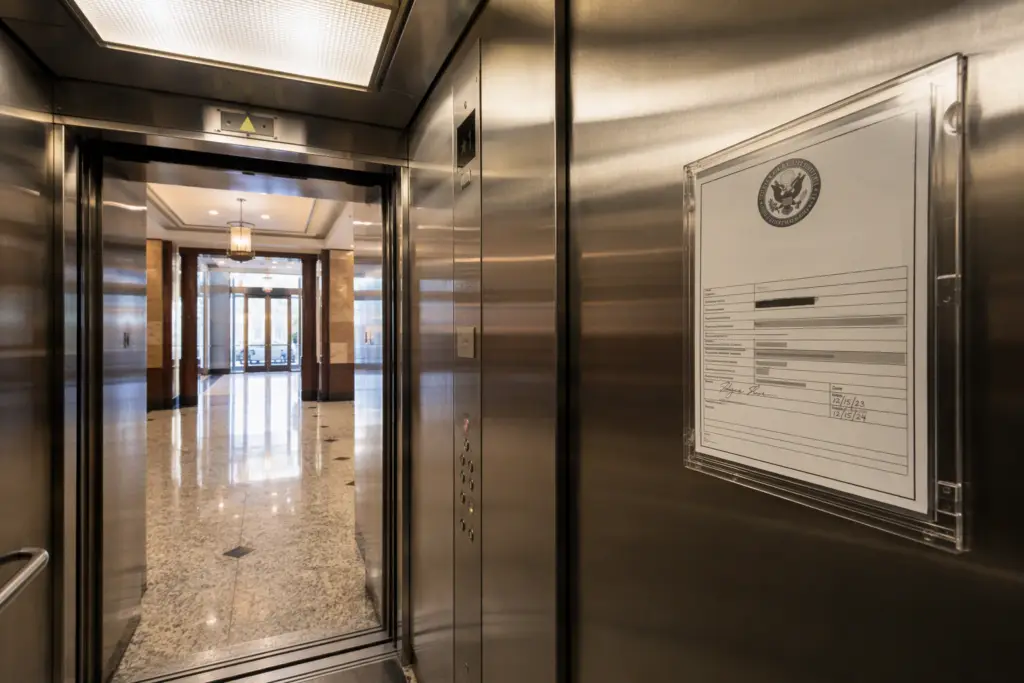
A defensible compliance documentation file should include the original ADA gap assessment report, all permits and AHJ inspection certificates, contractor work orders and component cut sheets, Braille signage installation records, and the current state certificate of operation.
In a DOJ investigation or private lawsuit, the ability to produce contemporaneous documentation that barrier removal was assessed, prioritized, and executed is a critical mitigating factor. Many building owners in the DC and Baltimore markets now maintain digital compliance files that are updated after every maintenance visit, modernization project, and annual inspection. ADA transition plans — written documents identifying barriers and scheduling removal — are required for state and local government entities with 50 or more employees and represent best practice for private entities of comparable size. Quality Elevator Company provides written assessment reports that serve as the foundation for this documentation.
18. How does OSHA intersect with elevator ADA compliance projects?
The Occupational Safety and Health Administration (OSHA) governs worker safety during elevator modernization and maintenance work, requiring that all elevator mechanics work under lockout/tagout procedures, fall protection protocols, and confined-space entry rules where applicable.
OSHA’s General Industry standards apply to elevator maintenance, and OSHA’s Construction standards apply during modernization projects. Employers of elevator mechanics — including subcontractors brought in for ADA upgrade work — must comply with applicable OSHA standards. Building owners who direct the means and methods of work may bear joint-employer OSHA exposure in some circumstances. Engaging a reputable elevator contractor with documented safety programs reduces this risk. OSHA requirements do not change the ADA compliance obligations but must be managed in parallel during any upgrade project.
19. How often should an ADA-compliant elevator be reassessed to ensure continued compliance?
ADA compliance is an ongoing obligation, not a one-time certification — elevators should be reassessed whenever alterations are made to the cab, controls, or building, and a full ADA audit is advisable at least every few years as standards and enforcement guidance evolve.
ADA Standards are updated periodically, and DOJ enforcement priorities shift over time. Additionally, elevator components degrade — door timing drifts, lighting dims, audible systems fail — in ways that can create non-compliance in equipment that previously passed. Annual state inspections by the AHJ confirm mechanical safety but not accessibility. Building owners should incorporate a brief ADA compliance walkthrough into their annual elevator maintenance contract. Quality Elevator Company recommends combining the ADA review with the annual state inspection visit to maximize efficiency and identify emerging issues before they become enforcement liabilities.
20. How do I get started with an ADA elevator compliance assessment for my property in Baltimore, Washington DC, Philadelphia, or Richmond?
The first step is engaging a licensed elevator contractor operating in your jurisdiction to perform a formal gap assessment that measures physical dimensions, tests all required features, and produces a written report documenting every deficiency against current ADA Standards and applicable ASME codes.
Property owners should bring to the assessment any available documentation: original elevator permits, prior inspection reports, the building’s certificate of occupancy, and any prior ADA assessments or transition plans. The assessment should culminate in a prioritized remediation scope with itemized upgrade recommendations. For buildings in Maryland, DC, Pennsylvania, and Virginia, Quality Elevator Company performs comprehensive ADA and ASME compliance assessments and can coordinate all permitting, modernization work, and AHJ inspection scheduling from a single point of contact — simplifying a process that otherwise requires coordinating multiple contractors, engineers, and regulatory agencies.
Ready to Know Exactly Where Your Elevator Stands?
ADA elevator compliance is a legal obligation with real enforcement consequences — but it is also entirely manageable with the right expertise and a clear plan. Whether you own a commercial building in Baltimore, a government facility in Washington DC, a healthcare property in Philadelphia, or a multifamily tower in Richmond, the path to compliance starts with a thorough, documented assessment.
Contact Quality Elevator Company for a free elevator assessment. Our team serves property owners across Maryland, the District of Columbia, Pennsylvania, and Virginia, providing ADA gap analysis, ASME compliance review, modernization scoping, and full-service project management — all coordinated with local AHJ permitting and inspection requirements.
Call us today at 301-779-9116 to schedule your free elevator assessment and take the first step toward documented, defensible ADA compliance.
Need elevator service you can rely on? Quality Elevator Company is ready to help.