Direct Answer: Most elevators in Maryland, Washington DC, Virginia, and Pennsylvania require a full safety inspection annually, with periodic device testing every one to five years depending on equipment type — all governed by state adoption of ASME A17.1 Safety Code for Elevators and Escalators and local amendments.
Elevator Inspection Frequency and Rules in Maryland, DC, Virginia & Pennsylvania: Complete FAQ
Elevator inspection requirements are not uniform across state lines. Building owners and facility managers operating in the Mid-Atlantic region must navigate four separate regulatory frameworks, each with its own inspection intervals, testing protocols, permit fees, and enforcement agencies. This FAQ hub covers every angle of elevator inspection compliance — from annual certificate requirements to hydraulic pressure tests — for Maryland, Washington DC, Virginia, and Pennsylvania.
How Often Does an Elevator Need to Be Inspected?
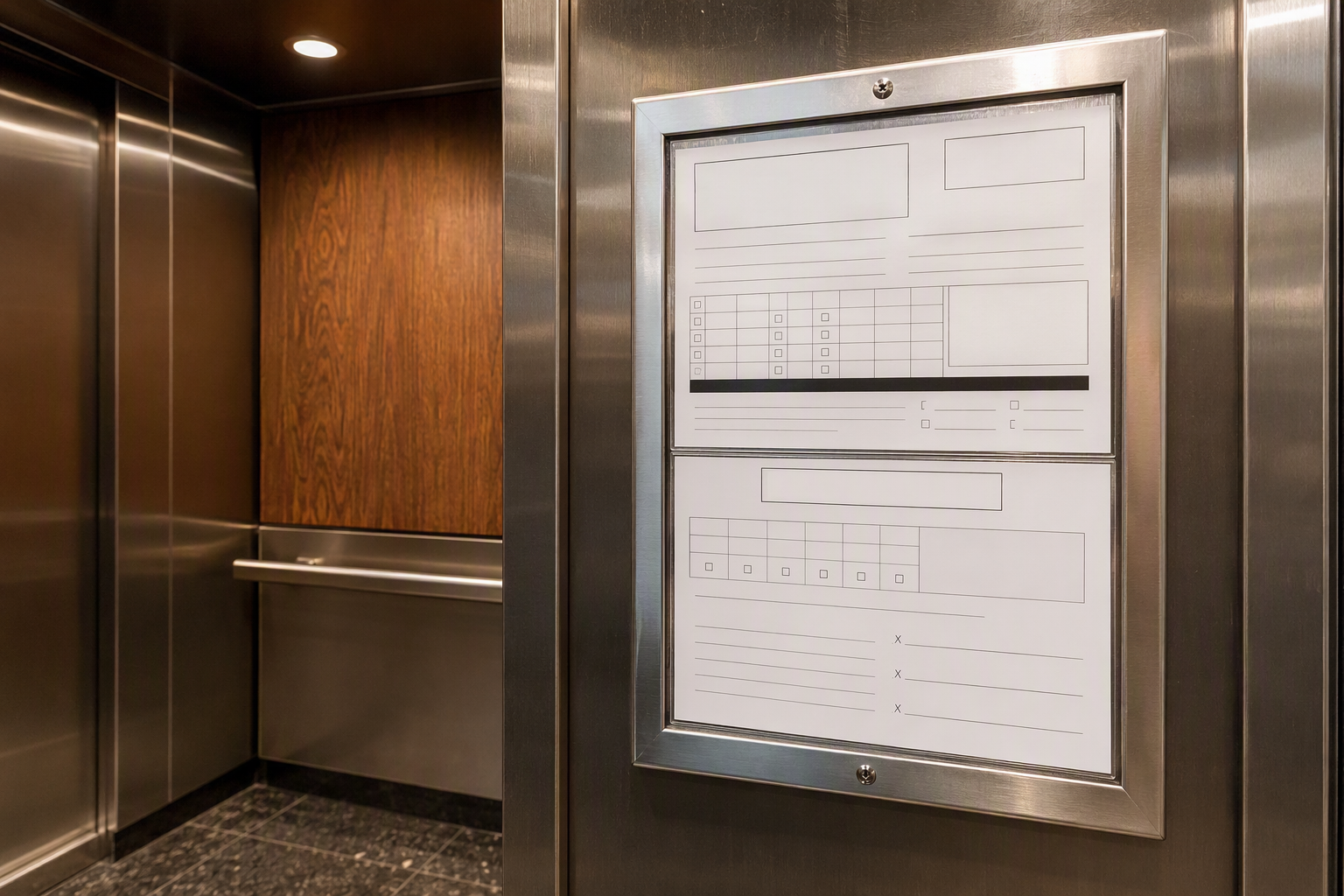
Most elevators require a full safety inspection at least once every twelve months, plus periodic device testing on one-year, three-year, and five-year cycles as defined by ASME A17.1.
The ASME A17.1 Safety Code for Elevators and Escalators is the nationally recognized model code that establishes inspection and test frequency for virtually every type of conveyance — traction elevators, hydraulic elevators, escalators, moving walks, and platform lifts. Maryland, Washington DC, Virginia, and Pennsylvania have each adopted ASME A17.1 as their base standard, though each jurisdiction applies its own amendments and enforcement rules on top of it.
In practical terms, a building owner should expect an annual routine inspection, a five-year full-load safety test for traction equipment, and a five-year hydraulic pressure/relief test for hydraulic units. Certain safety devices — overspeed governors, safeties, and buffers — have their own mandated test schedules that a qualified elevator contractor must document and report to the authority having jurisdiction (AHJ).
What Is the ASME A17.1 Code and Why Does It Matter?
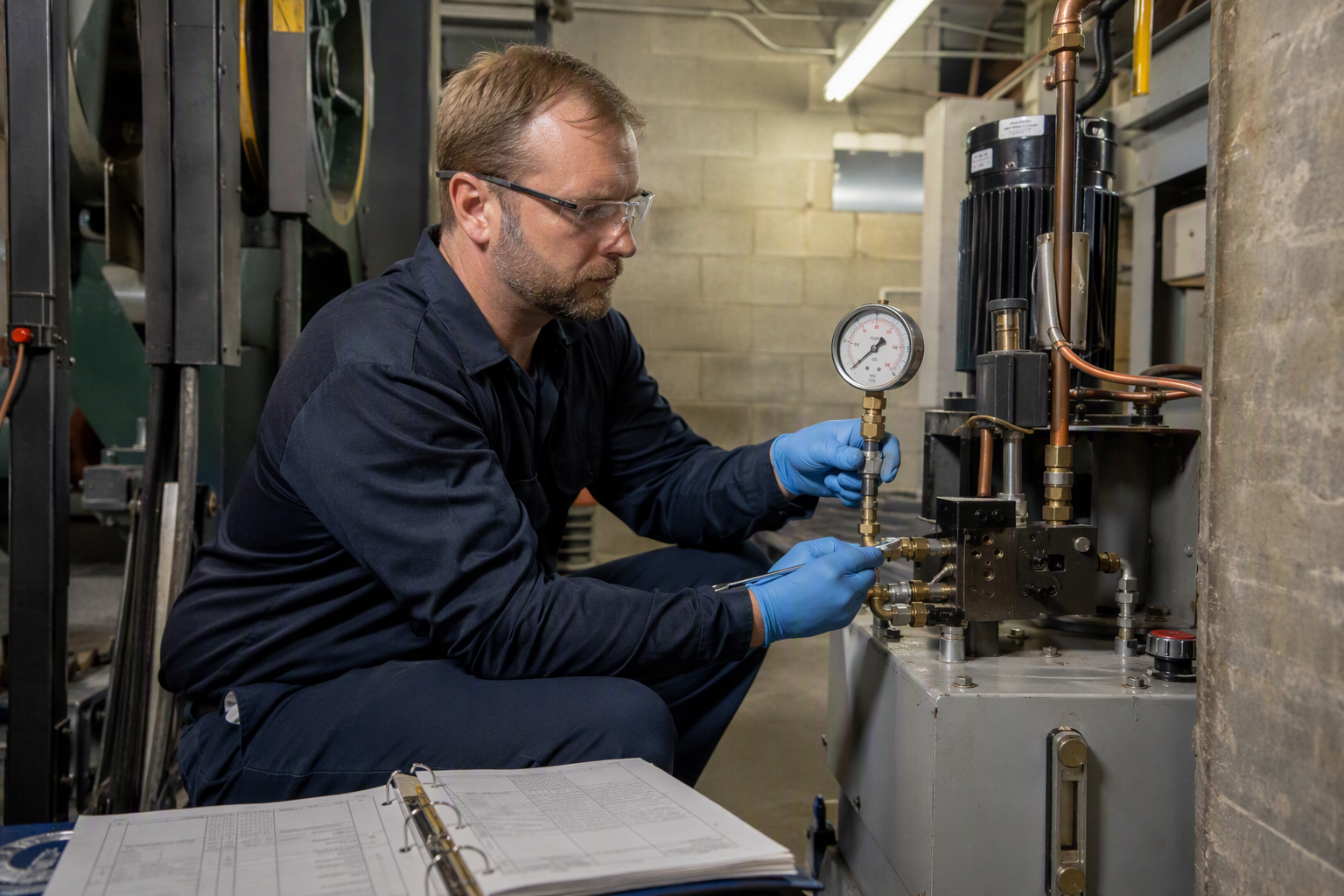
ASME A17.1 is the foundational safety code that all four jurisdictions in Quality Elevator Company’s service area have adopted as the basis for their elevator regulations.
Published by the American Society of Mechanical Engineers, ASME A17.1 defines minimum safety requirements for the design, construction, installation, operation, inspection, testing, maintenance, alteration, and repair of elevators and escalators. The code is updated on a regular cycle, and the 2019 edition (reaffirmed and referenced through 2026) is the version most recently adopted or referenced by the Mid-Atlantic states covered here.
Understanding A17.1 is important for building owners because violations found during an inspection are cited against specific code sections. When an inspector issues a violation, the correction notice will reference the A17.1 paragraph that was not met. A qualified elevator service company will be familiar with these citations and will know exactly what repair or adjustment brings the equipment back into compliance before the follow-up inspection.
What Are the Elevator Inspection Rules in Maryland?
Maryland requires annual inspections of elevators and related conveyances, administered by the Maryland Department of Labor’s Division of Labor and Industry, Elevator Safety Unit.
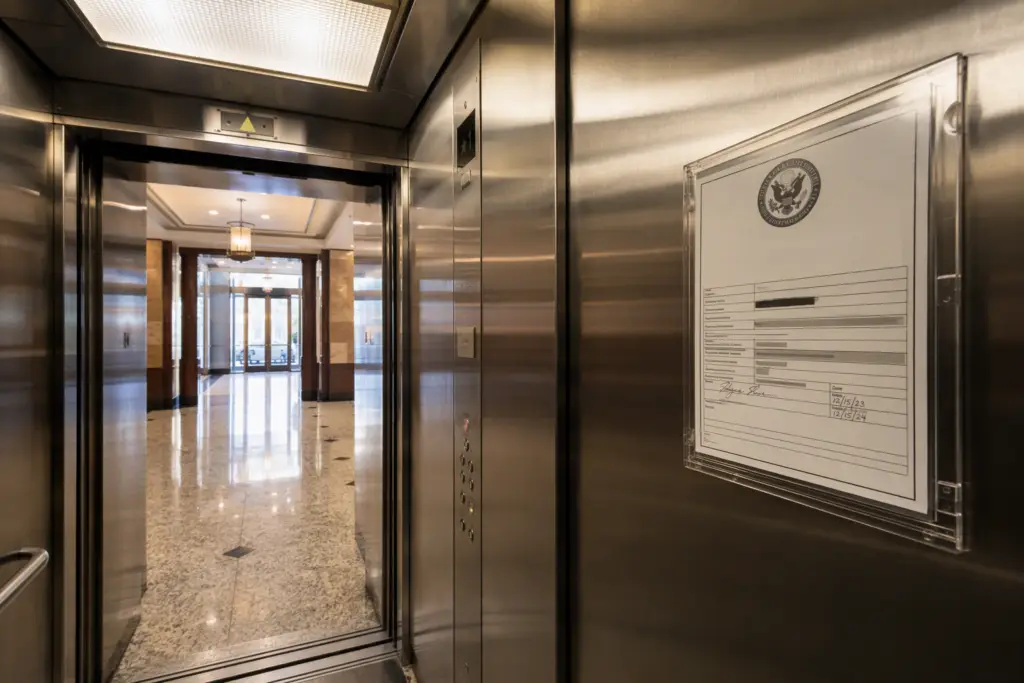
The Maryland Elevator Safety Law (Maryland Code, Labor and Employment Article, Title 12, Subtitle 9) mandates that all elevators, escalators, and related conveyances be inspected at intervals not to exceed twelve months. After passing inspection, the building receives a Certificate of Operation that must be posted in or near the elevator car. Operating an elevator without a valid certificate is a violation subject to civil penalties.
Maryland also requires that all elevator contractors performing work in the state be licensed through the Department of Labor. Inspections may be performed by state inspectors or by licensed third-party inspection agencies — a model that gives building owners some flexibility in scheduling but requires that all reports be submitted to the state. Quality Elevator Company coordinates inspection scheduling and documentation on behalf of building owners throughout the Baltimore metro area, reducing the administrative burden on facilities teams.
What Are the Elevator Inspection Rules in Washington DC?
Washington DC requires annual elevator inspections administered by the DC Department of Buildings, Elevator Inspection Program, with ASME A17.1 as the adopted standard.
In the District of Columbia, elevator owners must obtain an annual operating permit from the DC Department of Buildings. The inspection must be conducted by a DC-licensed elevator inspector, and the current permit must be displayed inside the elevator cab at all times. DC also enforces mandatory periodic testing requirements aligned with ASME A17.1 intervals, including five-year full-load tests for traction elevators.
DC’s dense urban building stock — from historic low-rise commercial buildings to modern high-rise mixed-use towers — presents unique challenges. Older hydraulic systems in particular may require more frequent attention to stay compliant with current code requirements for single-bottom cylinders, leak detection, and fluid containment. Buildings that have not updated hydraulic units installed before certain code dates may face mandatory modernization requirements as part of the inspection process.
What Are the Elevator Inspection Rules in Virginia?
Virginia administers elevator safety through the Virginia Department of Labor and Industry (DOLI), which requires annual inspections under the Virginia Elevator Safety Law and the Virginia Uniform Statewide Building Code.
Virginia’s elevator inspection program covers traction, hydraulic, and special purpose elevators, as well as escalators and moving walks. Annual certificates are required, and the state conducts both routine inspections and follow-up inspections after major repairs or alterations. Virginia has adopted the ASME A17.1 code with state-specific amendments.
Richmond and Northern Virginia building owners should note that Virginia requires elevator contractors to be licensed by DOLI, and inspectors must hold valid Virginia elevator inspector credentials. The periodic test schedule follows ASME A17.1 intervals: annual routine inspections, three-year governor/safety/buffer tests, and five-year full-load tests. Quality Elevator Company serves the Richmond market and helps property managers stay ahead of Virginia’s documentation and certification deadlines.
What Are the Elevator Inspection Rules in Pennsylvania?
Pennsylvania requires annual elevator inspections through the Pennsylvania Department of Labor and Industry, Bureau of Occupational and Industrial Safety, Elevator Division, under the Pennsylvania Elevator and Lifting Device Safety Law.
Pennsylvania’s framework is notably detailed. The state issues a Certificate of Operation following a satisfactory annual inspection and requires that this certificate be prominently displayed inside the elevator cab. Pennsylvania also mandates that elevator owners register each conveyance with the state and pay the associated permit fees. The inspection cycle for standard passenger and freight elevators is annual, with ASME A17.1 periodic test requirements layered on top.
Philadelphia building owners dealing with the city’s historic building stock — including many pre-war hydraulic elevators — should pay particular attention to Pennsylvania’s requirements around hydraulic cylinder testing, single-bottom cylinder phase-out timelines, and pit waterproofing. The Philadelphia market involves both city-level enforcement and state oversight, and navigating dual-layer compliance requires a service contractor familiar with both frameworks.
What Is the Difference Between an Inspection and a Test?
An inspection is a visual and operational review of the elevator system, while a test is a hands-on functional verification of specific safety devices under defined load and speed conditions.
ASME A17.1 distinguishes clearly between inspections and tests. A routine annual inspection involves the inspector verifying physical condition, reviewing maintenance records, checking safety device indicators, and observing normal operation. A periodic test, by contrast, requires the elevator contractor to actually operate a safety device — for example, tripping an overspeed governor to verify that the car safety engages — under controlled conditions with the inspector witnessing the result.
Tests carry a higher cost and logistical complexity than routine inspections because they typically require advance scheduling, may take the elevator out of service for a portion of a business day, and require certified technicians with specific test equipment. Building owners should plan for both routine annual inspections and the more involved periodic tests on the ASME A17.1 schedule.
What Is the ASME A17.1 Periodic Test Schedule?
ASME A17.1 establishes a tiered schedule of periodic tests at one-year, three-year, and five-year intervals, each targeting specific safety devices and systems.
The table below summarizes the principal periodic tests required by ASME A17.1 for common elevator types found in Maryland, DC, Virginia, and Pennsylvania commercial buildings. Individual jurisdictions may apply amendments that modify these intervals.
| Test Type | Elevator Type | ASME A17.1 Interval | What Is Verified |
|---|---|---|---|
| Routine Safety Inspection | All types | Annual (every 12 months) | Visual, operational, maintenance records review |
| Hydraulic Pressure & Relief Test | Hydraulic elevators | Every 5 years | System pressure, relief valve setting, cylinder integrity |
| Full-Load Safety Test | Traction elevators | Every 5 years | Safeties, buffers, overspeed governor under rated load |
| Governor/Safety/Buffer Test | Traction elevators | Every 5 years (some jurisdictions 3 years) | Governor trip speed, safety engagement, buffer return |
| Firefighters’ Emergency Operation (FEO) Test | All elevators with FEO | Annual (as part of routine inspection) | Phase I recall, Phase II operation, door reopening |
| Standby Power Operation Test | Elevators with standby power | Annual | Transfer to standby power, leveling, door operation |
| Seismic Switch Test (where applicable) | Traction and hydraulic | Per local amendment | Seismic switch function and elevator response |
Building owners should work with their elevator service contractor to maintain a master test calendar that tracks when each of these tests is due for every conveyance in the building. Missed periodic tests are a common source of certificate-of-operation violations.
What Happens If an Elevator Fails Inspection?
If an elevator fails inspection, the AHJ typically issues a Notice of Violation and may order the unit taken out of service until the deficiencies are corrected and a re-inspection is completed.
The severity of the response depends on the nature of the violation. A minor deficiency — such as a missing or expired certificate posted in the cab, or a burned-out cab light — will typically generate a correction notice with a defined timeframe for remedy. A major safety deficiency — such as a failed buffer, a malfunctioning door reopening device, or an inoperative firefighters’ emergency operation panel — may result in an immediate out-of-service order.
In Maryland, DC, Virginia, and Pennsylvania, operating an elevator under an out-of-service order exposes building owners to civil penalties and potential liability. The correct procedure after receiving any violation notice is to engage a licensed elevator contractor immediately to assess the deficiency, perform the necessary repair, and request a re-inspection from the AHJ. Quality Elevator Company assists building owners in the Baltimore, Washington DC, Philadelphia, and Richmond markets with rapid violation response and re-inspection coordination.
What Should a Building Owner Do Immediately After Receiving a Violation Notice?
A building owner who receives an elevator violation notice should follow a structured response to protect occupants, avoid penalties, and restore service as quickly as possible.
- Read the notice carefully and identify every cited deficiency, the applicable ASME A17.1 or state code section, and the compliance deadline stated on the notice.
- Determine whether the elevator must be taken out of service immediately — if the notice includes an out-of-service order, post the required out-of-service signage on all cab and lobby doors and lock off the elevator.
- Contact a licensed elevator contractor in the applicable jurisdiction the same business day to schedule a site visit and deficiency assessment.
- Obtain a written scope of work and timeline from the contractor that specifically addresses each cited deficiency by code section.
- Authorize and schedule the repair work, ensuring the contractor pulls any required permits before commencing work.
- Request a re-inspection from the AHJ once the contractor has certified that all deficiencies have been corrected.
- Confirm receipt of an updated Certificate of Operation and post it in the elevator cab before returning the unit to service.
- Update your maintenance records to document the deficiency, the repair performed, and the re-inspection outcome for future reference.
Does ADA Compliance Factor Into Elevator Inspections?
ADA requirements for elevators are a separate obligation from state safety inspections, but non-compliant features may be flagged during inspections and can become a compliance issue during renovations or alterations.
The Americans with Disabilities Act (ADA) requires that elevators in facilities subject to its provisions meet accessibility standards covering cab size, door width and timing, control button height and braille markings, audible and visual floor indicators, and handrail requirements. These requirements are enforced separately from the elevator safety code — typically through building permit review, ADA complaints, or civil litigation — rather than through the ASME A17.1 inspection process.
However, building owners should be aware that an alteration to any part of an elevator system may trigger a requirement to bring the entire cab into current ADA compliance. This “path of travel” obligation means that a routine modernization project can create unexpected ADA scope. A knowledgeable elevator service contractor will flag potential ADA triggers before work begins.
What Is the Difference Between Preventive Maintenance and an Official Inspection?
Preventive maintenance is an ongoing service performed by the elevator contractor to keep equipment running safely and reliably, while an official inspection is a regulatory compliance event performed or witnessed by a government-authorized inspector.
Preventive maintenance typically involves monthly or quarterly visits by a licensed elevator mechanic who lubricates components, adjusts brake and door settings, tests safety circuits, and identifies wear items before they cause failures or violations. This ongoing maintenance is separate from — and does not replace — the annual regulatory inspection.
Buildings with consistent, well-documented preventive maintenance programs routinely pass annual inspections with fewer deficiencies than buildings where maintenance is deferred. State inspectors in Maryland, DC, Virginia, and Pennsylvania are authorized to review maintenance logs as part of the inspection process. Gaps in the maintenance record can themselves constitute a violation.
Who Is Qualified to Inspect an Elevator?
Elevator inspectors must hold a valid license or certification recognized by the AHJ in the state or jurisdiction where the inspection takes place.
In Maryland, DC, Virginia, and Pennsylvania, elevator inspectors must meet specific credentialing requirements set by each jurisdiction’s licensing authority. Many inspectors hold certification from the Quality Assurance Bureau (QAB) of the National Elevator Industry or from ASME’s Qualified Elevator Inspector (QEI) certification program — credentials that are widely recognized by state AHJs. Some jurisdictions allow inspections only by state-employed inspectors; others permit licensed third-party inspection agencies to perform routine inspections subject to state oversight.
Building owners should verify that any inspector conducting an official inspection holds current credentials recognized by the applicable AHJ. Inspection reports signed by an unqualified inspector will not be accepted for certificate-of-operation issuance.
How Does an Elevator Permit Work and Do I Need One?
Elevator permits are required in all four jurisdictions covered here — both for initial installation and for alterations — and are separate from the annual certificate of operation.
Permits are issued by the state or local AHJ before work begins on installation, alteration, or major repair. The permit process typically requires submission of engineering drawings, equipment specifications, and contractor license information. Work performed without a permit is a violation and may require the unauthorized work to be inspected — or in some cases demolished and redone — before a certificate of operation can be issued or renewed.
Annual inspections and certificates of operation are also governed by fees established by each jurisdiction. These fees vary and are subject to change; building owners should consult the current fee schedule of the applicable state or DC agency to budget accurately.
What Are the Consequences of Operating an Elevator Without a Valid Certificate?
Operating an elevator without a valid Certificate of Operation is a violation in all four jurisdictions and can result in civil penalties, mandatory shutdown, and liability exposure for the building owner.
Each jurisdiction sets its own penalty structure. In general, operating a non-certified elevator exposes the building owner to recurring daily civil penalties for each day of continued non-compliance. In the event of an occupant injury on a non-certified elevator, the absence of a current certificate can be used as evidence of negligence in civil litigation. Beyond the financial exposure, building owners have an ethical obligation to ensure that occupants and visitors are using equipment that has been formally verified as safe.
Certificates typically expire twelve months after issuance. Building owners who manage multiple conveyances in multiple states — a common scenario for property management companies operating across the Quality Elevator Company service area — should maintain a centralized compliance calendar to prevent accidental lapses.
How Long Does an Elevator Inspection Take?
A routine annual elevator inspection typically takes between one and three hours depending on the type and complexity of the equipment, the number of floors served, and the completeness of maintenance records.
A straightforward hydraulic elevator in a three-story commercial building will generally require less inspection time than a high-speed traction elevator with a machine room, multiple access points, and firefighters’ emergency operation. Periodic tests — particularly five-year full-load tests on traction elevators — can require several hours and may necessitate taking the elevator out of service for a portion of the test day. Building management should notify occupants in advance and make provisions for stair access during any out-of-service period.
Having a complete, current maintenance log ready for the inspector at the start of the inspection can meaningfully reduce inspection time and the likelihood of records-related violations.
What Types of Elevators and Conveyances Are Subject to These Inspection Requirements?
Inspection requirements extend beyond passenger elevators to include freight elevators, escalators, moving walks, dumbwaiters, platform lifts, stairway chairlifts, and material lifts, all governed by ASME A17.1 and applicable state amendments.
Building owners sometimes overlook non-passenger conveyances — particularly platform lifts serving ADA-required accessible routes, dumbwaiters in food service facilities, and freight elevators in loading dock areas. All of these conveyances require valid certificates in Maryland, DC, Virginia, and Pennsylvania. A comprehensive compliance program should account for every conveyance in the building, not just the primary passenger elevators.
Residential elevators in private single-family homes are generally exempt from commercial inspection requirements, though they remain subject to installation code requirements. Elevators in multi-family residential buildings — including apartment complexes and condominiums — are subject to full commercial inspection requirements in all four jurisdictions.
How Can Building Owners Keep Track of Inspection and Test Deadlines?
Building owners can manage inspection and test deadlines through a documented compliance calendar maintained in coordination with their elevator service contractor.
For single-building owners, a simple spreadsheet tracking the Certificate of Operation expiration date and each ASME A17.1 periodic test due date for every conveyance is sufficient. For property management companies overseeing multiple buildings and multiple jurisdictions, a more systematic approach — such as a facilities management platform that integrates with the elevator contractor’s service records — reduces the risk of missed deadlines.
Quality Elevator Company provides compliance tracking support for building owners and property managers across Baltimore, Washington DC, Philadelphia, and Richmond, helping to ensure that annual inspections and periodic tests are scheduled and completed before deadlines. This kind of proactive coordination is particularly valuable for owners whose portfolios span multiple states with differing regulatory calendars.
What Questions Should I Ask When Hiring an Elevator Inspection or Service Company?
Building owners should evaluate elevator service companies on licensing, jurisdictional experience, documentation practices, and responsiveness to violation notices before signing any service agreement.
Key questions to ask any elevator service contractor include: Is your company licensed to perform elevator work in this specific state or jurisdiction? Are your mechanics licensed in this jurisdiction? Can you provide references from similar buildings in this market? How do you document maintenance visits and communicate with the AHJ? What is your process when a unit receives a violation notice or out-of-service order?
Contractors who work across multiple jurisdictions — as Quality Elevator Company does in Maryland, DC, Virginia, and Pennsylvania — must maintain current licensure and keep their mechanics certified in each state where they operate. This multi-state competency is especially valuable for property management companies whose portfolios span the Mid-Atlantic region.
What Role Does OSHA Play in Elevator Safety?
OSHA governs elevator safety primarily in the context of worker safety during construction, maintenance, and repair operations, rather than regulating the routine operation of passenger elevators for building occupants.
OSHA standards address the safety of workers who install, maintain, and repair elevators — including requirements for lockout/tagout procedures, fall protection in elevator pits and hoistways, and the use of personal protective equipment. Building owners are responsible for ensuring that any contractor performing elevator work on their premises follows applicable OSHA standards. This obligation extends to verifying that the contractor’s mechanics are properly trained and that safe work practices are followed during every service visit.
OSHA’s role is distinct from the state AHJ’s role in issuing certificates of operation. A building can be in compliance with its state elevator inspection certificate and still face OSHA liability if a worker is injured due to unsafe maintenance practices.
How Can I Prepare My Building for an Elevator Inspection?
Preparing for an elevator inspection involves ensuring access, organizing documentation, verifying basic operational items, and coordinating with the licensed elevator contractor in advance.
The following preparation steps help inspections proceed efficiently and reduce the likelihood of avoidable violations:
- Confirm the inspection date and time with both the AHJ or inspection agency and the elevator contractor, ensuring a qualified mechanic will be present to operate equipment during the inspection.
- Ensure unrestricted access to the machine room, pit, and all elevator lobbies at every floor the elevator serves.
- Assemble all maintenance logs for the period since the last inspection and have them available for the inspector’s review.
- Verify that the current (or most recently issued) Certificate of Operation is posted in the elevator cab.
- Confirm that cab lighting, emergency lighting, and the emergency communication device are functioning — these are among the most commonly cited minor deficiencies.
- Check that firefighters’ emergency operation (Phase I and Phase II) panels are intact and undamaged — vandalism to FEO panels is a common issue in high-traffic urban buildings.
- Notify building occupants of the inspection date and expected duration so they can plan for potential brief out-of-service periods during test sequences.
- Address any known deficiencies identified during routine maintenance visits before the inspection date so they do not appear on the inspection report.
Get Expert Elevator Compliance Help Across Maryland, DC, Virginia & Pennsylvania
Keeping elevators inspection-ready across multiple jurisdictions is a demanding compliance challenge. Quality Elevator Company provides licensed elevator service, inspection coordination, violation response, and compliance tracking for building owners and property managers throughout Baltimore MD, Washington DC, Philadelphia PA, and Richmond VA.
Whether a building has a single hydraulic elevator or a portfolio of traction and specialty conveyances across multiple states, the Quality Elevator Company team helps ensure every unit holds a current certificate of operation and meets all ASME A17.1 periodic test requirements on schedule.
Contact Quality Elevator Company for a free elevator assessment: 301-779-9116
Need elevator service you can rely on? Quality Elevator Company is ready to help.