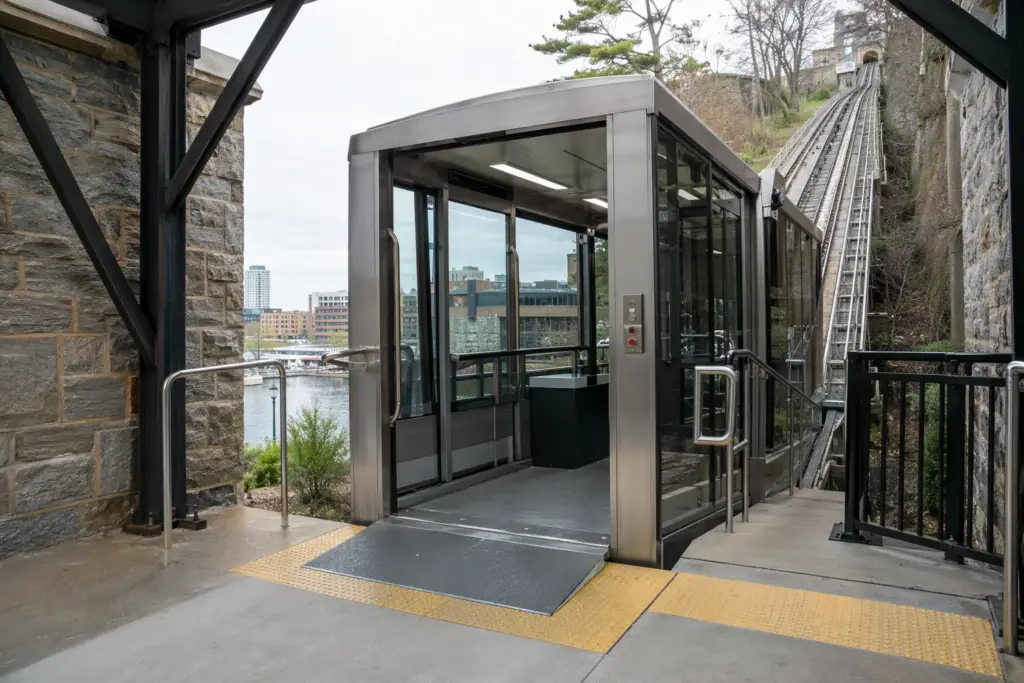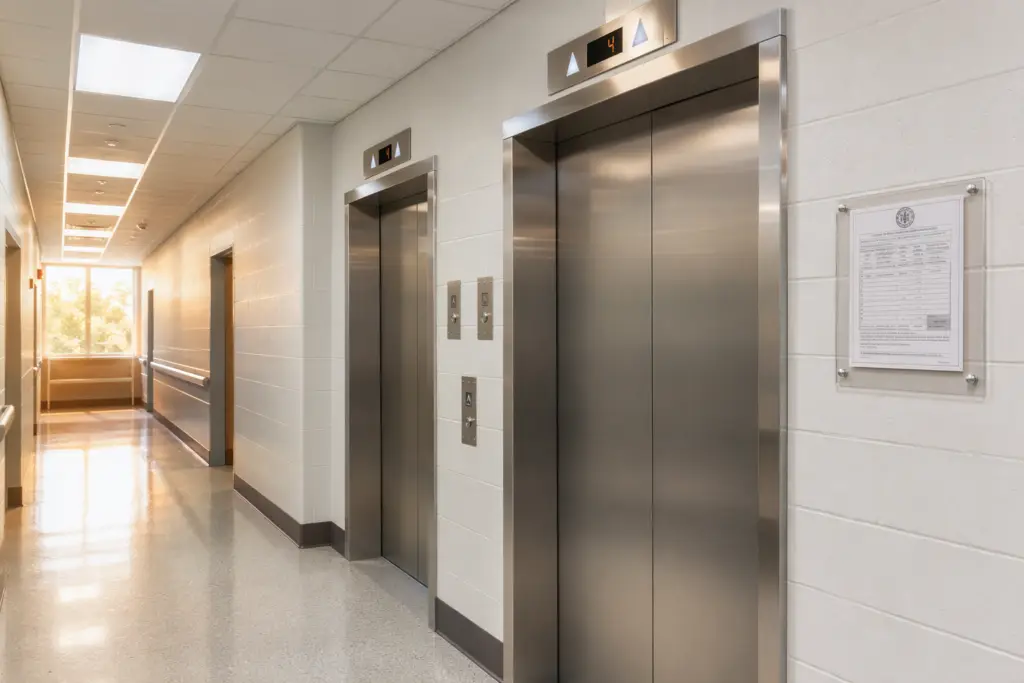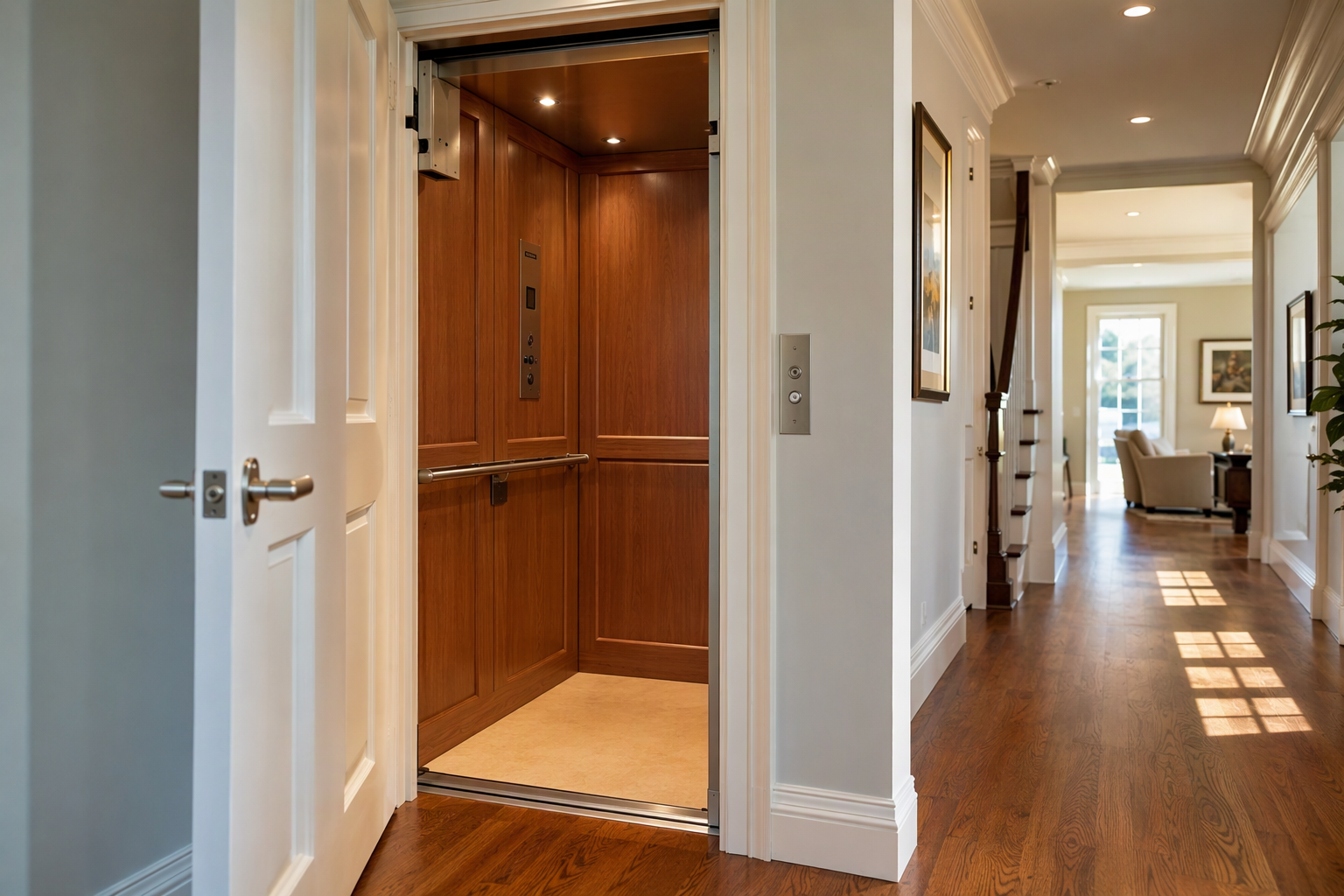
Yes. Quality Elevator Company inspects residential elevators, home lifts, and wheelchair lifts installed in private homes across the Baltimore MD, Washington DC, Philadelphia PA, and Richmond VA service area. Residential elevator inspection involves a different regulatory framework than commercial inspections — in some jurisdictions the state or local authority exempts single-family homes from mandatory certification, while in others the same annual inspection cycle applies. Either way, a periodic professional inspection is the most reliable way to keep a home elevator safe and code-compliant.
What types of residential elevator equipment does Quality Elevator Company inspect?
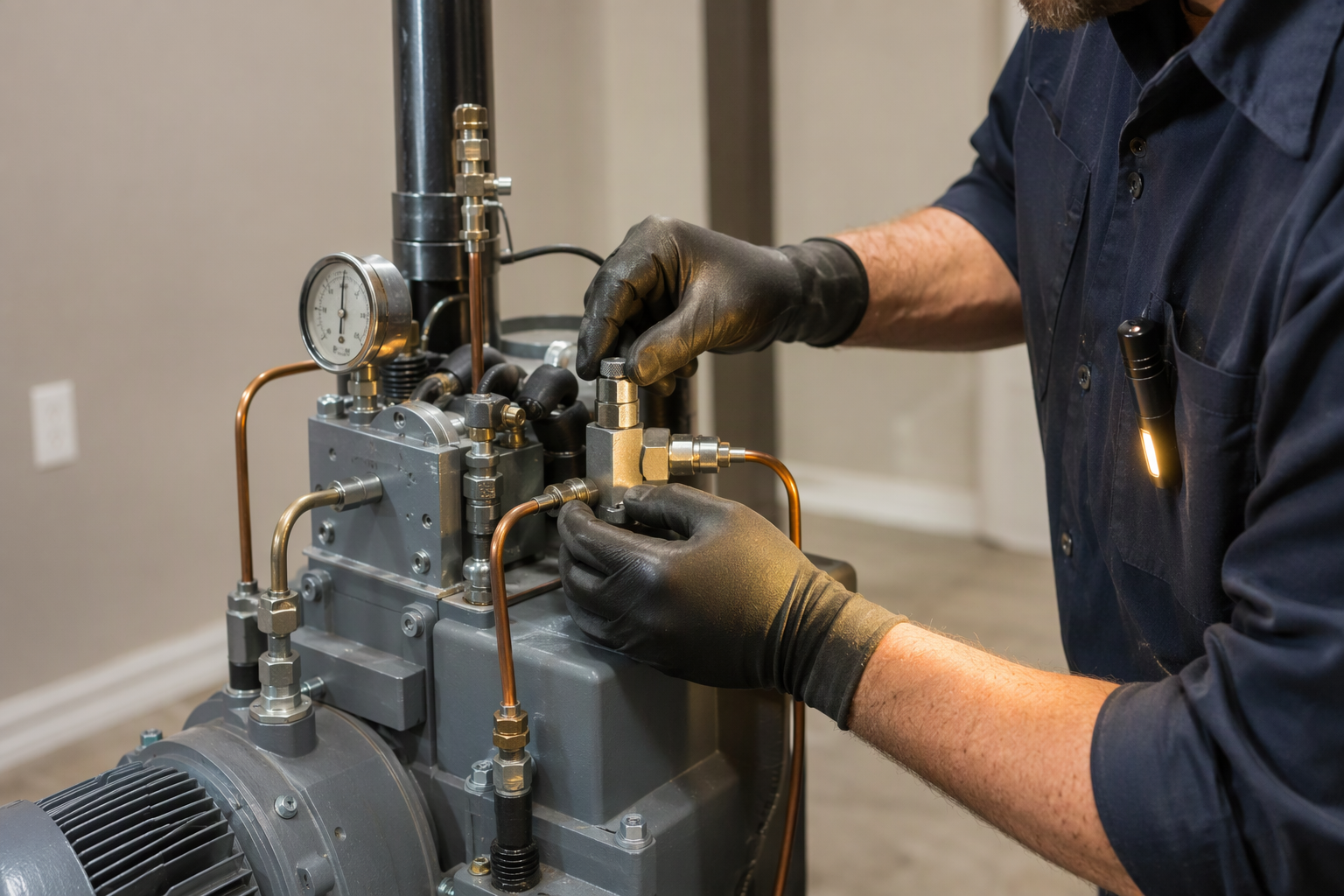
Quality Elevator Company inspects any powered vertical conveyance installed in a private home, including traditional traction and hydraulic home elevators, pneumatic (vacuum-driven) elevators, platform wheelchair lifts, inclined stairlifts, and limited-use/limited-application (LU/LA) elevators.
Each equipment type carries its own inspection protocol under the ASME A17.1/CSA B44 Safety Code for Elevators and Escalators. Hydraulic home elevators, for example, require oil-line integrity checks and pressure-relief valve testing that do not apply to traction units. Pneumatic elevators require seal and vacuum-chamber inspections. Platform lifts reference ASME A18.1, the Safety Standard for Platform Lifts and Stairway Chairlifts, in addition to A17.1. A thorough inspection addresses every category relevant to the specific equipment in the home.
Are residential home elevators legally required to be inspected?
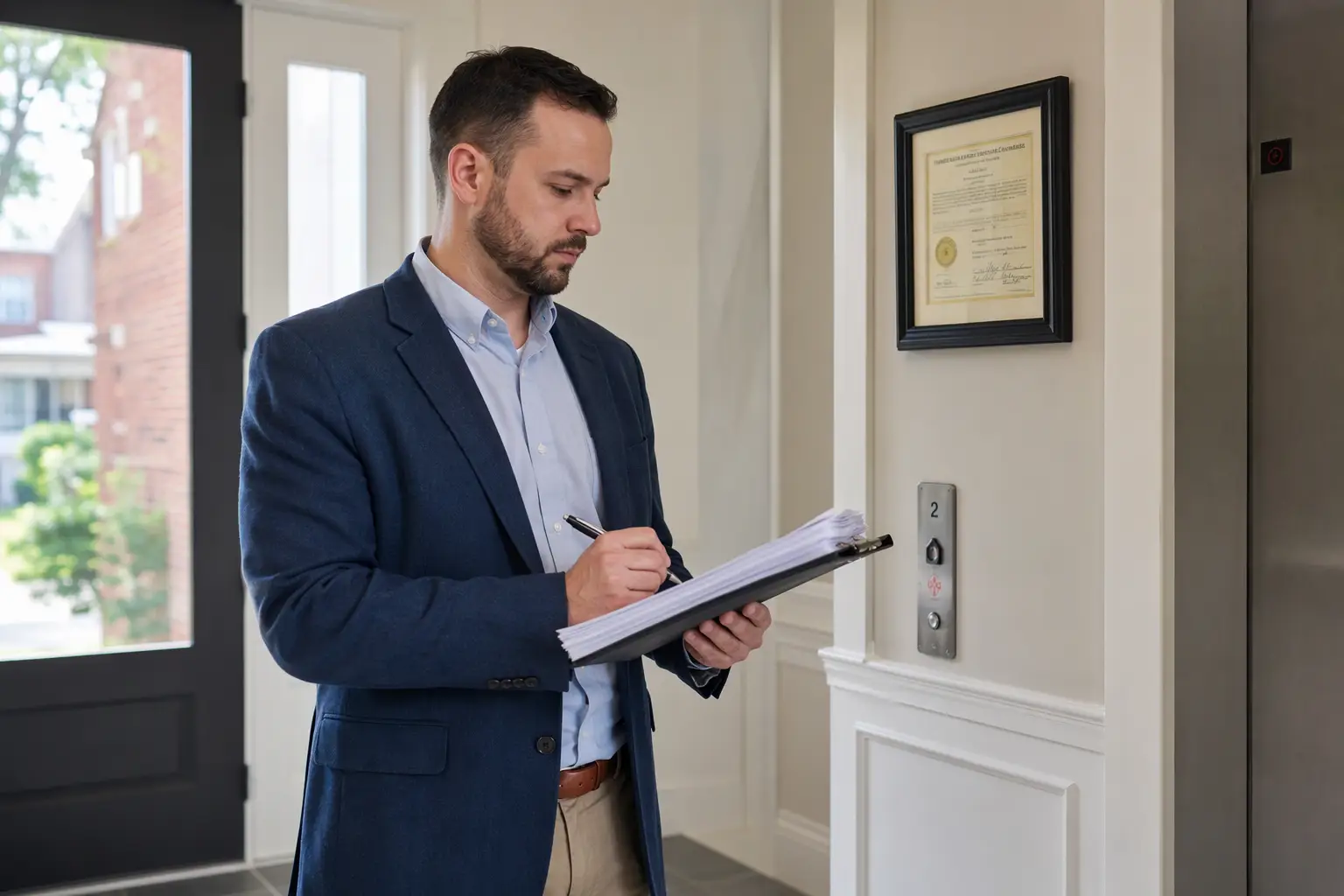
The legal obligation varies by jurisdiction and, in some markets, by the type of residential structure — single-family homes are explicitly exempt from mandatory state inspection in Maryland and Pennsylvania, while Virginia and DC apply broader rules that may still reach certain residential settings.
The table below summarizes what each jurisdiction requires as of 2026:
| Jurisdiction | Regulator | Mandatory Inspection for Single-Family Homes? | Adopted ASME Edition | Inspection Interval (Residential Where Applicable) |
|---|---|---|---|---|
| Maryland | Maryland Department of Labor, Division of Labor and Industry | No — the inspection and certificate law generally does not apply to units in privately owned single-family homes | ASME A17.1-2022/CSA B44:22 (effective June 17, 2026) | Not mandated for single-family homes; annual inspection strongly recommended |
| Pennsylvania | Pennsylvania Department of Labor and Industry | No — UCC elevator rules do not apply to lifting devices used only by occupants of a single dwelling unit | ASME A17.1-2000/A17.1a-2002 (new permit applications from Dec 20, 2026 use A17.1-2016) | Not mandated for single-family homes; periodic inspection recommended |
| Virginia | Local building department under 13VAC5-63, Virginia Uniform Statewide Building Code | Exempt — the Virginia USBC exempts elevators in single-family homes, two-family homes, and townhouses from local inspection jurisdiction | ASME A17.1/CSA B44-2019 (effective January 18, 2024) | Not mandated for covered residential types; annual voluntary inspection recommended |
| District of Columbia | DC Department of Buildings (DOB) | Yes — all elevators and escalators in the District must be inspected and certified; no blanket single-family exemption exists under DC’s rules | ASME A17.1-2013/CSA B44-13 (2017 DC Building Code, effective May 29, 2020) | Category 1 inspection every 12 months; Category 5 inspection every 60 months; certificate valid for two years |
Even where a mandatory inspection law does not apply, an uninspected home elevator poses real safety risk to family members, caregivers, and visitors. Homeowners’ insurance carriers and home-sale inspectors increasingly flag elevators that lack documented service records.
What does a residential elevator inspection cover?
A residential elevator inspection examines the mechanical, electrical, and structural components that determine whether the unit can operate safely under load.
A comprehensive inspection addresses the following areas:
- Car and door safety devices: Inspection of door interlocks, car-gate contacts, and door re-opening devices to confirm they prevent movement unless doors are fully closed and latched.
- Drive system: Review of the motor, controller, and drive mechanism — hydraulic pump and cylinder integrity on hydraulic units, sheave and rope condition on traction units, or vacuum seal and tube condition on pneumatic units.
- Safeties and buffers: Testing of overspeed governors, car safeties, and pit buffers to verify they will arrest an uncontrolled descent.
- Leveling and landing accuracy: Confirmation that the car stops within acceptable tolerance at each landing to prevent tripping hazards.
- Lighting and ventilation: Verification that car lighting, pit lighting, and machine-space ventilation meet code minimums.
- Emergency features: Testing of the emergency stop switch, alarm, and manual lowering device so occupants can be safely retrieved during a power failure.
- Structural elements: Visual inspection of the hoistway, guide rails, brackets, and sill supports for corrosion, wear, or structural movement.
- Hydraulic systems (where applicable): Check of oil lines, fittings, and the pressure-relief valve; inspection for leaks that could become a fire or environmental hazard.
- Load test documentation: Review of any available prior load-test records and, where warranted, performance of a no-load or partial-load operational test.
- Code compliance review: Comparison of the unit’s current condition against the edition of ASME A17.1 that governed its original permit, and identification of any items that have drifted out of compliance.
How often should a residential elevator be inspected?
Even where state law does not mandate annual inspections for single-family home elevators, the ASME A17.1 Safety Code for Elevators and Escalators and the manufacturers of residential elevator equipment typically recommend at minimum an annual maintenance-and-inspection visit.
More frequent inspection may be warranted when a home elevator serves elderly or mobility-impaired users who depend on the unit daily, when the home has experienced flooding, structural settlement, or seismic activity, when the equipment is more than ten years old and has not undergone modernization, or when any unusual noise, vibration, leveling error, or door hesitation has been observed. Quality Elevator Company can help homeowners develop an inspection schedule matched to the age and usage pattern of their specific equipment.
Does DC’s mandatory inspection law apply to elevators in private residences?
DC’s inspection and certification requirement applies broadly to all elevators and escalators in the District, and DC’s rules do not carry a blanket exemption for single-family homes the way Maryland and Pennsylvania do.
Under DC Department of Buildings (DOB) requirements and 12-A DCMR Chapter 30, all elevators in DC must be inspected and certified for operation using a DOB-approved third-party elevator inspection agency. Periodic and Category 1 inspections must occur every 12 months, and a Category 5 inspection must occur every 60 months. Each inspection must be conducted by an ASME QEI-certified inspector. A DC certificate of inspection is valid for two years, and a copy of the current certificate must be conspicuously displayed in the elevator car. Homeowners in Washington DC with a private elevator should treat their unit as subject to this framework unless they receive written guidance to the contrary from DOB.
Does Maryland’s inspection law apply to private home elevators?
Maryland’s elevator inspection and certificate law generally does not apply to units in privately owned single-family homes, so a mandatory state inspection certificate is not required for a standard residential home elevator.
The exemption is established under the Maryland Department of Labor, Division of Labor and Industry framework governed by Public Safety Article, Title 12, Subtitle 8 of the Annotated Code of Maryland. However, the exemption does not mean an uninspected home elevator is safe or that a homeowner has no legal exposure if the elevator injures someone. A voluntary annual inspection conducted by a licensed contractor — one licensed by the Maryland Elevator Safety Review Board — provides documentation that the owner exercised reasonable care. All maintenance, repair, and testing on Maryland elevator units must be performed by a person licensed as an elevator mechanic by the Maryland Elevator Safety Review Board.
Does Pennsylvania’s inspection law apply to elevators in private homes?
Pennsylvania’s elevator rules under 34 Pa. Code Chapter 405 do not apply to lifting devices used only by the occupants of a single dwelling unit, so a single-family home elevator is exempt from the state’s mandatory certificate-of-operation requirement.
This exemption is administered by the Pennsylvania Department of Labor and Industry. For homeowners in Philadelphia, it is worth noting that elevator inspection and certification in Philadelphia falls under the Pennsylvania Department of Labor and Industry statewide program — not Philadelphia’s own Department of Licenses and Inspections. Despite the statutory exemption, Pennsylvania’s adopted code standard, currently ASME A17.1-2000 with A17.1a-2002 addenda for existing permits and ASME A17.1-2016 for new permit applications submitted on or after December 20, 2026, provides the technical benchmark that any responsible inspection should reference.
Does Virginia’s inspection law apply to home elevators?
Virginia’s local-authority inspection jurisdiction does not extend to elevators in single-family homes, two-family homes, or townhouses, making those units exempt from mandatory periodic inspection by the local building department.
Virginia’s elevator inspection framework is established under 13VAC5-63, the Virginia Uniform Statewide Building Code, which took effect in its current 2021 edition on January 18, 2024 and references ASME A17.1/CSA B44-2019. The local building department — for example, the City of Richmond Department of Planning and Development Review, Bureau of Permits and Inspections — enforces the code for commercial and multi-family buildings but not for the exempt residential categories listed above. For residential townhouse or multi-family structures that fall outside those exemptions, the local authority’s annual periodic inspection requirement applies. In all cases, any person performing maintenance or repair on a Virginia elevator must be certified as an elevator mechanic by the Virginia Board for Contractors, and any contractor installing, repairing, or removing elevator equipment must hold an Elevator/Escalator Contracting (EEC) specialty license.
What is an ASME A17.1 Category 1 versus Category 5 test, and do they apply to home elevators?
Under the ASME A17.1 Safety Code for Elevators and Escalators, Category tests are defined levels of periodic examination and testing that escalate in scope and frequency based on equipment risk.
A Category 1 test is a no-load safety test performed annually; it verifies that the safety devices, governors, and brakes function correctly without requiring the car to be dropped into free fall. A Category 5 test — sometimes called a full-load safety test — requires application of the rated load and, for traction elevators, an actual governor trip and safety application. Category 5 tests are required every five years for most elevator types. In DC, where residential elevators are not exempt, both the Category 1 annual test and the Category 5 five-year test apply. In Maryland, Pennsylvania, and Virginia, single-family home elevators are typically exempt from mandated Category testing, but those test protocols remain the industry benchmark for a thorough voluntary inspection. Quality Elevator Company technicians follow these protocols regardless of whether a jurisdiction mandates them.
What happens if a residential elevator fails an inspection?
When an inspection identifies a deficiency, the appropriate response depends on its severity — some findings allow continued supervised operation while repairs are scheduled, while others require the unit to be taken out of service immediately.
If a home elevator fails inspection, the recommended course of action is:
- Receive the written inspection report: The inspector should provide a written finding specifying each deficiency, its code reference, and its risk classification.
- Classify the deficiency: Determine whether the finding is an immediate hazard (the unit must be shut down) or a non-immediate deficiency (a repair can be scheduled while the unit continues to operate under monitoring).
- Take the unit out of service if required: If the inspector identifies a hazard to occupants, the unit should be locked out and physically prevented from operation until repairs are complete.
- Engage a licensed elevator contractor for repairs: In Maryland, all repairs must be performed by a licensed elevator mechanic. In Virginia, all repair work requires a certified mechanic and a licensed EEC contractor. In DC, the contractor must hold a DC elevator contracting license issued by the DC Board of Industrial Trades.
- Obtain any required permits: In DC, taking an elevator out of service requires a DOB permit under ASME A17.1 Section 8.11.1.4. In Pennsylvania, major repairs, replacements, or alterations require a permit from the Department of Labor and Industry, and the unit may not return to service until the department inspects and passes it.
- Schedule a re-inspection: After repairs are completed, schedule a follow-up inspection to confirm all deficiencies have been corrected before returning the unit to regular use.
- Update documentation: Ensure maintenance records, repair invoices, and re-inspection reports are retained at an accessible location in the home — a practice consistent with Maryland’s requirement that records be kept at a readily accessible central location in the building.
Does the ADA require home elevators?
The Americans with Disabilities Act (ADA) generally does not apply to private residences — it governs places of public accommodation, commercial facilities, and state and local government facilities.
A single-family home is not a public accommodation under the ADA, so a homeowner does not have a federal obligation under the ADA to install or maintain a residential elevator. The Fair Housing Act, administered separately, requires accessibility features in certain newly constructed multi-family buildings with four or more units, but that law’s reach does not extend to detached single-family homes. Despite the lack of a federal mandate, many homeowners install residential elevators proactively for aging-in-place purposes or to accommodate a family member with a mobility impairment. When a home is also used as an Airbnb or short-term rental, ADA applicability may change — an attorney familiar with hospitality law should be consulted.
How is a home elevator inspection different from a commercial elevator inspection?
The core safety principles are the same, but residential inspections differ in regulatory oversight, documentation requirements, equipment scale, and inspection frequency compared to commercial elevator inspections.
Commercial elevators in Maryland, DC, Virginia, and Pennsylvania are subject to mandatory annual or semi-annual inspections, state-issued or locally issued certificates of operation displayed in the car, and mandatory witnessing of tests by a certified inspector. Residential home elevators in Maryland, Pennsylvania, and Virginia (single-family structures) operate outside those mandatory frameworks, so the inspection is voluntary and driven by the homeowner’s safety diligence rather than a regulatory deadline. Equipment differences are also significant: residential elevators typically carry lower rated loads, travel shorter travel distances, run at lower speeds, and use simpler controller technology than commercial units, which affects the specific tests performed. Quality Elevator Company applies commercial-grade inspection rigor to every residential unit it services.
What records should a homeowner keep after a residential elevator inspection?
A homeowner should retain a written inspection report, any test data sheets, a record of all repairs or adjustments made, and invoices documenting the work and the credentials of the contractor who performed it.
Good recordkeeping serves multiple purposes: it demonstrates due diligence to an insurer or home-sale buyer, it helps the next technician understand the unit’s service history, and it provides evidence that the homeowner acted responsibly if an injury claim ever arises. In Maryland, the law requires that maintenance, repair, test, and inspection records for regulated elevators be kept at a readily accessible central location in the building. Even though single-family homes are exempt from that statutory requirement, following the same practice is prudent. Records should include the inspector’s name, the date of inspection, the ASME standard edition used as the reference, every finding, every corrective action taken, and the parts replaced.
Does a home elevator need to be inspected before selling a house?
There is no universal statutory requirement in Maryland, Pennsylvania, or Virginia that a home elevator be certified before a residential real estate transaction closes, but buyers’ home inspectors and lenders increasingly flag uncertified or unserviced elevators as a material condition issue.
A pre-sale inspection by a qualified elevator contractor accomplishes several objectives: it identifies any safety deficiencies that the seller may be legally obligated to disclose, it provides the buyer with confidence that the equipment is safe, and it eliminates the possibility of a last-minute repair demand derailing the closing timeline. In DC, where residential elevators without a blanket exemption must carry a valid DOB certificate of inspection, an expired or missing certificate should be resolved before listing the property. Quality Elevator Company can conduct a pre-sale residential elevator inspection and provide written documentation suitable for real estate disclosure packages.
What should a homeowner do if their home elevator has not been serviced in several years?
A homeowner whose elevator has not been professionally serviced for an extended period should treat the unit as potentially unsafe and arrange a comprehensive inspection before resuming regular operation.
The recommended steps are:
- Restrict use immediately: Limit or stop use of the elevator until a qualified inspector has cleared it, particularly if the unit will carry elderly, young, or mobility-impaired family members.
- Gather all available records: Locate the original installation permit, any prior inspection reports, and any manufacturer documentation — this information helps the inspector understand what edition of ASME A17.1 applies to the original installation.
- Contact a licensed elevator contractor: In Maryland, the contractor must be licensed by the Maryland Elevator Safety Review Board. In Virginia, the contractor must hold an EEC specialty license through the Virginia Board for Contractors. In DC, the contractor must hold a DC elevator contracting license.
- Schedule a comprehensive inspection: Request an inspection that covers all ten areas listed earlier in this guide, not merely a quick operational check.
- Address all findings before resuming normal use: Even findings classified as non-immediate deficiencies should be corrected promptly on a unit that has gone years without service.
- Establish a recurring maintenance schedule: After the initial catch-up inspection, establish an annual or more frequent service agreement to prevent another extended lapse.
Can a home elevator be inspected as part of a new home purchase or construction?
Yes — an inspection at the point of purchase or at the completion of new construction is one of the most effective times to establish a baseline condition record and confirm the elevator was installed in compliance with the applicable edition of ASME A17.1.
For new construction in Maryland, the state conducts a final acceptance inspection after an elevator unit is installed and before it is placed in service. In Pennsylvania, the Department of Labor and Industry conducts an acceptance inspection before a new elevator is put into service, and the unit may not be used until it passes. In Virginia, the local building department performs a final inspection for new elevator installations before occupancy. In DC, the DOB-approved third-party inspection agency conducts the required inspections and submits reports through the Citizen Access Portal. For a home purchase where the elevator was installed under a prior owner, a third-party inspection by Quality Elevator Company gives the buyer an independent condition assessment independent of what any seller disclosure may state.
What elevator codes apply to home elevator installations in the Quality Elevator Company service area?
Every residential elevator installation in the Quality Elevator Company service area must comply with the edition of the ASME A17.1/CSA B44 Safety Code for Elevators and Escalators that was in effect when the installation permit was issued, as adopted by the governing jurisdiction.
As of 2026: DC has adopted ASME A17.1-2013/CSA B44-13 as referenced by the 2017 DC Building Code (effective May 29, 2020), with DOB plans to update to codes based on 2024 model codes by the end of 2027. Maryland has adopted ASME A17.1-2022/CSA B44:22 effective June 17, 2026, with the applicable edition determined by the date the installation contract was signed. Pennsylvania applies ASME A17.1-2000 with A17.1a-2002 addenda to existing permits, and ASME A17.1-2016 with Pennsylvania modifications will apply to new permit applications submitted on or after December 20, 2026. Virginia’s 2021 Uniform Statewide Building Code, effective January 18, 2024, references ASME A17.1/CSA B44-2019. The edition applied to an existing home elevator typically depends on when its original permit was issued — the requirements in effect at first certification generally remain in effect for that elevator.
How can a homeowner verify that an elevator inspector is qualified?
A homeowner should confirm that the inspector and the performing contractor hold the credentials required by the jurisdiction where the home is located.
In DC, inspections must be conducted by an ASME QEI-certified inspector from a DOB-approved third-party agency, and the elevator contractor must hold a license from the DC Board of Industrial Trades. In Maryland, tests must be performed by a licensed elevator mechanic and witnessed by a qualified elevator inspector; both licenses are issued by the Maryland Elevator Safety Review Board within the Maryland Department of Labor. In Pennsylvania, inspections must be conducted by a UCC-certified elevator inspector, and third-party agencies must be certified by the Department of Labor and Industry. In Virginia, the local code official oversees inspections; any elevator mechanic performing work must be certified by the Virginia Board for Contractors, and contractors must hold an EEC specialty license. Homeowners should ask for license numbers and verify them directly with the relevant licensing authority before authorizing work.
What should homeowners expect during a Quality Elevator Company residential inspection visit?
During a Quality Elevator Company residential inspection, a technician will conduct a systematic review of all accessible components of the elevator system, perform operational tests, and prepare a written report documenting findings and any recommended corrective actions.
The visit typically begins with a review of any existing records the homeowner can provide, followed by a machine-room or drive-mechanism examination, a pit inspection, a hoistway and car examination, and a series of operational tests at each landing. The homeowner or a designated representative should be available to access all parts of the home where elevator equipment is located, including the machine space, pit access panel, and all landings. Following the inspection, Quality Elevator Company provides a written report that includes each inspected component, its condition, any code reference applicable to a deficiency, and the recommended corrective action. This documentation can be retained in the homeowner’s permanent records and shared with real estate agents, insurers, or future contractors as needed.
Contact Quality Elevator Company for a free elevator assessment at 301-779-9116.
Need elevator service you can rely on? Quality Elevator Company is ready to help.