ADA Elevator Requirements for Multifamily Buildings: Compliance Data and Code Guide
ADA elevator requirements in multifamily housing sit at the intersection of federal civil rights law, federal fair housing standards, and state-adopted building codes. Property owners, developers, and property managers in the District of Columbia, Maryland, Pennsylvania, and Virginia must navigate all three layers simultaneously. Getting any layer wrong exposes a building to federal enforcement action, costly retrofits, and potential litigation. This guide synthesizes what federal law demands, how state codes in the Quality Elevator Company service region implement those demands, and what property stakeholders should track heading into 2025 and 2026.
What Federal Law Governs ADA Elevator Requirements for Multifamily Housing?
Two federal statutes control accessibility in multifamily residential construction, and they overlap in ways that frequently cause confusion.
The Americans with Disabilities Act applies primarily to places of public accommodation and commercial facilities. Pure residential dwelling units generally fall outside Title III of the ADA. However, the common areas of a multifamily building — the lobby, corridors, leasing office, fitness center, parking structure, and the elevator itself — can qualify as places of public accommodation or be subject to ADA requirements depending on how they are used and who has access to them.
The Fair Housing Amendments Act of 1988 (FHAA) is the more directly applicable federal statute for residential elevator requirements. For covered multifamily dwellings — buildings with four or more units built for first occupancy after March 13, 1991 — the FHAA requires that all units on a building’s accessible route meet seven specific design and construction requirements. One of those requirements is that the public and common areas be readily accessible to and usable by people with disabilities. In any building with an elevator, every floor must be on an accessible route, which means the elevator itself must meet accessibility standards.
The ADA Standards for Accessible Design, the Fair Housing Act Design and Construction Requirements, and the guidelines published by the U.S. Access Board collectively define the dimensional and operational requirements that an elevator must meet to satisfy federal accessibility mandates.
Which Multifamily Buildings Are Required to Have an Accessible Elevator?
Federal law does not require every multifamily building to install an elevator. The elevator obligation is triggered by the combination of building type, number of stories, and date of first occupancy.
Under the Fair Housing Act’s design and construction requirements, covered multifamily dwellings include buildings with four or more units. Within that category, every unit in a building that has an elevator must be on an accessible route. For buildings without elevators, the accessible-route requirement applies only to ground-floor units, unless a building has four or more units and more than one story — in that case, the FHAA’s requirements kick in for every floor.
Practically, this means that a mid-rise or high-rise apartment or condominium building with four or more units built after March 13, 1991, virtually always requires an elevator to put every floor on an accessible route. A two-story four-plex might satisfy the law by making only the ground floor compliant, but once a developer installs an elevator voluntarily, all floors served by that elevator must comply with the accessible route requirements.
Section 504 of the Rehabilitation Act independently requires recipients of federal financial assistance — including properties financed through HUD programs, Low Income Housing Tax Credits, or similar programs — to meet accessibility standards regardless of building age or story count.
What Are the Specific Dimensional Requirements for a Multifamily ADA Elevator?
The ADA Standards for Accessible Design and the Fair Housing Act guidelines set minimum dimensional thresholds that an elevator car must meet to be considered accessible. These are the requirements that engineers, architects, and elevator contractors work from during design and installation.
Key dimensional and operational requirements for an accessible elevator include:
- Car dimensions: The ADA Standards specify a minimum clear floor area inside the elevator car. For automatic side-slide doors, the car must be at least 80 inches deep with at least 68 inches of clear width, or at least 51 inches wide with at least 80 inches of clear depth, depending on door configuration. Other configurations are permitted with equivalent usable floor area.
- Door clear width: The minimum clear opening width for an accessible elevator door is 36 inches.
- Door timing: Doors must remain open long enough for a person using a mobility device to enter and exit safely. The ADA Standards require that the door remain fully open for at least three seconds.
- Floor leveling: The elevator must automatically level within one-half inch of the floor landing to prevent tripping hazards.
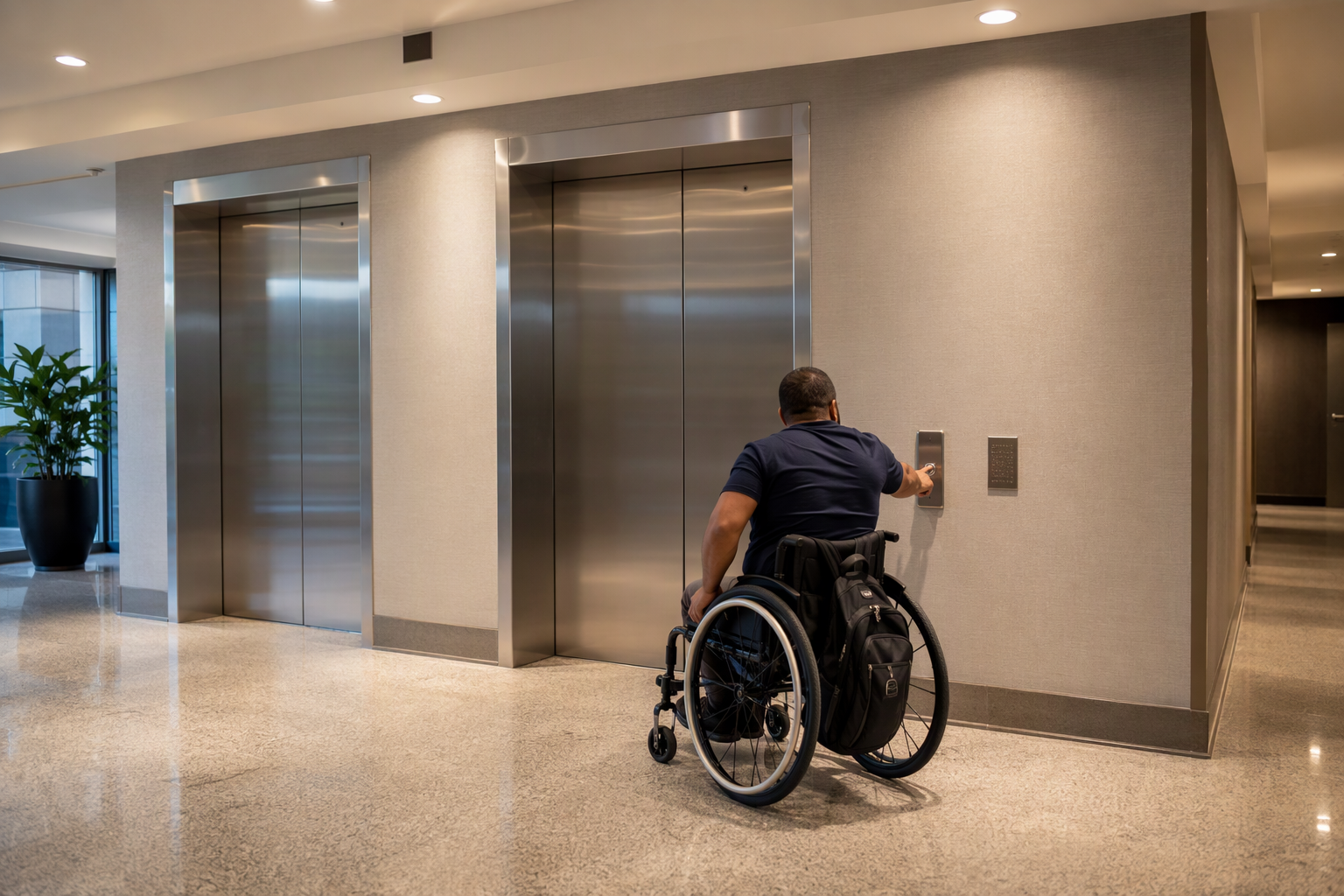
- Call controls: Hall call buttons must be centered at 42 inches above the floor, and car controls must be within accessible reach ranges.
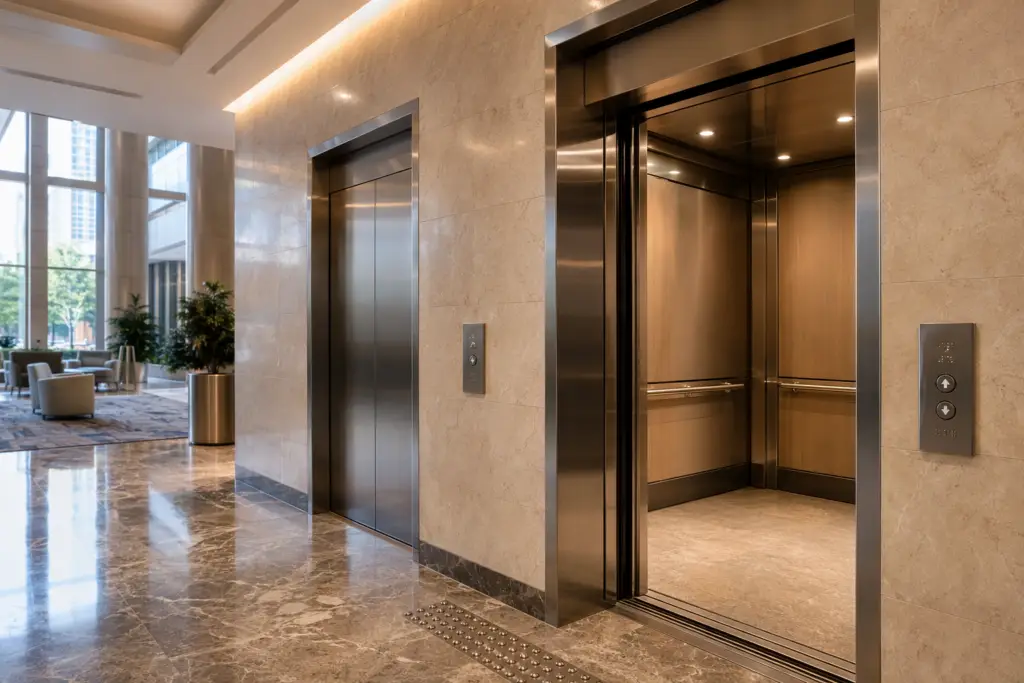
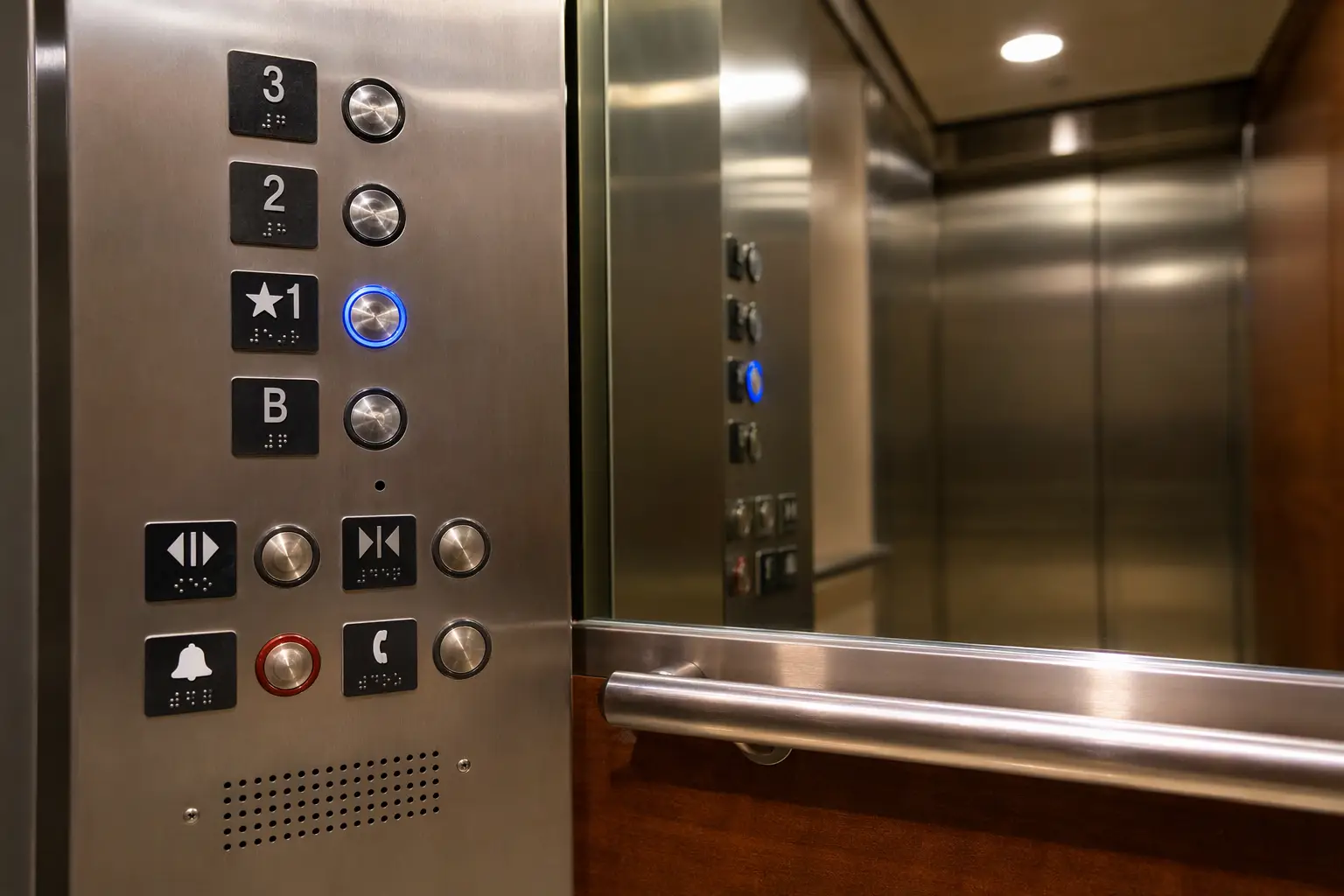
- Tactile and visual indicators: Raised characters and Braille must appear on control buttons, and the floor must be announced audibly and visually.
- Emergency communication: A two-way communication system must be provided in the car, and it must be accessible to users who are deaf or hard of hearing, meeting the specific requirements of the ADA Standards.
How Do State Elevator Codes in DC, Maryland, Pennsylvania, and Virginia Interact with ADA Requirements?
ADA and Fair Housing Act standards set the accessibility floor. State-adopted elevator safety codes — primarily editions of the ASME A17.1/CSA B44 Safety Code for Elevators and Escalators — govern the structural, mechanical, and safety aspects of the elevator equipment. Both layers apply simultaneously, and compliance with one does not guarantee compliance with the other.
In the District of Columbia, the DC Department of Buildings (DOB) enforces the 2017 DC Building Code, which references ASME A17.1-2013/CSA B44-13. All new multifamily elevator installations must pass a DOB-approved third-party inspection by an ASME QEI-certified inspector before receiving a certificate of inspection. The DOB plans to adopt codes based on the 2024 model codes by the end of 2027, which may update the referenced ASME edition.
In Maryland, the Maryland Department of Labor, Division of Labor and Industry, Elevator and Escalator Safety enforces COMAR 09.12.81 under the authority of the Annotated Code of Maryland, Public Safety Article, Title 12, Subtitle 8. Maryland adopted ASME A17.1-2022/CSA B44:22 effective June 17, 2026. Every multifamily elevator must be registered with the Commissioner at least 60 days before completion and must receive an annual periodic inspection by a third-party qualified elevator inspector.
In Pennsylvania, the Pennsylvania Department of Labor and Industry, Bureau of Occupational and Industrial Safety, Elevator Section enforces 34 Pa. Code Chapter 405. Pennsylvania’s elevator regulation (Regulation #12-123) transitions to ASME A17.1-2016 for permit applications made on or after December 20, 2026. Electric and hydraulic elevators in Pennsylvania require periodic inspections at intervals of no more than six months.
In Virginia, elevator inspections are enforced at the local level under the Virginia Uniform Statewide Building Code (13VAC5-63), which adopted ASME A17.1/CSA B44-2019 effective January 18, 2024. Local building departments — such as the City of Richmond’s Bureau of Permits and Inspections — conduct final acceptance inspections and annual inspections. All elevator mechanics must hold Virginia state certification, and contractors must carry an Elevator/Escalator Contracting specialty license from the Virginia Board for Contractors.
What Is the Accessible Route Requirement for Multifamily Buildings with Elevators?
When a multifamily building has an elevator, the accessible route must connect the accessible building entrance, all accessible common-use areas, and every dwelling unit on every floor. The route must be continuous, without steps, and must maintain the minimum clear width and turning-space dimensions required by the applicable accessibility standard.
This means that meeting the dimensional requirements of the elevator car alone is insufficient. The hallway approaching the elevator must also meet accessible-width minimums, the elevator lobby must provide adequate maneuvering clearance, and every element from the parking area or public sidewalk to the individual unit door must form an unbroken accessible chain.
Breaks anywhere in that chain — a narrow corridor, a lobby door with excessive opening force, a landing that does not level within tolerance — constitute violations independent of whether the elevator itself is code-compliant.
What Are the Steps to Bring a Noncompliant Multifamily Elevator into ADA Compliance?
- Commission a full accessibility audit. Engage a licensed accessibility consultant or elevator contractor to measure the existing elevator car dimensions, door clear width, control heights, leveling accuracy, and emergency communication system against current ADA Standards and Fair Housing Act guidelines.
- Document all deficiencies in writing. Create a gap report identifying every dimensional, operational, and signage deficiency, referencing the specific ADA Standard or Fair Housing guideline that is not satisfied.
- Apply for the required elevator permit. In DC, Maryland, and Pennsylvania, any alteration to an existing elevator requires a permit from the respective state elevator authority. In Virginia, the permit is issued by the local building department.
- Engage a licensed elevator contractor. In Maryland, the contractor must be licensed by the Maryland Elevator Safety Review Board. In Virginia, the contractor must hold an Elevator/Escalator Contracting specialty license. In DC, the contractor must hold a DC elevator contracting license.
- Perform the required alterations. This may include car expansion, door operator replacement, control panel relocation, leveling device adjustment, Braille overlay installation, or emergency phone upgrade.
- Schedule and pass the acceptance inspection. In Maryland and Pennsylvania, the state authority conducts a final acceptance inspection before the elevator returns to service. In DC, a DOB-approved third-party inspector conducts the inspection. In Virginia, the local code official inspects and passes the work.
- Display the new certificate of inspection. Post or make available the updated certificate as required by the jurisdiction — in the elevator car, in the machine room, or in the building operator’s office, depending on jurisdiction-specific rules.
- Update maintenance and inspection records. Maryland specifically requires that all maintenance, repair, test, and inspection records be kept at a readily accessible central location in the building.
Are There ADA Elevator Exemptions That Apply to Multifamily Buildings?
Yes, but the exemptions are narrower than many property owners assume.
The ADA itself contains an elevator exemption for buildings that are fewer than three stories or have fewer than 3,000 square feet per story, unless the building is a shopping center, a shopping mall, or a facility of a professional health care provider. This exemption applies to Title III commercial buildings and is frequently misapplied to residential properties.
The Fair Housing Act’s design and construction requirements do not contain the same elevator exemption. Under the FHAA, the question is whether every unit in a building with an elevator is on an accessible route — the ADA’s story-and-square-footage exemption is simply not part of the FHAA analysis.
Section 504 requirements for federally assisted housing contain no general elevator exemption for low-rise buildings.
Existing buildings undergoing alterations face a somewhat different analysis: alterations must, to the maximum extent feasible, make the altered path of travel accessible. If an alteration is made to a primary function area, the accessible route — including the elevator serving that area — must also be brought into compliance unless the cost of doing so is disproportionate, generally defined as exceeding 20 percent of the cost of the primary alteration.
What Is the Maryland-Specific Requirement for Elevator Rescue Litters?
Maryland has a building-specific requirement that goes beyond standard ADA accessibility dimensions. Under Maryland law, each new building constructed after July 1, 1985, with at least one planned elevator must have a passenger elevator capable of carrying a 6-foot-8-inch rescue litter horizontally. This requirement is tracked and enforced by the Maryland Department of Labor, Division of Labor and Industry, Elevator and Escalator Safety. Multifamily developers in Maryland must verify that at least one elevator car in a new building is dimensioned to satisfy this requirement in addition to Fair Housing Act and ADA minimums.
How Often Must a Multifamily Elevator Be Inspected in DC, Maryland, Pennsylvania, and Virginia?
| Jurisdiction | Periodic Inspection Interval | Authoritative Source |
|---|---|---|
| District of Columbia | Category 1 inspection every 12 months; Category 5 inspection every 60 months | DC Department of Buildings (DOB) |
| Maryland | Annual periodic inspection; comprehensive five-year inspection for wire-rope and rack-and-pinion elevators | Maryland Department of Labor, Division of Labor and Industry |
| Pennsylvania | Periodic inspection at intervals of no more than 6 months (electric and hydraulic elevators) | Pennsylvania Department of Labor and Industry, Elevator Section |
| Virginia | Annual periodic inspection required; locality may require six-month intervals | Virginia Uniform Statewide Building Code (13VAC5-63) |
What Happens if a Multifamily Elevator Fails an Accessibility Inspection or Complaint Investigation?
Federal enforcement of ADA and Fair Housing Act accessibility requirements can be initiated by a private complaint filed with the U.S. Department of Housing and Urban Development (HUD), a complaint to the U.S. Department of Justice, or a private lawsuit filed by an aggrieved individual or advocacy organization.
HUD and DOJ have authority to investigate design and construction complaints, seek injunctive relief requiring retrofits, and in some cases impose civil monetary penalties. Courts have awarded damages to plaintiffs in Fair Housing Act design and construction cases, and consent decrees have required building owners to retrofit noncompliant buildings and pay the costs of independent monitors.
At the state level, operating an elevator without a valid certificate of inspection is a violation of state law in DC, Maryland, and Pennsylvania, with the respective elevator authorities empowered to order an elevator out of service. In Virginia, local building officials have parallel authority under the USBC.
Beyond regulatory sanctions, noncompliant common areas in a multifamily building can create civil liability exposure under the Fair Housing Act for any unit that was marketed, rented, or sold while the building failed to meet design and construction requirements.
What Are the Industry Trends for 2025–2026 Affecting ADA Elevator Compliance in Multifamily?
Several converging trends are shaping how multifamily property owners and developers approach ADA elevator compliance heading into 2025 and 2026.
Code adoption cycles are accelerating in the Quality Elevator Company service region. Maryland’s adoption of ASME A17.1-2022/CSA B44:22 effective June 17, 2026, and Pennsylvania’s transition to ASME A17.1-2016 for new permit applications from December 20, 2026, mean that elevator contractors and inspectors across the region are simultaneously managing older and newer code editions depending on when equipment was permitted. This complexity rewards property owners who maintain detailed permit and inspection records.
Emergency communication technology is evolving. The ADA Standards require two-way communication that is accessible to people who are deaf or hard of hearing. As cellular and VoIP communications increasingly replace traditional phone lines, and as interpretations around video and text-based emergency communication continue to develop at the federal level, multifamily owners should work closely with their elevator contractors to understand what their jurisdiction-specific adopted code edition currently requires and what changes may come.
HUD enforcement of Fair Housing Act design and construction requirements has historically targeted new construction, but aging multifamily stock built in the 1990s and early 2000s is increasingly the subject of complaints as buildings age and deficiencies that may have existed since original construction become apparent. Property owners who have not recently audited their accessible routes — not just their elevator cars — are carrying compliance risk.
Modernization demand is rising across the multifamily sector. Buildings originally constructed in the 1970s and 1980s often have elevator equipment that predates the ADA entirely and cannot be brought into compliance through adjustment alone. Full cab renovations or car sling replacements are frequently the only path to meeting current dimensional requirements, and those projects require the same permit-and-inspection process as new installations under state elevator codes.
How Does Quality Elevator Company Support Multifamily ADA Compliance?
Quality Elevator Company works with multifamily property owners, developers, and property managers across the District of Columbia, Maryland, Pennsylvania, and Virginia on elevator assessments, modernizations, and ongoing maintenance programs. The company approaches ADA elevator compliance through a data-driven process: documenting existing conditions against current federal accessibility standards and jurisdiction-specific adopted ASME A17.1/CSA B44 requirements, identifying the specific alterations needed, and managing the permit and inspection process with the relevant authority having jurisdiction — whether that is the DC Department of Buildings, the Maryland Department of Labor, Division of Labor and Industry, the Pennsylvania Department of Labor and Industry, or the local building department in Virginia.
For multifamily properties undergoing repositioning, refinancing, or change of ownership, elevator accessibility documentation is increasingly part of the due diligence process. Quality Elevator Company provides assessment reports that support that documentation need while identifying equipment conditions that affect both ADA compliance and ongoing operational safety.
What Should a Multifamily Property Owner Do if They Are Unsure Whether Their Elevator Meets ADA Requirements?
The first step is to treat the question as a factual, documentable compliance matter rather than an assumption. Many multifamily properties that were built after 1991 and believed to be compliant at the time of construction have elevator cars or accessible routes that do not meet current ADA Standards dimensional requirements — sometimes because of minor construction deviations from approved plans, sometimes because standards have been clarified through federal guidance since the building was completed.
Property owners should gather the original elevator permit, the most recent certificate of inspection, and any prior accessibility audit reports. Those documents establish the baseline from which a current-condition assessment can measure gaps. If those records are unavailable — a common situation in older multifamily buildings that have changed ownership — the starting point is a physical measurement audit of the elevator car, lobby, and accessible route by a qualified elevator contractor familiar with ADA and Fair Housing Act requirements.
In the DC, Maryland, Pennsylvania, and Virginia region, any alteration that results from that audit will require engaging the state elevator authority or local building department early in the process. Permit timelines, inspection scheduling, and certificate issuance timelines all affect project planning, and experienced elevator contractors factor those regulatory timelines into project schedules from the outset.
Contact Quality Elevator Company for a free elevator assessment at 301-779-9116.
Need elevator service you can rely on? Quality Elevator Company is ready to help.