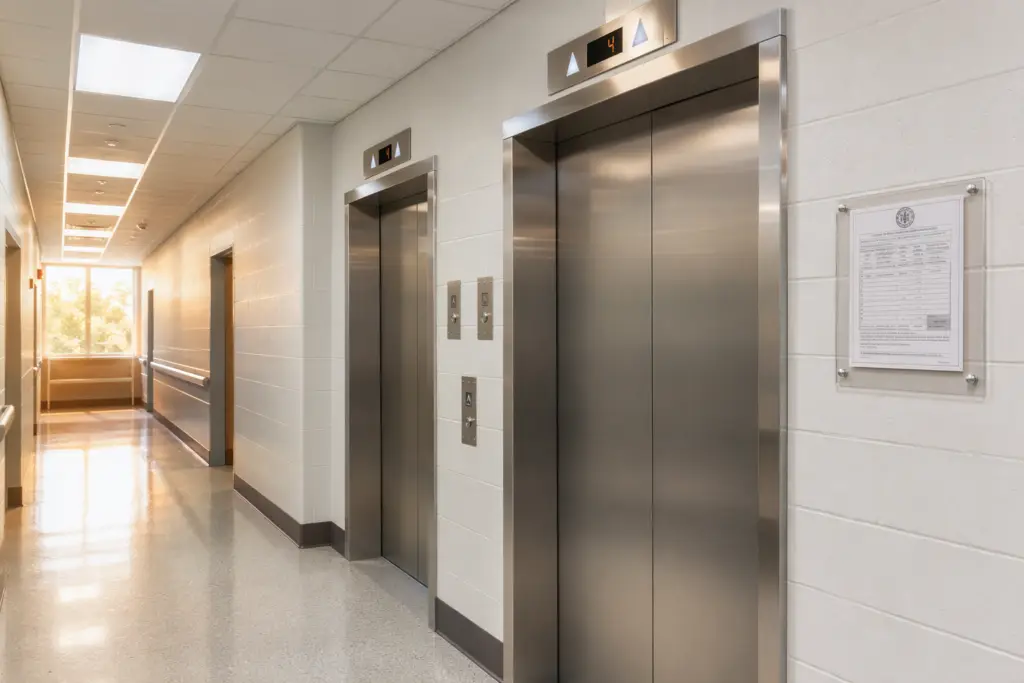
ADA Elevator Code Requirements for Healthcare Facilities
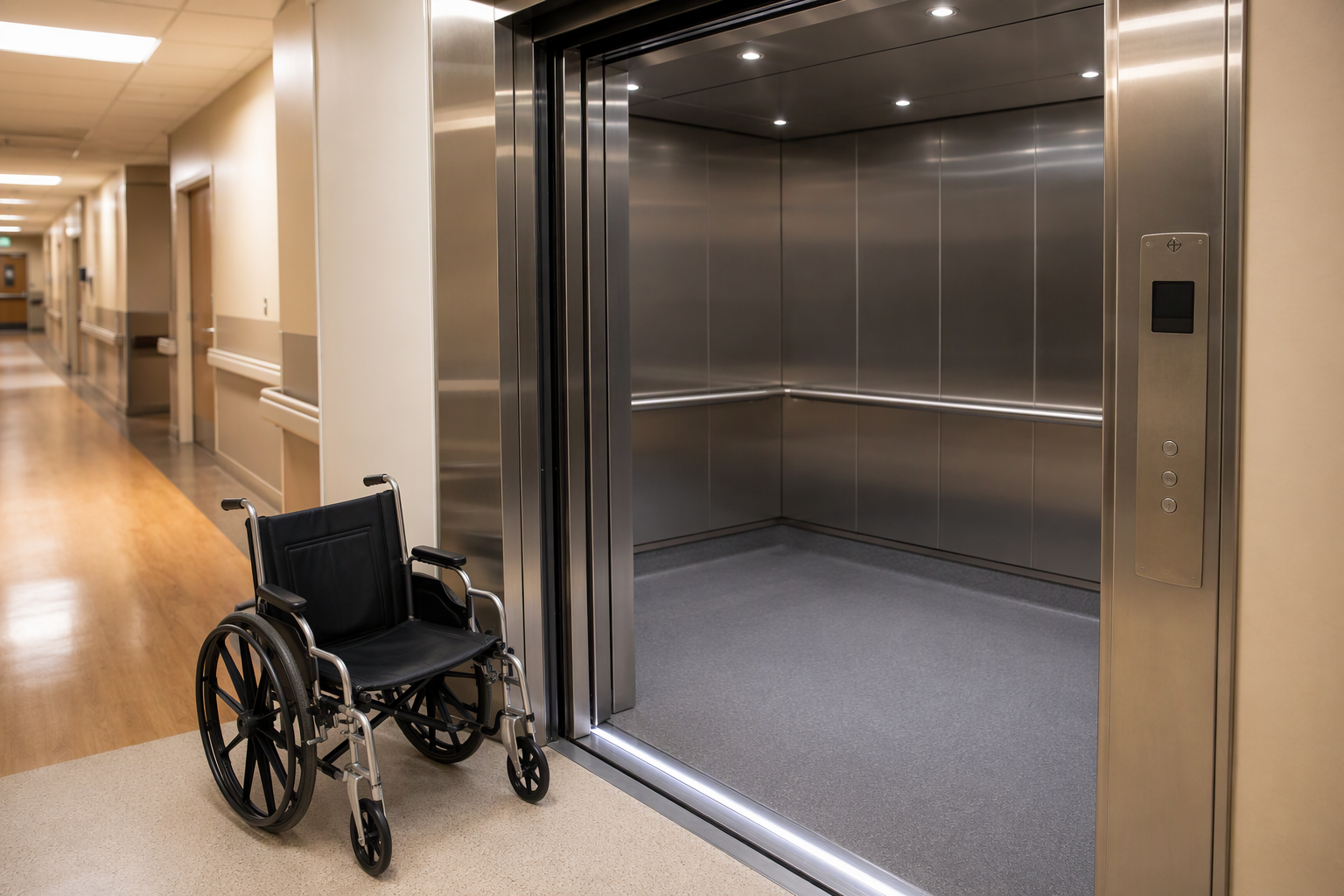
ADA elevator code for healthcare facilities requires that passenger elevators provide accessible routes connecting all floors served by the building, meeting minimum cab dimensions, door timing, control height, and signage standards under the ADA Standards for Accessible Design. Healthcare environments add an additional layer of complexity because elevators must also accommodate gurneys, wheelchairs, medical equipment carts, and emergency evacuation procedures — all while remaining compliant with state inspection mandates in Maryland, Washington DC, Pennsylvania, and Virginia.
What Does ADA Elevator Code Require in Healthcare Buildings?
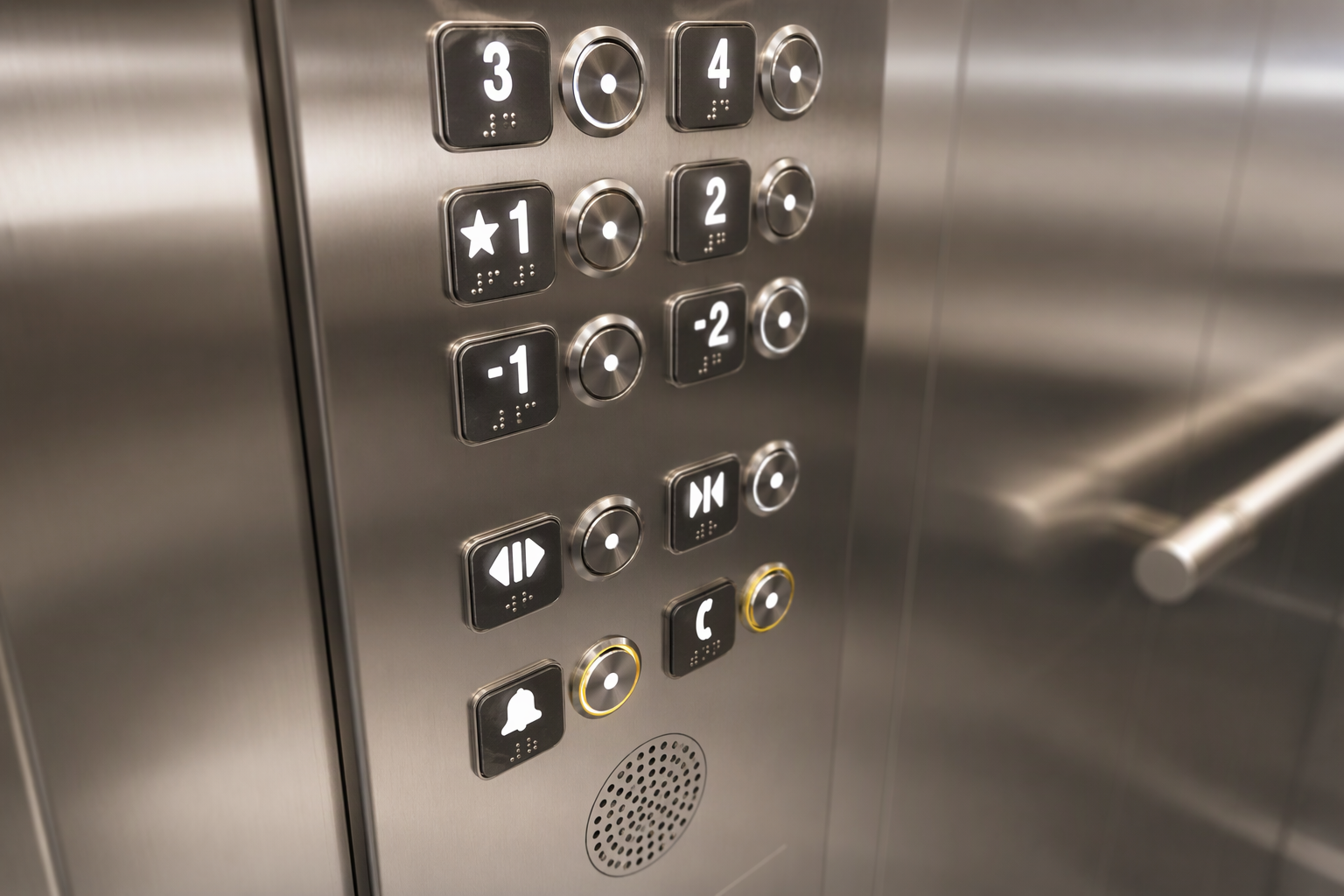
The ADA Standards for Accessible Design establish the baseline accessibility requirements that apply to elevators in healthcare facilities. Key requirements include:
- Accessible route: At least one accessible route must connect all floors of a multi-story healthcare building. Where an elevator is the only means of vertical access, it must meet ADA requirements in full.
- Cab dimensions: Elevator cabs must provide minimum interior dimensions that allow a wheelchair user to enter, turn, and exit. For hospital and medical settings, larger cab dimensions are strongly advisable to accommodate stretchers and equipment.
- Door reopening devices: Doors must remain open long enough for a person using a mobility device to board and must include a reopening device sensitive to obstructions.
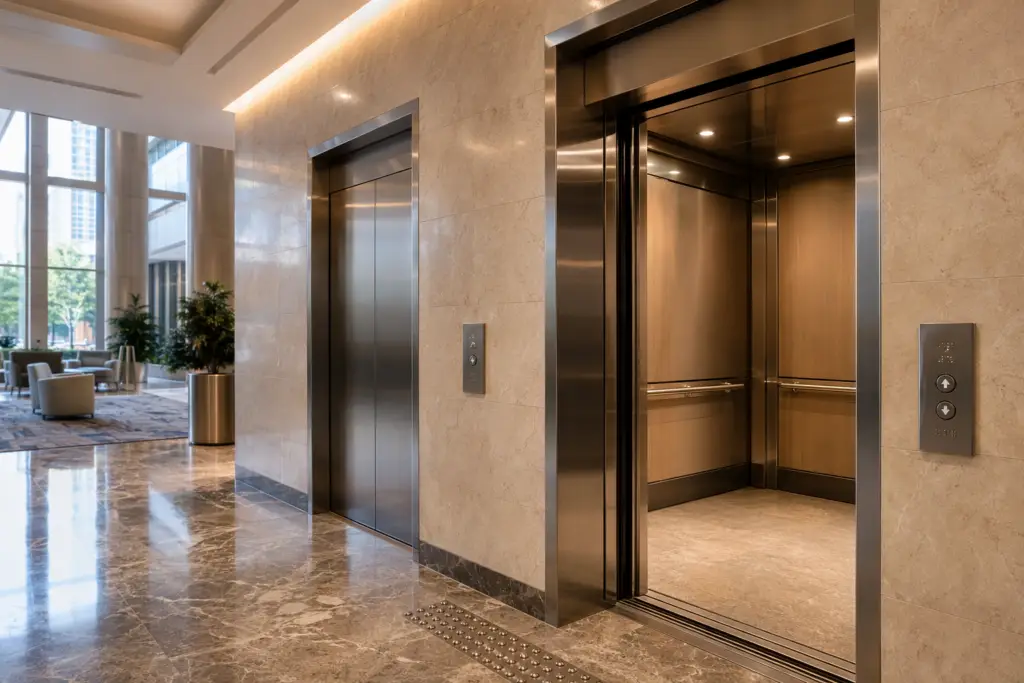
- Call button height: Call buttons on elevator lobbies must be mounted between 15 and 48 inches above the finished floor, within reach range for wheelchair users.
- Floor designations: Raised and Braille floor designations must appear on both jambs of the elevator hoistway entrance.
- Visual and audible signals: Hall lanterns must provide both audible and visible signals indicating the direction of elevator travel.
- Emergency communication: A two-way communication system must connect the cab to a point outside the hoistway for emergency use — a critical safety feature in healthcare settings where patients may be non-verbal or medically vulnerable.
These requirements apply to new construction and to alterations of existing facilities. Quality Elevator Company evaluates each of these elements during assessments of healthcare elevator installations across Baltimore, Washington DC, Philadelphia, and Richmond.
How Does ASME A17.1 Interact With ADA Code in Hospitals?
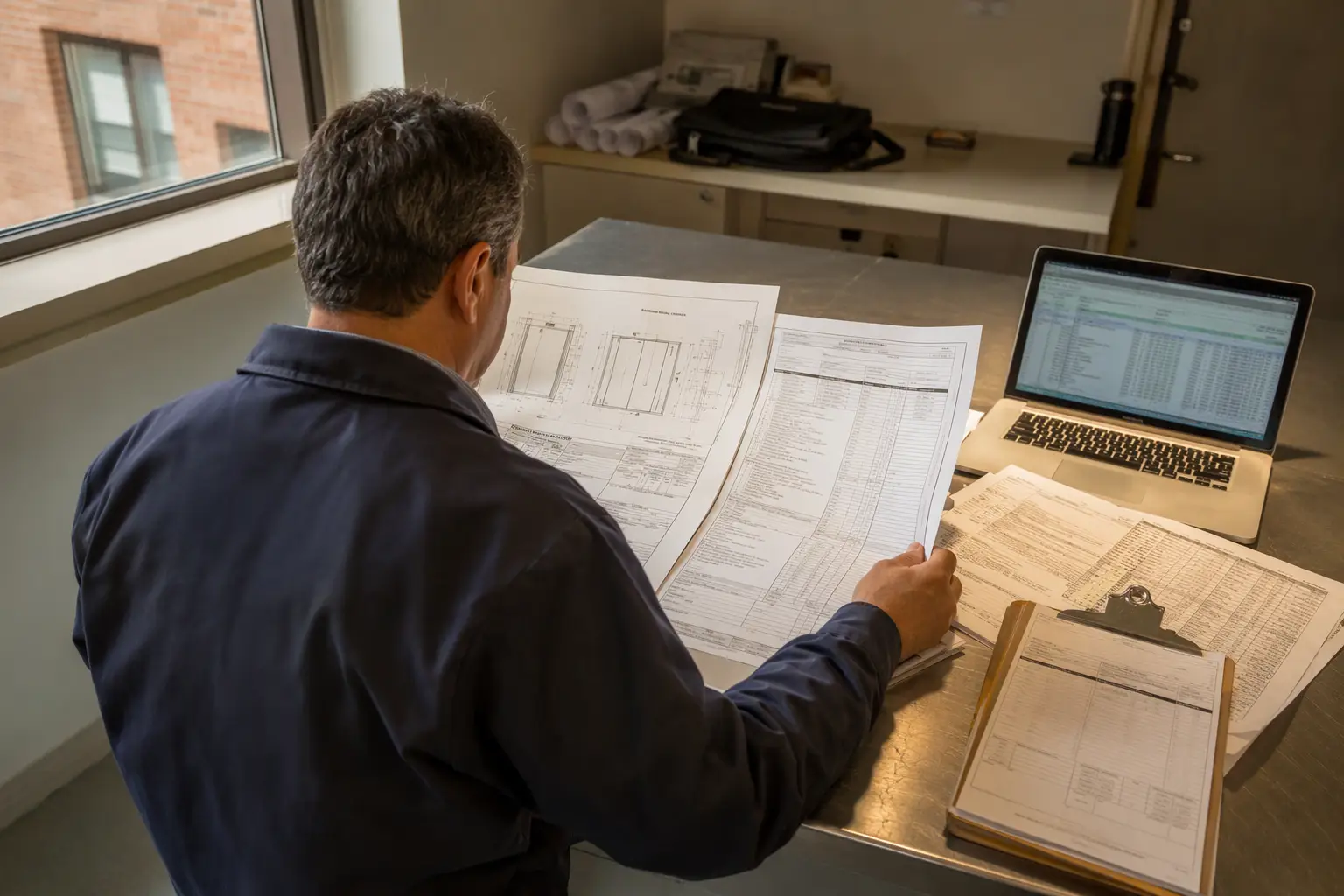
The ASME A17.1 Safety Code for Elevators and Escalators governs the mechanical, electrical, and structural safety of elevator equipment, while the ADA governs accessibility. In a healthcare setting, these two frameworks operate simultaneously. ASME A17.1 addresses cab construction, load ratings, door speed, emergency lighting, and inspection intervals — all of which affect the ability of an elevator to safely serve patients on gurneys or in wheelchairs. For example, ASME A17.1 requirements for door closing force and door speed directly support ADA door timing mandates. Compliance with one standard does not guarantee compliance with the other; a healthcare facility must satisfy both.
Are There State-Specific ADA Elevator Requirements in Maryland, DC, Pennsylvania, and Virginia?
Each jurisdiction served by Quality Elevator Company layers its own inspection and licensing requirements on top of federal ADA and ASME standards.
Maryland: The Maryland Department of Labor, Division of Labor and Industry, Elevator and Escalator Safety regulates elevators under the Annotated Code of Maryland, Public Safety Article, Title 12, Subtitle 8, and COMAR 09.12.81. Maryland adopted the ASME A17.1-2022/CSA B44:22 edition, effective June 17, 2026, with Maryland modifications. Healthcare facilities must have each elevator unit inspected annually by a third-party qualified elevator inspector, and wire-rope-suspended elevators require a comprehensive five-year inspection. The certificate of inspection must be posted conspicuously in or on the elevator. Maryland also requires new buildings constructed after July 1, 1985, with at least one planned elevator to include a passenger elevator capable of carrying a 6-foot-8-inch rescue litter horizontally — a requirement with direct implications for hospital design and gurney transport.
Washington DC: The DC Department of Buildings (DOB) enforces elevator requirements under 12-A DCMR Chapter 30 and the 2017 DC Building Code, which references ASME A17.1-2013/CSA B44-13. All elevators in DC healthcare facilities must be inspected and certified through a DOB-approved third-party inspection agency using ASME QEI-certified inspectors. Category 1 inspections are required every 12 months and Category 5 inspections every 60 months. In DC buildings with passenger elevators, at least one elevator must remain in operation whenever the building is occupied — a provision that carries serious implications for hospitals and urgent care facilities where vertical access is clinically essential.
Pennsylvania: The Pennsylvania Department of Labor and Industry, Bureau of Occupational and Industrial Safety, Elevator Section has statewide jurisdiction, including Philadelphia. Under 34 Pa. Code Chapter 405, electric and hydraulic elevators must be inspected at intervals of no more than six months. Pennsylvania’s updated elevator regulation takes effect December 20, 2026, at which point permit applications will be governed by ASME A17.1-2016 with Pennsylvania modifications and Category 1 tests become an annual stand-alone requirement. Healthcare facility operators in Philadelphia should note that inspection and certification is conducted by the Pennsylvania Department of Labor and Industry, not by the City of Philadelphia’s own department.
Virginia: Under the Virginia Uniform Statewide Building Code (13VAC5-63), local building departments enforce elevator requirements. The 2021 USBC, which took effect January 18, 2024, incorporates ASME A17.1/CSA B44-2019. All Virginia healthcare facility elevators require at least an annual periodic inspection, and localities may require six-month intervals. In Richmond, the City of Richmond Department of Planning and Development Review, Bureau of Permits and Inspections, administers elevator annual inspections and certificates. No one may perform elevator mechanic work in Virginia without state certification from the Virginia Board for Contractors.
What Elevator Cab Dimensions Are Required for Healthcare Use?
ADA Standards specify minimum cab dimensions, but hospitals, surgery centers, and long-term care facilities typically need dimensions beyond those minimums to accommodate hospital beds, stretchers, and large medical equipment. When assessing a healthcare elevator, Quality Elevator Company examines whether cab dimensions, door widths, and clear floor areas are adequate not just for ADA compliance but for the specific clinical workflows of the facility — including gurney transport, bariatric equipment, and emergency evacuation scenarios. Maryland’s rescue litter requirement reinforces this need at the statutory level.
How Often Must Healthcare Facility Elevators Be Inspected?
Inspection intervals vary by jurisdiction:
- Maryland: Annual periodic inspection required; five-year comprehensive inspection for wire-rope-suspended elevators.
- Washington DC: Category 1 inspection every 12 months; Category 5 inspection every 60 months, each by an ASME QEI-certified inspector through a DOB-approved agency.
- Pennsylvania: Periodic inspection at intervals of no more than six months for electric and hydraulic elevators; under rules effective December 20, 2026, Category 1 tests annually.
- Virginia: At minimum an annual periodic inspection; local authorities may require semi-annual inspections.
Healthcare facilities should schedule inspections well in advance of certificate expiration, as an out-of-service elevator in a hospital or medical office building creates both safety and regulatory risk.
What Happens If a Healthcare Elevator Fails an ADA Inspection?
If an elevator fails to meet ADA accessibility requirements, the facility may be subject to complaints filed with the U.S. Department of Justice or private civil rights litigation. ADA compliance is enforced independently of state elevator safety certificates — a valid inspection certificate does not confirm ADA conformance. When an accessibility deficiency is identified, the facility must remediate the specific element (door timing, signage, control height, etc.) and document the correction. Quality Elevator Company assists healthcare clients in identifying both safety code deficiencies and accessibility gaps during assessments, so that corrective work can be prioritized and planned.
What Is the Process for Bringing a Healthcare Elevator Into ADA Compliance?
- Conduct a full accessibility audit of all passenger elevators in the facility, measuring cab dimensions, door widths, control heights, door timing, signage, and communication systems against current ADA Standards for Accessible Design.
- Document every deficiency in writing, noting the specific ADA section and the measured or observed condition.
- Prioritize deficiencies by severity — items affecting primary accessible routes serving clinical areas take precedence.
- Obtain the required permits from the appropriate state authority (Maryland Department of Labor, DC DOB, Pennsylvania L&I, or the local Virginia building department) before beginning any alteration work.
- Have a licensed elevator contractor perform the remediation work. In Virginia, the contractor must hold an Elevator/Escalator Contracting (EEC) specialty license; in Maryland, the contractor must be licensed by the Maryland Elevator Safety Review Board.
- Schedule a post-alteration acceptance inspection with the applicable state or local authority before returning the elevator to service.
- Post the updated certificate of inspection in the cab or as otherwise required by the jurisdiction.
- Maintain records of the audit, the corrective work, and the inspection reports in an accessible location in the building, as required in Maryland and best practice elsewhere.
Do Emergency Power Requirements Affect Healthcare Elevator ADA Compliance?
Healthcare facilities are subject to life-safety and emergency power requirements that intersect with elevator operation. During a power outage, an elevator that loses power cannot serve as an accessible route. While emergency power provisions for elevators are addressed through building codes and the ASME A17.1 Safety Code for Elevators and Escalators rather than the ADA directly, healthcare facilities must evaluate whether their emergency power systems support continued elevator operation on at least one accessible cab. Facilities should confirm that at least the ADA-designated accessible elevator is connected to emergency power, ensuring continuity of the accessible route for patients who cannot use stairs.
What Records Must Healthcare Facilities Keep for Elevator Compliance?
Record-keeping requirements exist at both the federal and state level. In Maryland, maintenance, repair, test, and inspection records must be kept at a readily accessible central location in the building. In DC, owners submit third-party inspection reports for the past two years to the DOB through the Citizen Access Portal to obtain a certificate of inspection. In Pennsylvania, accident reports must be submitted to the Department of Labor and Industry when an elevator incident causes a fatality or requires professional medical care. Healthcare facilities, which are subject to additional accreditation and regulatory scrutiny, benefit from maintaining a consolidated elevator compliance file that includes permits, inspection reports, certificates, and records of any repairs or alterations.
How Do Modernization Projects Affect ADA Compliance in Existing Healthcare Facilities?
When a healthcare facility modernizes an existing elevator — replacing controls, cab interiors, door operators, or drive systems — the alteration triggers a review of ADA accessibility elements in the path of travel affected by the work. Under the ADA, alterations to a primary function area require that the accessible path of travel to the altered area be brought into compliance to the extent that the cost of the accessibility improvements does not exceed a defined portion of the overall alteration cost. Quality Elevator Company works with healthcare facility managers to plan modernization projects that address both mechanical code compliance under the applicable ASME A17.1 edition and accessibility improvements required by the ADA, reducing the risk of piecemeal work that leaves compliance gaps.
Questions Your Inspector Will Ask
During a state periodic inspection or an ADA accessibility evaluation at a healthcare facility, inspectors and auditors commonly ask the following:
- Is the current certificate of inspection posted in the cab or otherwise displayed as required by this jurisdiction?
- When was the last Category 1 (annual) test performed, and who witnessed it?
- For Maryland facilities: When was the last five-year comprehensive inspection completed for wire-rope-suspended elevators?
- Are all elevator control buttons mounted within ADA reach range, and are floor designations provided in raised characters and Braille on both jambs?
- Does the two-way emergency communication system connect to a staffed location, and has it been tested recently?
- Do elevator doors reopen on contact or sensing, and is door open time sufficient for a wheelchair or gurney user to board?
- Are hall lanterns providing both audible and visible signals in each direction?
- Have any alterations or repairs been made since the last certificate was issued, and were the required permits obtained?
- For Pennsylvania facilities: Has an accident report been submitted for any incident requiring professional medical care?
- Is there documentation of the elevator contractor’s license on file, and in Maryland, does it reflect coverage under the required liability and property damage insurance minimums?
- In DC: Is there at least one elevator in continuous operation while the building is occupied?
Why Do Healthcare Facilities Face Greater Elevator Compliance Risk?
Healthcare facilities operate under higher scrutiny than typical commercial buildings for several reasons. Joint Commission accreditation surveys and CMS Conditions of Participation reviews may examine the functionality and safety of vertical transportation as part of the Environment of Care standards. An out-of-service or non-compliant elevator in a hospital or outpatient facility can interrupt clinical operations, delay emergency response, and expose the facility to regulatory citations, ADA complaints, and liability claims. Regular preventive maintenance, timely inspection scheduling, and prompt remediation of deficiencies identified by Quality Elevator Company help healthcare operators manage these risks proactively.
Contact Quality Elevator Company for a free elevator assessment at 301-779-9116.
Need elevator service you can rely on? Quality Elevator Company is ready to help.