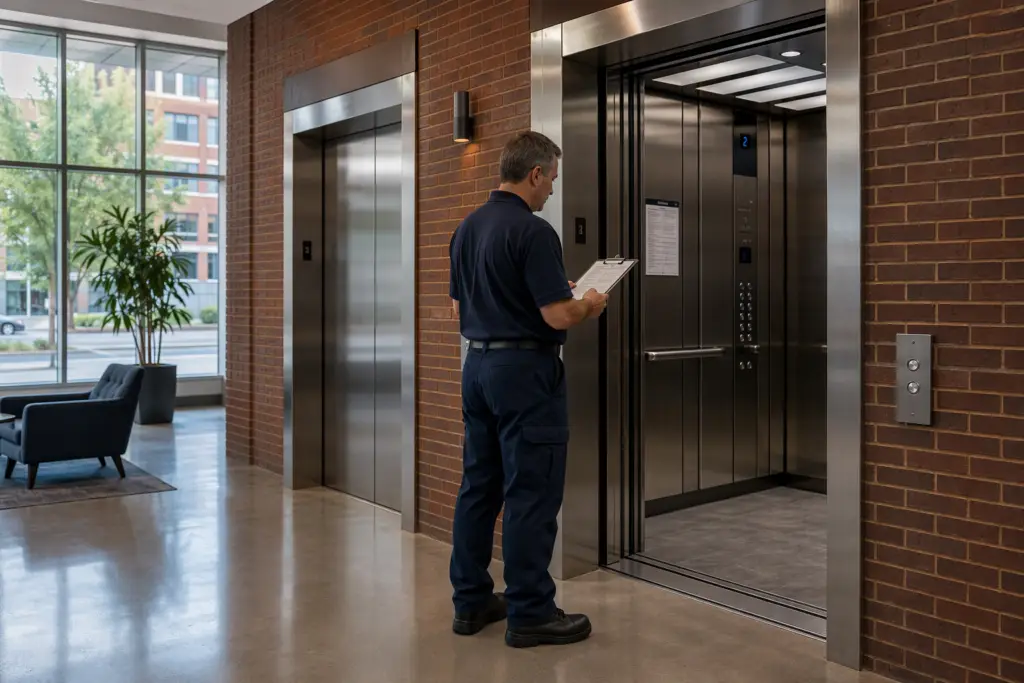
A commercial building elevator service contract is a formal maintenance agreement between a building owner or property manager and a licensed elevator service company that defines inspection schedules, preventive maintenance tasks, emergency response obligations, code compliance responsibilities, and repair coverage terms to keep elevators operating safely and legally.

Commercial Building Elevator Service Contract: Complete FAQ Guide
Whether you manage an office tower in Washington DC, a mixed-use development in Baltimore, a healthcare facility in Philadelphia, or a retail complex in Richmond, a well-structured elevator service contract is one of the most consequential maintenance decisions you will make. This guide answers every critical question building owners, property managers, and facilities directors ask before signing — or renewing — an elevator maintenance agreement.
What exactly is a commercial building elevator service contract?
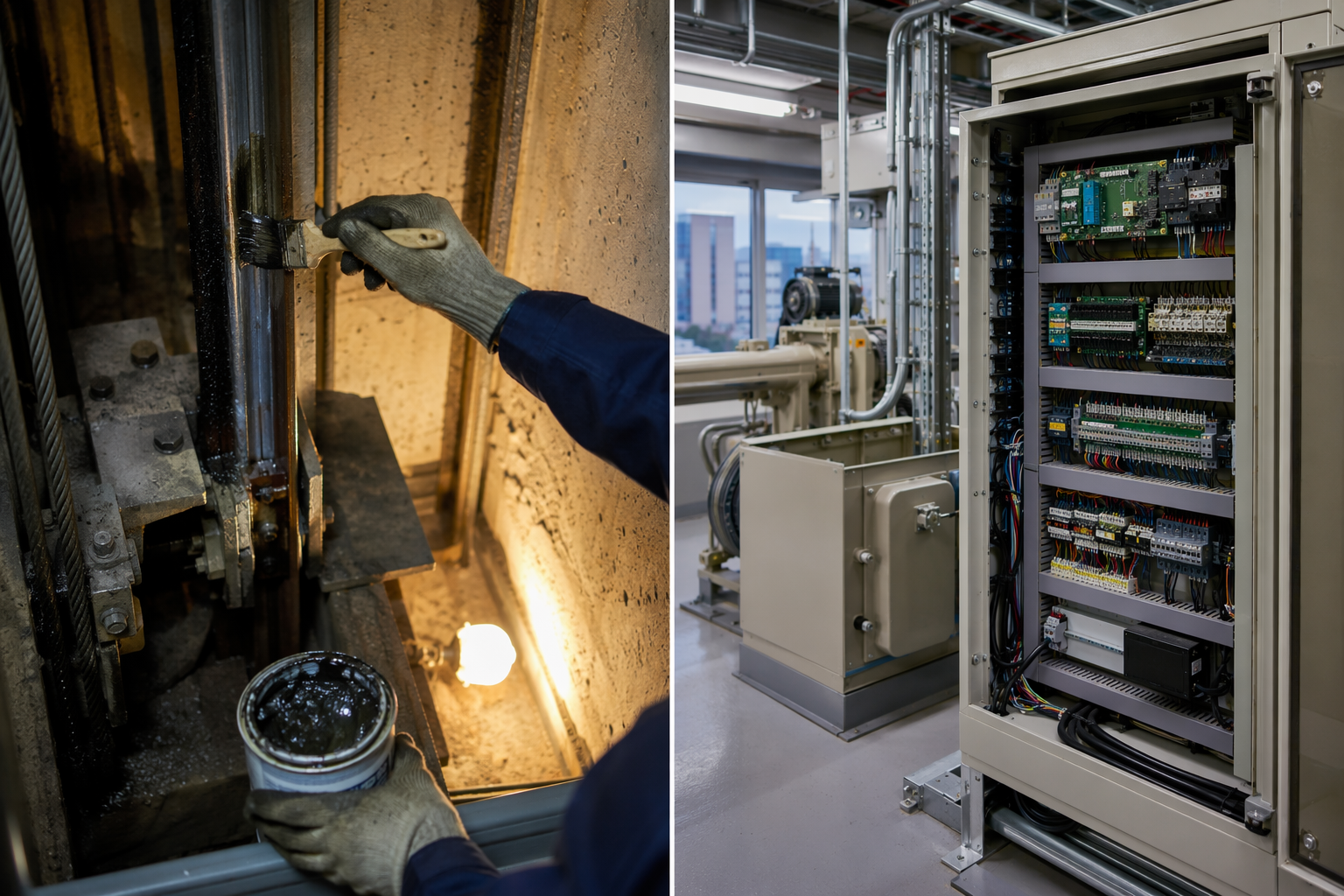
A commercial elevator service contract is a legally binding maintenance agreement that outlines the scope of preventive maintenance, inspection frequency, code compliance obligations, parts and labor coverage, and emergency service terms between a building owner and a certified elevator service provider.
At its core, the contract protects three parties simultaneously: the building owner from liability, elevator passengers from unsafe equipment, and the service provider from scope creep. A well-drafted agreement will specify which tasks are performed on a scheduled basis (lubrication, safety device testing, controller inspection), which repairs are included in the monthly fee versus billed separately, and how the contractor documents compliance with applicable codes.
Commercial contracts differ meaningfully from residential agreements. Commercial elevators operate under higher duty cycles, carry larger passenger loads, and are subject to mandatory third-party inspections by state and local authorities. The contract must account for all of these variables to be enforceable and protective.
What are the different types of elevator maintenance contracts available?
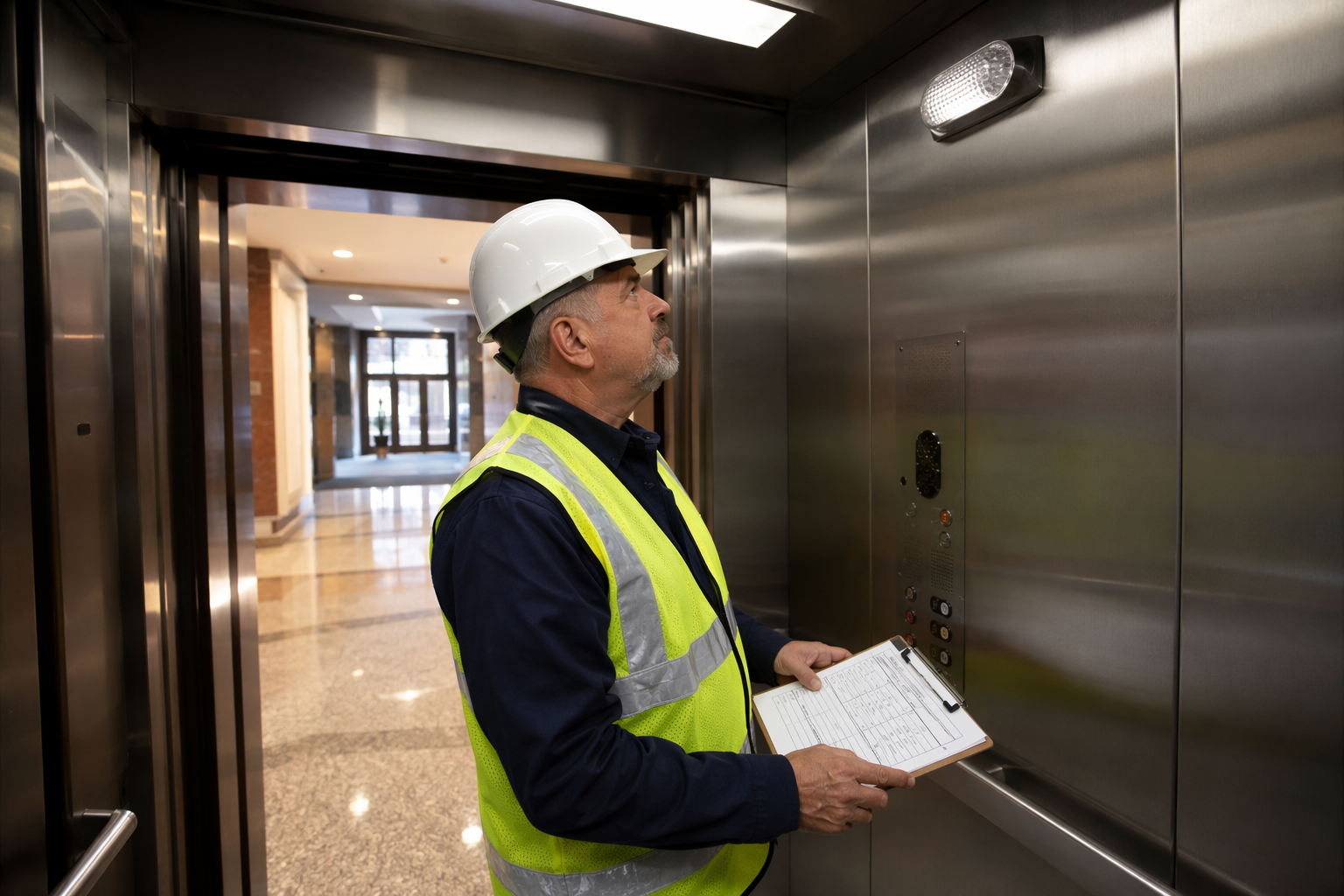
Elevator service contracts generally fall into four tiers: oil-and-grease (basic), full maintenance (comprehensive), parts-only, and custom performance-based agreements — each offering a different balance of cost predictability and coverage depth.
Oil-and-Grease (Basic): The contractor performs routine lubrication, adjustment, and safety device testing. All parts and major repairs are billed separately. This is the lowest-cost entry point but carries the highest risk of unpredictable repair invoices.
Full Maintenance (Comprehensive): The contractor covers most parts and labor, excluding items such as vandalism, misuse damage, or major modernization components. This is the most common contract type for commercial buildings with moderate-to-high traffic.
Parts-Only: The building owner employs in-house mechanics but outsources parts supply and periodic specialist inspections. Rarely used outside of large institutional portfolios.
Performance-Based: Increasingly common in larger commercial portfolios, these contracts tie contractor compensation to measurable outcomes such as uptime percentages and callback rates. They require robust data-sharing and are best suited for buildings with elevator monitoring technology already in place.
What does a typical elevator service contract include?
A typical elevator service contract includes scheduled preventive maintenance visits, lubrication and adjustment of mechanical components, safety device testing, code compliance documentation, emergency callback service, and a defined parts and labor coverage scope.
Standard line items found in most commercial agreements include:
- Inspection and adjustment of door operators, interlocks, and door contacts
- Lubrication of guide rails, ropes, sheaves, and machine bearings
- Testing of safeties, governors, and buffers per applicable code intervals
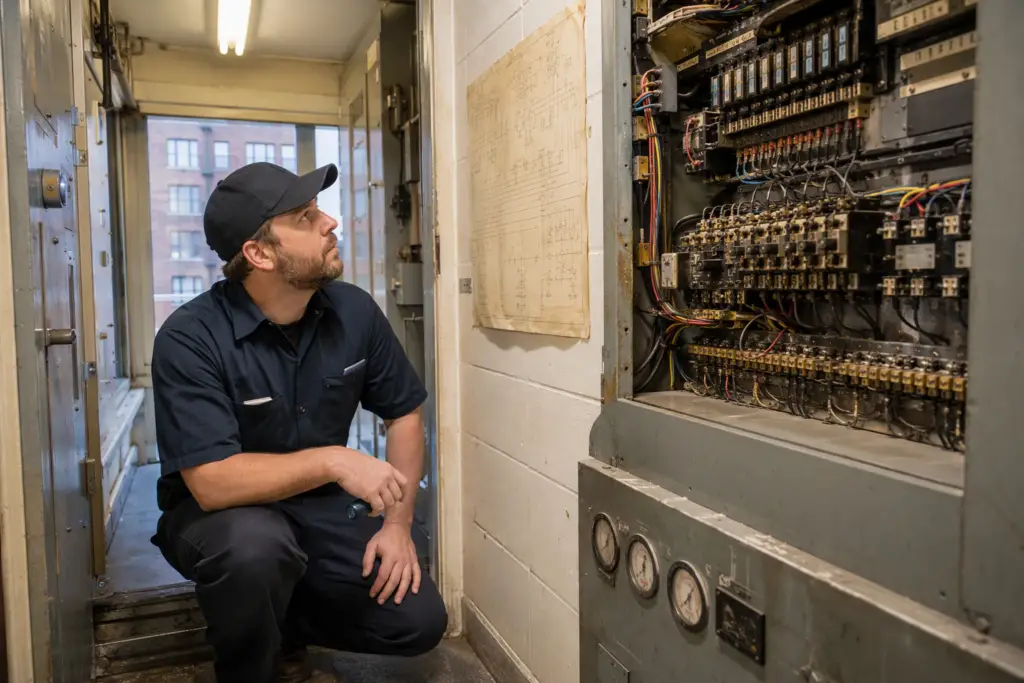
- Controller and electrical system inspection
- Pit and machine room housekeeping compliance checks
- Hydraulic fluid level checks and leak inspections (for hydraulic units)
- Documentation of all maintenance activities in the elevator log book
- Coordination with state or local inspection authorities for annual or periodic inspections
What a contract does not typically include is equally important to understand: modernization, major component replacement (motors, controllers, cables on many agreements), cosmetic repairs, and damage resulting from misuse or third parties.
How often should a commercial elevator be serviced under a contract?
Most commercial elevators in moderate-to-high-traffic buildings require monthly preventive maintenance visits, though exact intervals depend on the building’s duty cycle, equipment type, and the requirements of the applicable state jurisdiction.
High-traffic buildings — such as hospitals, transit-adjacent office towers, and hotels — may justify more frequent scheduled visits, while low-traffic buildings with one or two elevators may operate on a quarterly schedule for certain tasks. The contract should explicitly define visit frequency, the tasks performed at each visit level, and how records are maintained.
State and local codes in Maryland, DC, Virginia, and Pennsylvania each establish mandatory inspection intervals that are independent of — and in addition to — routine maintenance visits. These inspections are typically performed by a state-licensed inspector and must not be confused with contractor maintenance calls.
What code and regulatory requirements govern elevator maintenance contracts?
Elevator maintenance in commercial buildings is governed primarily by the ASME A17.1 Safety Code for Elevators and Escalators, supplemented by state-specific adoption statutes and local amendments in each jurisdiction Quality Elevator Company serves.
ASME A17.1 establishes the nationally recognized baseline for elevator design, installation, inspection, testing, and maintenance. Each jurisdiction adopts and amends this standard on its own legislative cycle. As of 2026, Maryland, the District of Columbia, Virginia, and Pennsylvania each maintain active elevator safety programs administered by their respective labor or building safety departments. These programs require:
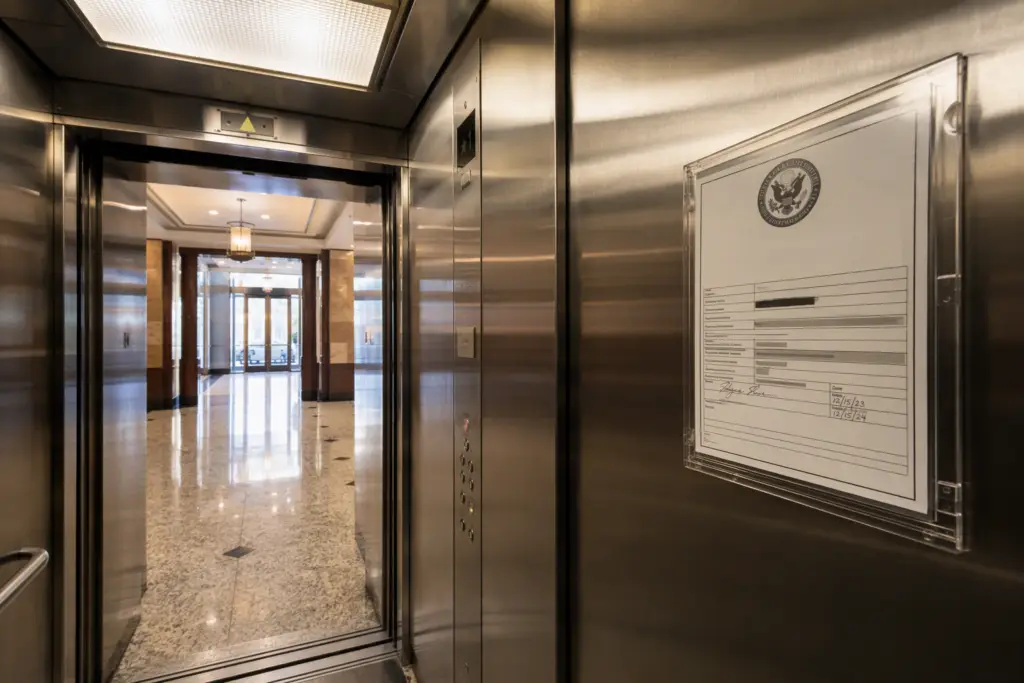
- Certificates of operation posted inside the elevator cab
- Periodic inspections by licensed third-party inspectors or state employees
- Documented maintenance logs accessible to inspectors
- Prompt correction of deficiencies cited in inspection reports
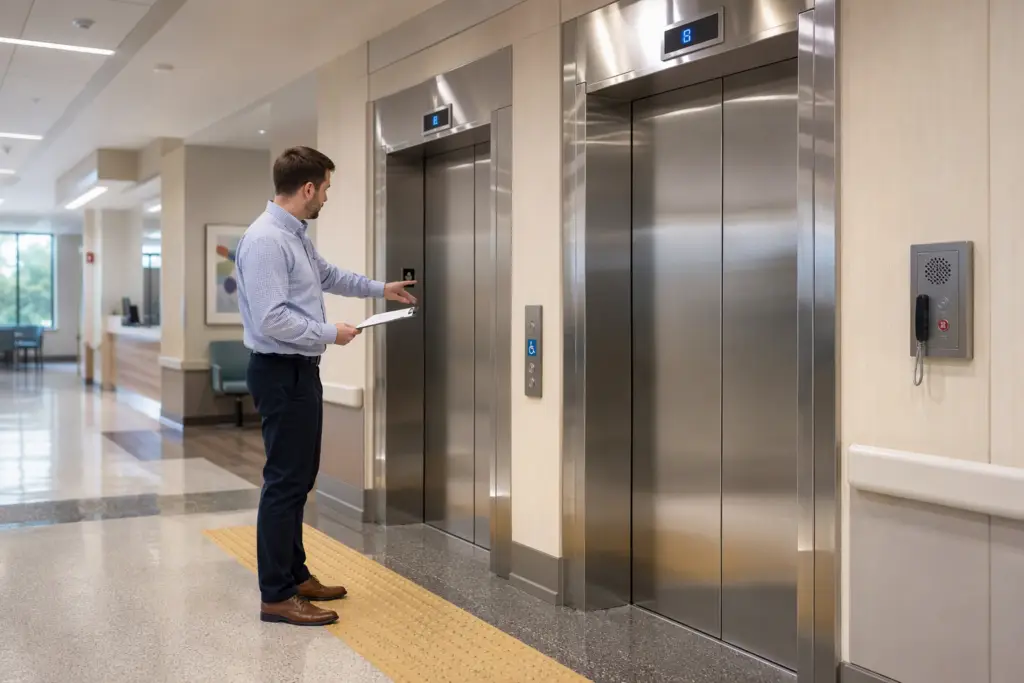
The Americans with Disabilities Act (ADA) also applies to elevators in commercial buildings, establishing requirements for accessible controls, door timing, audible signals, and cab dimensions. A comprehensive service contract should include provisions for maintaining ADA compliance features — not merely mechanical operation.
OSHA regulations further govern safe working conditions during elevator maintenance and inspection, including lockout/tagout procedures, machine room access controls, and pit safety requirements. Contractors operating under your service agreement are obligated to follow OSHA standards during all service visits.
What should building owners look for when comparing elevator service contracts?
When comparing elevator service contracts, building owners should evaluate the scope of included parts and labor, visit frequency, compliance documentation practices, exclusion clauses, contract length and termination rights, and the contractor’s familiarity with local regulatory requirements.
| Evaluation Criterion | Minimum Acceptable Standard | Best Practice Standard |
|---|---|---|
| Preventive Maintenance Frequency | Quarterly for low-traffic; monthly for moderate traffic | Monthly for all commercial buildings; visit records provided in writing |
| Parts Coverage | Expendable parts (filters, brushes, fuses) | Full parts and labor excluding major modernization |
| Compliance Documentation | Maintenance log book maintained on-site | Digital records accessible to building owner; inspection coordination included |
| Emergency Callback | Defined response protocol; hours stated clearly | 24/7 callback provision with documented escalation procedure |
| Contract Term | One-year renewable | Flexible term with reasonable early termination clause |
| Code Compliance Responsibility | Contractor performs required safety tests | Contractor coordinates state/local inspections and provides deficiency resolution |
| Exclusion Clauses | Clearly defined in writing | Limited exclusions; vandalism and misuse are the primary carve-outs |
| Proprietary Parts Lock-In | Non-proprietary or transferable parts access | No proprietary restrictions; equipment accessible to any licensed contractor |
Proprietary parts lock-in deserves special attention. Some national manufacturers program their controllers to accept service only from their own technicians, effectively removing the building owner’s ability to change contractors without significant costs. A transparent service provider will disclose whether any installed equipment creates this dependency before the contract is signed.
How much does a commercial elevator service contract cost?
The cost of a commercial elevator service contract varies based on equipment type, age, number of units, building traffic level, geographic market, and the scope of coverage — so building owners should obtain multiple itemized quotes rather than relying on industry averages.
Several factors drive pricing upward: older equipment requiring more frequent adjustments, hydraulic units that need annual fluid analysis, high-rise traction elevators with complex control systems, and buildings with multiple units that require coordinated maintenance scheduling. Conversely, newer equipment under manufacturer warranty, low-traffic installations, and buildings with well-documented maintenance histories may attract more competitive pricing.
When evaluating cost, total cost of ownership is the correct framework. A lower monthly fee on an oil-and-grease contract may result in substantially higher annual repair billings compared to a full-maintenance agreement. Building owners should ask contractors to model both scenarios using the equipment history on file.
What are common red flags in an elevator service contract?
Common red flags in elevator service contracts include automatic renewal clauses with minimal notice requirements, broad exclusion language that effectively voids comprehensive coverage, requirements to use proprietary parts that limit future contractor options, and vague emergency response language without defined obligations.
Additional warning signs include:
- No defined visit frequency or list of tasks performed at each visit
- Lack of written maintenance logs or digital reporting
- Exclusions so broad that only lubrication is reliably covered
- No mention of code compliance or inspection coordination
- Long initial terms (five or more years) with punitive exit penalties
- No provision for building owner access to maintenance records
- Absence of any deficiency correction protocol following inspections
Building owners in Baltimore, Washington DC, Philadelphia, and Richmond should verify that any prospective contractor holds current licensing in the applicable state or district. Unlicensed work can void the building’s certificate of operation and expose the owner to significant liability.
What is the difference between a maintenance contract and an inspection?
A maintenance contract is an ongoing service agreement for routine upkeep and repair, while an elevator inspection is a formal compliance evaluation — typically conducted by a licensed third-party inspector or government authority — that verifies the elevator meets applicable safety codes.
These two activities are legally distinct. A building can have an active maintenance contract and still fail an inspection if the contractor has not addressed cited deficiencies or if equipment has deteriorated beyond acceptable tolerances. Conversely, a building cannot substitute regular inspections for ongoing maintenance — the inspection only captures a point-in-time snapshot of the elevator’s condition.
The ASME A17.1 Safety Code for Elevators and Escalators defines specific periodic test intervals for various safety components, and inspectors will verify that these tests have been performed and documented. A well-drafted maintenance contract assigns clear responsibility for performing these periodic tests and retaining the records required to demonstrate compliance.
How should a building owner prepare before signing an elevator service contract?
Before signing an elevator service contract, a building owner should audit existing equipment records, obtain at least three competing bids with identical scope definitions, review the contractor’s licensing status in the applicable jurisdiction, and have legal counsel review auto-renewal and termination provisions.
Follow this process to ensure a well-informed decision:
- Gather all existing maintenance logs, inspection certificates, and repair records for each elevator unit.
- Document equipment make, model, age, and drive type (traction or hydraulic) for each unit in the building.
- Define minimum service requirements in writing before soliciting bids, so all proposals can be compared on equal terms.
- Request a physical walkthrough and equipment condition report from each bidding contractor before final proposals are submitted.
- Verify each contractor’s license status with the Maryland Department of Labor, DC Department of Buildings, Pennsylvania Department of Labor and Industry, or Virginia Department of Labor and Industry, as applicable.
- Compare proposed contracts line by line — specifically exclusions, visit frequency, parts coverage, and emergency service language.
- Negotiate auto-renewal notice periods to a minimum of 60 to 90 days and cap early termination penalties.
- Confirm that the selected contractor will provide written maintenance reports after each visit and coordinate all required state inspections.
What happens if an elevator fails a state or local inspection under an active service contract?
If an elevator fails a state or local inspection, the building owner is legally responsible for correcting cited deficiencies and must not return the unit to service until a re-inspection confirms compliance — the existence of a maintenance contract does not transfer this legal obligation to the contractor.
However, a well-structured service contract should include clear provisions for how the contractor responds to inspection failures. These provisions typically specify the timeframe within which the contractor must provide a deficiency correction plan, whether corrective repairs are covered under the contract or billed separately, and who is responsible for scheduling the re-inspection.
Quality Elevator Company recommends that building owners in all four service markets request an explicit inspection response clause in any new or renewing contract, documenting in writing how the contractor will handle deficiency letters from state or local authorities.
How does elevator age and equipment type affect service contract terms?
Older elevators and hydraulic systems typically require broader parts coverage provisions and more frequent maintenance intervals than newer traction units, which means building owners of aging equipment should scrutinize exclusion clauses with particular care.
Hydraulic elevators introduce additional considerations: underground cylinder systems may be subject to environmental regulations regarding fluid containment and leak detection, and hydraulic fluid must be maintained at proper levels and viscosity. A service contract covering a hydraulic unit should address fluid maintenance, seal integrity checks, and, where applicable, underground cylinder testing as required by the applicable edition of ASME A17.1.
Traction elevators — whether geared or gearless — involve rope, sheave, and machine room components that have defined replacement lifecycles. Contracts covering older traction units should specify how rope inspection findings are handled and whether rope replacement is within contract scope or subject to a separate capital expense proposal.
What ADA compliance obligations apply to commercial elevator maintenance contracts?
Under the Americans with Disabilities Act, commercial elevators in buildings subject to Title III must maintain accessible features in working order, meaning the service contract should include specific provisions for ADA-relevant components such as door timing, floor call buttons, audible indicators, and Braille signage.
ADA requirements do not merely apply at installation — they are an ongoing operational obligation. A door that closes too quickly fails ADA standards even if it was originally installed correctly. Similarly, an audible floor indicator that has malfunctioned without correction creates both an accessibility violation and a potential liability exposure for the building owner.
Service contracts should explicitly list ADA-sensitive components and define how the contractor reports and resolves any identified deficiencies. Buildings undergoing significant alterations may also trigger path-of-travel ADA upgrade requirements, which should be addressed in concert with the elevator service provider.
What is the role of elevator monitoring technology in modern service contracts?
Remote elevator monitoring technology allows service contractors to detect developing faults, track door cycle counts, log entrapment events, and prioritize maintenance visits based on actual equipment condition data rather than fixed schedules — and modern service contracts should address who owns this data and how it is used.
Connected monitoring systems can reduce unplanned downtime by identifying anomalies before they result in service interruptions. For commercial building owners, the practical benefit is fewer passenger entrapments, more predictable maintenance costs, and a documented operational history that supports both insurance and compliance objectives.
When reviewing a contract that includes monitoring technology, building owners should confirm: whether the monitoring hardware is owned or leased, what happens to the data if the contract is terminated, whether the data feeds are accessible to the building owner in real time, and how the contractor integrates monitoring data into its maintenance scheduling decisions.
How do multi-elevator buildings structure their service contracts?
Multi-elevator buildings typically consolidate all units under a single contractor agreement to simplify scheduling, accountability, and compliance documentation — though the contract should include unit-level service records to ensure no individual elevator’s maintenance is deferred.
Consolidating units with one provider creates operational advantages: a single point of contact for emergency response, consistent documentation practices across the portfolio, and potential pricing leverage from volume. However, it also concentrates risk. If the contractor underperforms, all units in the building are affected simultaneously.
Building owners managing multi-elevator properties in Baltimore, DC, Philadelphia, or Richmond should require unit-level maintenance logs in addition to building-level summaries. This granularity is essential for identifying patterns — such as a single cab with persistently high callback rates — that might be obscured in aggregate reporting.
What should a building owner do immediately if an elevator becomes unsafe during a contract period?
If a commercial elevator presents an immediate safety hazard during an active contract period, the building owner must act quickly and systematically to protect passengers, preserve evidence, and engage the appropriate parties.
- Take the elevator out of service immediately by placing it in the off or independent service position and securing the machine room.
- Post clearly visible out-of-service signage at all floor landings to prevent passengers from attempting to use the unit.
- If passengers are entrapped, contact emergency services (911) first — do not attempt a non-professional rescue.
- Notify your elevator service contractor through their emergency callback line and document the time and content of the notification.
- Document all observable symptoms in writing before the contractor arrives: unusual sounds, door behavior, leveling issues, error codes, or any recent unusual events.
- Preserve any available monitoring data, error logs, or security camera footage from the incident period.
- Notify your state or local elevator authority if the safety issue involves a reportable incident (entrapment, injury, or major component failure) — requirements vary by jurisdiction.
- Do not return the elevator to service until the contractor provides written confirmation that the identified hazard has been corrected and the unit is safe to operate.
How do elevator service contracts differ across Maryland, DC, Pennsylvania, and Virginia?
Each jurisdiction — Maryland, the District of Columbia, Pennsylvania, and Virginia — maintains its own elevator safety program, licensing requirements for contractors and mechanics, and inspection intervals, meaning a service contract that is fully compliant in one market may require modifications to satisfy requirements in another.
Building owners with multi-state portfolios face added complexity: a contractor licensed in Maryland may require separate licensing to work in DC or Virginia, and inspection frequencies mandated by state authorities may differ from those specified in a standard national contract template. Quality Elevator Company holds the applicable certifications to operate across all four markets, which simplifies compliance management for owners with properties in multiple jurisdictions.
Contracts covering buildings in multiple states should explicitly reference the applicable jurisdiction’s code edition and inspection schedule for each property, rather than relying on generic language that may not satisfy all relevant authorities.
What questions should a property manager ask a prospective elevator service contractor?
Property managers should ask prospective elevator service contractors about their licensing status in the relevant jurisdiction, how they handle inspection failures, what their parts exclusion list includes, how maintenance records are provided to the building owner, and whether their equipment creates any proprietary service dependencies.
Additional high-value questions include:
- How is emergency callback service structured, and what escalation procedures exist if the initial response does not resolve the issue?
- Who specifically will be assigned to this building, and what is their qualification level under the applicable state licensing framework?
- How does the contractor coordinate with the state or local inspection authority for annual and periodic inspections?
- What is the process for obtaining a capital repair estimate when a major component falls outside contract scope?
- Does the contractor have experience with the specific equipment manufacturer and model installed in the building?
- How are maintenance records stored, and can the building owner access them independently of the contractor?
When is the right time to modernize rather than maintain an aging elevator under contract?
Building owners should evaluate elevator modernization when recurring repair costs under the maintenance contract consistently approach or exceed the cost of component replacement, when obsolete parts are no longer available from any supplier, or when the equipment cannot be brought into compliance with current code without major capital work.
Modernization is not a maintenance contract decision — it is a capital planning decision informed by maintenance data. A quality service contractor will provide honest assessments of equipment condition and flag cases where continued maintenance investment is unlikely to be cost-effective relative to modernization. Watch for contractors who delay modernization recommendations to protect recurring maintenance revenue, as this misalignment of incentives ultimately harms building owners and passengers alike.
Modernized equipment also resets the compliance baseline. Post-modernization, the elevator must meet the code edition in effect at the time of the work, which may introduce new features such as updated door protection devices, revised cab dimensions, or enhanced controller diagnostics that change the scope of future maintenance contracts.
Why should commercial building owners in Baltimore, DC, Philadelphia, and Richmond choose Quality Elevator Company for their service contract?
Commercial building owners in the Mid-Atlantic region benefit from working with a single certified elevator service company that understands the specific licensing, inspection, and code compliance requirements in each of the four markets, eliminating the complexity and risk of managing multiple contractors across jurisdictions.
Quality Elevator Company serves commercial properties across Baltimore MD, Washington DC, Philadelphia PA, and Richmond VA, providing maintenance contracts tailored to local regulatory requirements and the specific equipment installed in each building. The company’s geographic focus on the Mid-Atlantic market means that its service teams are familiar with the inspection authorities, code adoption cycles, and common equipment types found in these markets — practical knowledge that generalist national providers may lack.
For building owners evaluating service contract options, the combination of multi-jurisdiction expertise, transparent contract terms, and local presence makes Quality Elevator Company a compelling choice for properties throughout the region.
How can building owners ensure long-term elevator reliability through their service contract?
Long-term elevator reliability is achieved through consistent preventive maintenance execution, thorough documentation, proactive capital planning for aging components, and a service contract that creates genuine accountability between the building owner and the contractor.
Reliability is not a feature that can be purchased with a higher-tier contract alone. It requires active partnership: building owners who review maintenance reports, track callback frequency, and engage their contractor in annual planning conversations consistently achieve better outcomes than those who sign a contract and disengage. The service contract is the foundation, but the relationship is the operating mechanism.
Building owners should establish a formal annual review of their elevator service contract, using the year’s maintenance records, inspection results, and repair history to evaluate both equipment performance and contractor performance before the contract renews. This practice creates a structured opportunity to renegotiate scope, address persistent deficiencies, and plan capital expenditures for the year ahead.
Need elevator service you can rely on? Quality Elevator Company is ready to help.