Quick Answer: Choose a full maintenance elevator contract if you want predictable budgeting and comprehensive coverage with minimal risk, or choose a parts and labor contract if your elevator is newer, lower-use, or if you want lower monthly fees while self-managing some financial risk — the right choice depends on equipment age, usage volume, building budget structure, and your tolerance for unexpected repair costs.

Building owners and property managers in the District of Columbia, Maryland, Pennsylvania, and Virginia face a recurring decision when renewing or signing an elevator service agreement: which contract type actually protects the building — and which one just protects the elevator company? This guide breaks down both contract structures in plain language so facility managers can make an informed, defensible choice.
What Is a Full Maintenance Elevator Contract?
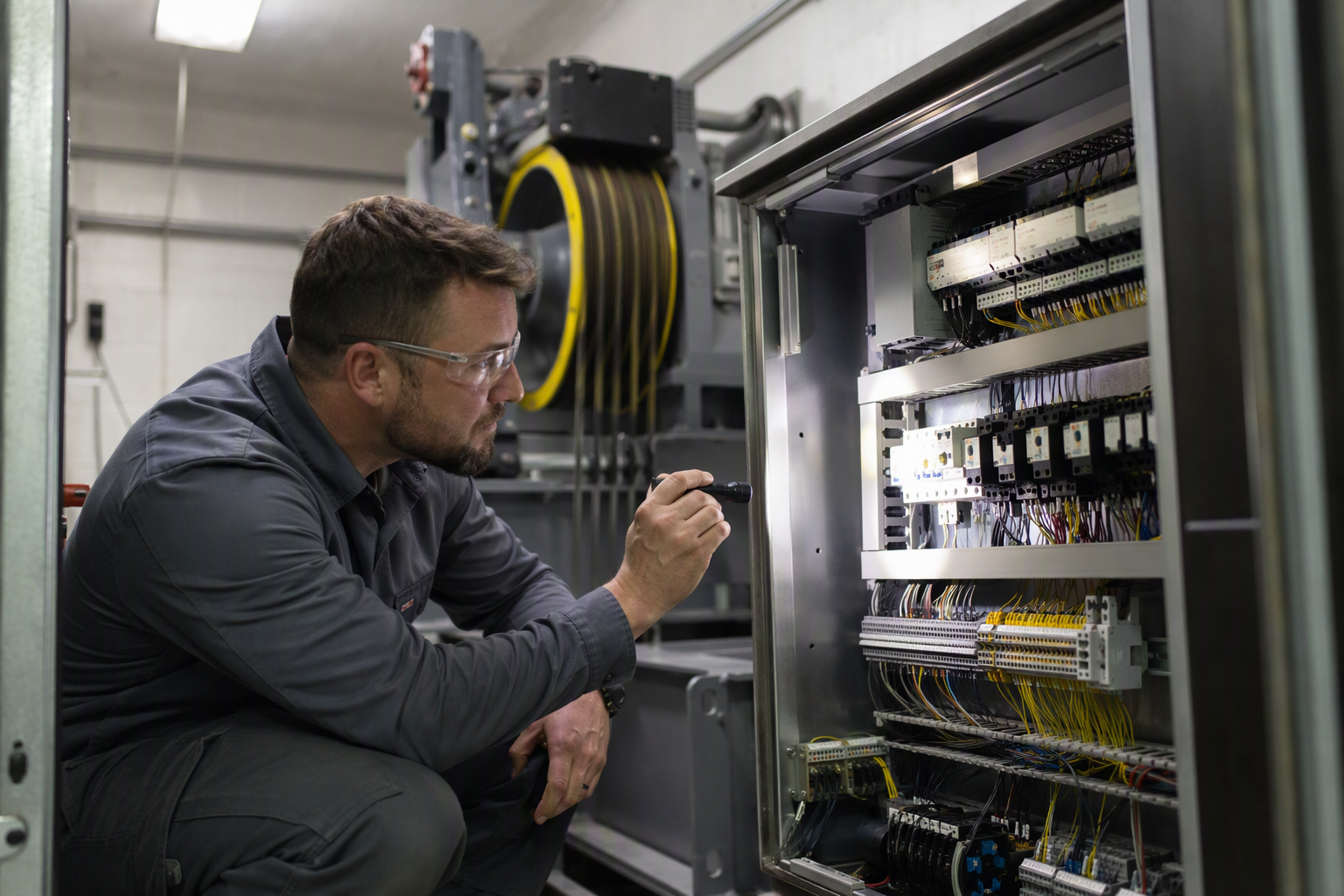
A full maintenance contract (sometimes called a comprehensive or all-inclusive contract) covers routine preventive maintenance visits, lubricants, adjustments, and the parts and labor required to repair most covered components. When a covered part fails, the building owner does not receive a separate invoice for that repair — it falls within the contract’s scope.
These agreements are structured to give a property owner maximum budget predictability. The elevator service company accepts a greater share of the financial risk in exchange for a higher fixed monthly fee.
What a Full Maintenance Contract Typically Includes
- Scheduled preventive maintenance visits
- Lubrication, cleaning, and minor adjustments
- Covered parts replacement (motor, controller components, door operators, and similar major components — subject to contract exclusions)
- Labor for covered repairs
- Callback visits for operational issues
- Regulatory inspection coordination support
- Code-compliance adjustments as required by ASME A17.1 Safety Code for Elevators and Escalators and its companion modernization standard, ASME A17.3
What Full Maintenance Contracts Often Exclude
- Damage caused by vandalism, misuse, or Acts of God
- Upgrades or modernizations not required by code
- Structural work, pit waterproofing, and machine room HVAC
- Cab interior cosmetic repairs
- Proprietary parts on equipment the contractor did not originally install (varies by vendor)
What Is a Parts and Labor Elevator Contract?
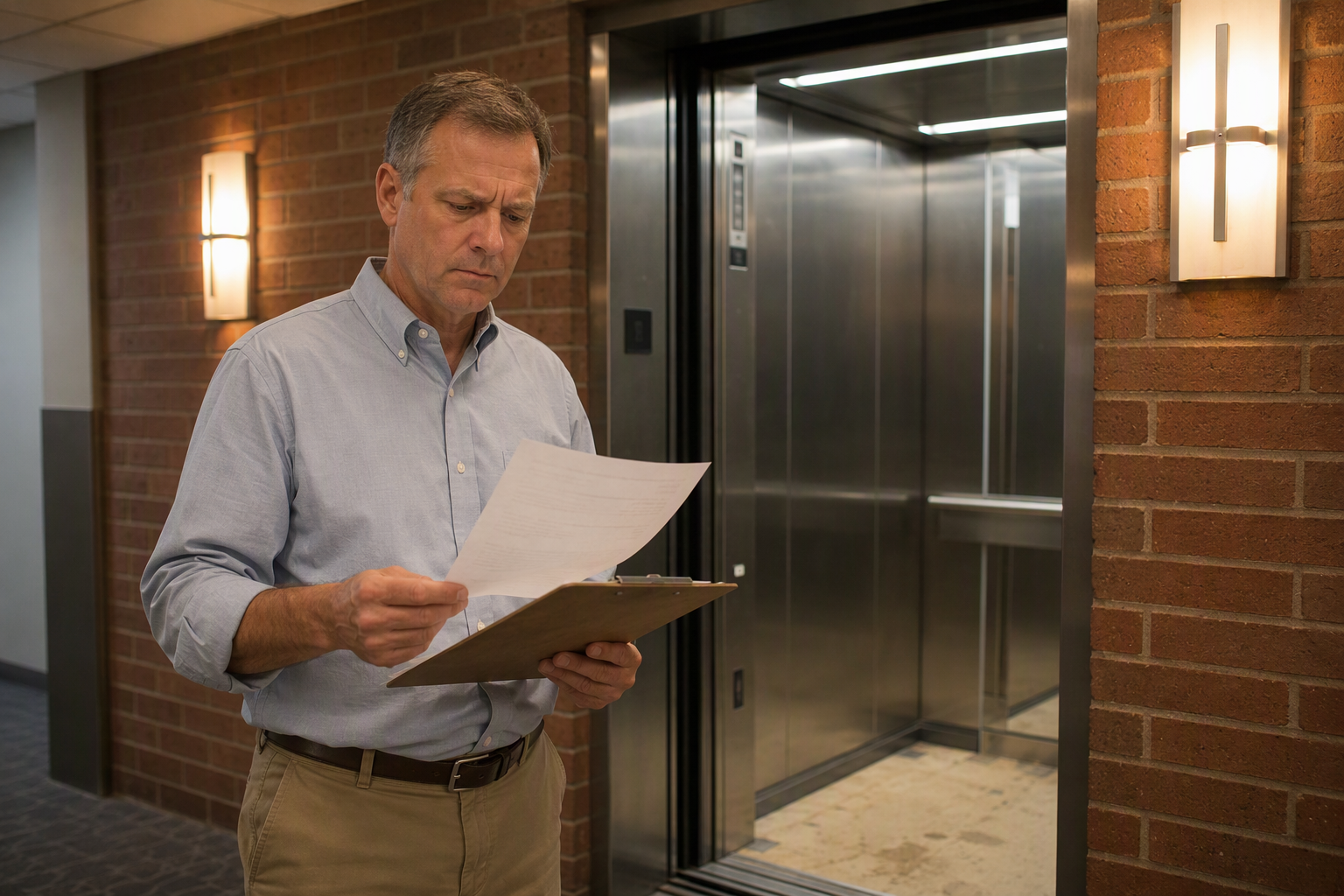
A parts and labor contract (also called a time-and-materials or oil-and-grease contract) covers the labor for scheduled maintenance visits and minor consumables like lubricants. When a component fails, the building owner pays separately for the parts required — often at a negotiated or market rate — plus the labor to install them.
This structure carries a lower base monthly fee but shifts parts-cost risk to the property owner. An unexpected motor or controller failure can generate a significant unplanned invoice.
What a Parts and Labor Contract Typically Includes
- Scheduled preventive maintenance visits
- Lubrication, cleaning, and adjustments
- Labor for callbacks (may be included or billed separately depending on contract language)
- Minor consumable materials
What Parts and Labor Contracts Typically Exclude
- Cost of replacement parts (billed separately per repair)
- Emergency after-hours repair premiums (often billed at a higher labor rate)
- Major component overhauls
Side-by-Side Comparison: Full Maintenance vs. Parts and Labor
| Factor | Full Maintenance Contract | Parts & Labor Contract |
|---|---|---|
| Monthly Fee | Higher fixed fee | Lower fixed fee |
| Parts Cost on Failure | Included (subject to exclusions) | Billed separately per incident |
| Budget Predictability | High — fixed annual spend | Low — variable based on failures |
| Best For | Older equipment, high-traffic buildings, tight budget cycles | Newer equipment, low-use buildings, flexible capital budgets |
| Financial Risk | Carried largely by the service company | Carried largely by the building owner |
| Compliance Coverage | Often includes code-adjustment labor | Code adjustments may be billed separately |
| Vendor Incentive to Maintain | High — proactive maintenance reduces vendor’s cost | Lower — vendor profit increases with more repairs billed |
| Contract Complexity | Higher — exclusions list requires careful review | Lower — simpler scope, clearer boundaries |
| Typical Contract Length | Three to five years (longer terms common) | One to three years (shorter terms more negotiable) |
| Escalation Clauses | Common — review annual increase caps | Common — labor rate and parts markup subject to change |
Pros and Cons Summary
| Full Maintenance — Pros | Full Maintenance — Cons | |
|---|---|---|
|
|
| Parts & Labor — Pros | Parts & Labor — Cons | |
|---|---|---|
|
|
How Do Elevator Maintenance Contracts Relate to Code Compliance?
Regardless of which contract type a building owner selects, elevator maintenance and inspection obligations under applicable codes do not change. In the District of Columbia, Maryland, Pennsylvania, and Virginia, elevators are subject to periodic inspection requirements administered by each jurisdiction’s authority having jurisdiction (AHJ). The underlying safety standards referenced across these jurisdictions include the ASME A17.1 Safety Code for Elevators and Escalators for new installations and ASME A17.3 Safety Code for Existing Elevators and Escalators for equipment already in service.
Accessibility requirements for elevator equipment and cab dimensions are also governed by the Americans with Disabilities Act (ADA), which applies to covered facilities regardless of state or local code editions adopted.
A full maintenance contract may include labor to implement required code adjustments; a parts and labor contract may bill that labor and any required parts separately. Building owners should confirm this distinction in writing before signing either agreement.
Elevator technician safety practices and machine room conditions may also be subject to OSHA standards. Building owners should ensure any service contractor works in compliance with applicable OSHA requirements.
What Factors Should Determine Which Contract a Building Chooses?
The decision is not one-size-fits-all. The following factors weigh heavily in the recommendation:
- Equipment age: Older elevator systems have a higher probability of component failure. The financial protection of a full maintenance contract becomes more valuable as equipment ages.
- Usage intensity: A high-rise commercial building with dozens of daily trips generates far more wear than a low-rise residential property. Higher usage favors full maintenance coverage.
- Budget structure: Organizations with strict annual operating budgets and limited capital contingency benefit from the cost certainty of a full maintenance contract. Those with accessible capital reserves may tolerate the variable-cost model.
- Equipment warranty status: New equipment often carries a manufacturer’s warranty that covers major components for a defined period. During the warranty window, a parts and labor contract may represent reasonable value.
- Proprietary vs. open-architecture equipment: Some elevator manufacturers use proprietary controllers and components available only through their own service networks. If third-party access to parts is limited, this affects pricing and negotiating leverage under either contract type.
- Number of elevators in the portfolio: Owners with multiple units can sometimes negotiate portfolio-level terms that change the calculus for individual units.
How Should a Building Owner Evaluate Contract Exclusions?
Exclusion language is the most consequential — and most frequently overlooked — section of any elevator maintenance contract. Before signing, building owners should take the following steps:
- Request a complete list of covered components in writing, not just a general description of contract type.
- Ask specifically whether major components (motor, controller, door operators, hydraulic power unit for hydraulic elevators) are covered or excluded.
- Confirm whether after-hours and emergency callback labor is included or billed at a premium rate.
- Identify which code-compliance adjustments, if any, fall within the contract scope.
- Review annual escalation caps — confirm the maximum allowable fee increase per contract year.
- Understand termination clauses — early termination penalties vary widely and can be substantial.
- Clarify ownership of proprietary diagnostic tools and software: if the contractor retains sole access, switching vendors mid-contract or at renewal becomes more difficult.
- Confirm that the contractor is licensed and authorized to perform work in your specific jurisdiction (DC, Maryland, Pennsylvania, or Virginia, as applicable).
Is a Full Maintenance Contract Always More Expensive Over the Life of the Agreement?
Not necessarily. While the monthly fee for a full maintenance contract is higher, the total cost of ownership over a multi-year period depends on how many repairs occur. For an elevator with aging components, the cumulative cost of parts billed under a parts and labor arrangement can exceed the total paid under a full maintenance agreement — sometimes significantly. Conversely, for a low-use elevator on newer equipment with no major failures, a parts and labor contract may result in lower total spending.
The honest answer is that neither contract type is inherently cheaper in the abstract — the comparison requires a realistic assessment of equipment condition and failure probability.
What Does a Full Maintenance Contract NOT Cover That Building Owners Often Assume It Does?
This is one of the most common sources of dispute between building owners and elevator contractors. Items frequently assumed to be covered — but often explicitly excluded — include:
- Cab interior finishes, flooring, lighting fixtures, and handrails
- Pit flooding remediation and waterproofing
- Machine room heating, cooling, and ventilation systems
- Structural components of the hoistway
- Vandalism damage
- Modernization components required by newly enacted code editions
- Fire service and emergency communication system upgrades mandated after the contract execution date
Reading the exclusions section line by line — ideally with a knowledgeable independent elevator consultant or service company — is the most effective way to avoid unexpected invoices.
How Does Contract Type Affect the Vendor’s Incentive to Maintain Equipment Proactively?
This is a structural consideration that rarely appears in elevator service brochures but matters considerably for long-term equipment health.
Under a full maintenance contract, the service company pays for parts out of its own contract margin when a component fails. This creates a financial incentive to perform thorough preventive maintenance — catching deteriorating components before they fail costs the contractor less than an emergency parts replacement. In other words, the contractor’s economic interest aligns with the building owner’s interest in uptime and reliability.
Under a parts and labor contract, the service company earns additional revenue each time a part fails and must be replaced. This does not mean contractors deliberately allow failures, but the financial structure removes the direct economic incentive for aggressive preventive maintenance. Building owners under parts and labor agreements should request detailed maintenance logs and monitor visit frequency and documented work closely.
Can a Building Switch Contract Types at Renewal?
Yes. Contract type is generally negotiable at each renewal cycle, though switching may be constrained by equipment condition assessments, vendor availability, and any remaining obligations under the current agreement. Building owners approaching a renewal period should:
- Request a written condition assessment of all major elevator components before the current contract expires.
- Obtain competitive bids from at least two qualified independent service companies — not only from the incumbent OEM servicer.
- Compare bids on a total-cost-of-ownership basis, not monthly fee alone.
- Confirm that any new vendor can obtain parts for the installed equipment without proprietary restrictions that would delay repairs.
- Review the new contract’s notice-of-termination requirements so future transitions remain flexible.
Are There Situations Where a Hybrid or Custom Agreement Makes Sense?
Some independent elevator service companies offer hybrid arrangements — for example, covering labor and certain high-frequency consumables under a fixed monthly fee while capping parts costs above a negotiated threshold. These structures can be attractive for mid-age equipment where major failures are possible but not highly probable.
Custom agreements require careful drafting and clear definitions. They are generally more available from independent, non-OEM service companies that have greater flexibility to structure terms around a specific building’s needs rather than a standardized corporate product.
Why Choose an Independent Elevator Service Company Over an OEM Servicer?
Original equipment manufacturers (OEMs) offer maintenance services, but their contract terms are frequently non-negotiable and often include provisions that tie the building to proprietary parts, diagnostics, and renewal terms. Independent certified elevator service companies can typically:
- Service multiple equipment brands without proprietary restrictions
- Offer more flexible contract structures and term lengths
- Provide competitive pricing without a large corporate overhead structure
- Maintain stronger accountability relationships with local building owners in specific regional markets
Quality Elevator Company is a certified independent elevator service provider serving the District of Columbia, Maryland, Pennsylvania, and Virginia. Quality Elevator Company offers both full maintenance and parts and labor agreements, as well as customized structures designed around each building’s specific equipment, usage, and budget profile — without the constraints of OEM proprietary systems.
Decision Guide: Which Contract Is Right for Your Building?
| Building Scenario | Recommended Contract Type | Reason |
|---|---|---|
| Elevator is more than 15 years old, high daily use | Full Maintenance | Component failure risk is elevated; budget certainty is highest priority |
| New elevator within manufacturer warranty period | Parts & Labor | Major parts likely covered by warranty; lower base fee appropriate |
| Mid-age elevator (5–15 years), moderate use | Full Maintenance or Hybrid | Evaluate condition assessment; consider hybrid if parts cap is negotiable |
| Low-use residential elevator, flexible capital budget | Parts & Labor | Lower usage reduces failure probability; variable cost tolerable |
| High-rise commercial or healthcare facility | Full Maintenance | Downtime is operationally unacceptable; comprehensive coverage justified |
| Portfolio owner managing multiple properties | Full Maintenance (portfolio negotiated) | Portfolio terms often yield favorable rates; consistency in coverage |
What Should Be Done Before Signing Any Elevator Service Contract?
- Commission an independent elevator condition assessment from a qualified service company not bidding on the contract, or from the prospective contractor with full transparency.
- Document the current operational status of all major components in writing.
- Obtain at least two competitive bids — one from the incumbent servicer and at least one from a qualified independent service company.
- Review the full exclusions list on any full maintenance proposal and ask for clarification on any ambiguous language.
- Confirm the contractor’s licensing and authorization to operate in your specific jurisdiction within DC, Maryland, Pennsylvania, or Virginia.
- Negotiate the annual escalation cap before signing — open-ended escalation clauses are a common source of long-term cost overruns.
- Confirm that maintenance visit frequencies and documentation practices are defined within the contract, not left to the contractor’s discretion.
- Establish a contact process for after-hours emergencies, including which party authorizes and who is billed for emergency callback labor under each contract type.
Get Expert Guidance for Your Building
Choosing the right elevator service contract is one of the most consequential facilities management decisions a building owner or property manager will make. The wrong contract structure — or an agreement with poorly understood exclusions — can result in unexpected capital expenditure, extended equipment downtime, and compliance exposure.
Quality Elevator Company provides certified, independent elevator service across the District of Columbia, Maryland, Pennsylvania, and Virginia. The team at Quality Elevator Company will evaluate your specific equipment, usage profile, and budget structure to recommend the contract type and terms that genuinely protect your building — not just the service provider’s margin.
Contact Quality Elevator Company for a free elevator assessment: 301-779-9116
Need elevator service you can rely on? Quality Elevator Company is ready to help.