How to Get a Quote for Replacing Multiple Elevators in a Courthouse or Government Facility
To get a quote for replacing multiple elevators in a courthouse or government facility, an owner or facility manager should compile a complete equipment inventory, gather existing inspection certificates and maintenance records, identify the authority having jurisdiction (AHJ) for each elevator, and contact a licensed elevator contractor to schedule a site assessment. The contractor will develop a phased scope of work, identify code-compliance gaps, and provide a detailed proposal covering equipment, labor, permitting, and scheduling.
What information does a facility need to gather before requesting an elevator replacement quote?
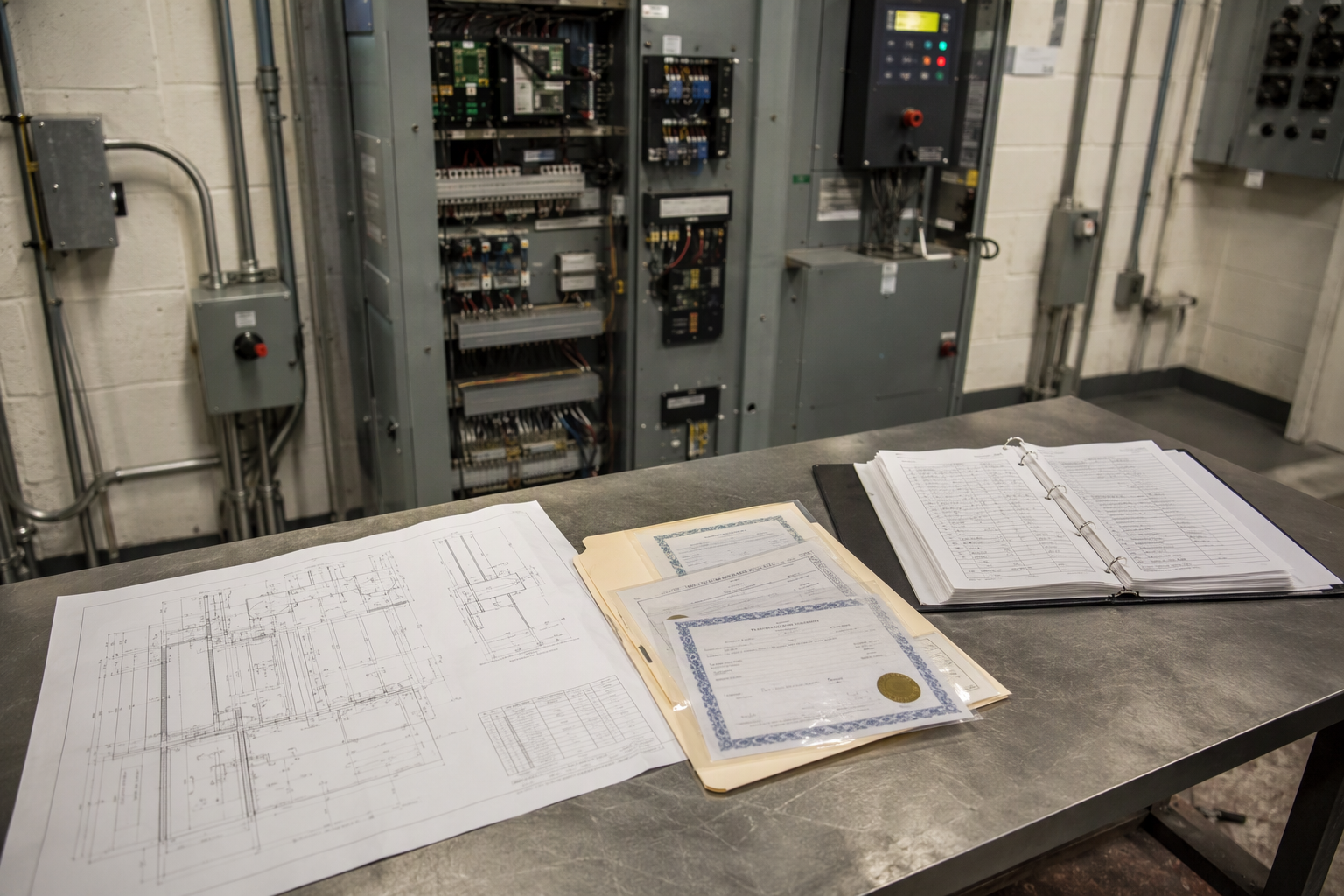
A facility should compile a complete equipment inventory, current inspection certificates, maintenance records, and architectural drawings before contacting any contractor.
Thorough pre-quote preparation prevents scope gaps and cost surprises later in the project. The minimum package a government facility manager should assemble includes: a list of every elevator unit by floor-stop configuration, rated capacity, drive type (hydraulic, traction, machine-room-less), and approximate installation date; copies of current certificates of inspection for each unit; at least three years of maintenance and repair logs; hoistway dimensions and pit drawings where available; and any prior modernization study or capital planning report.
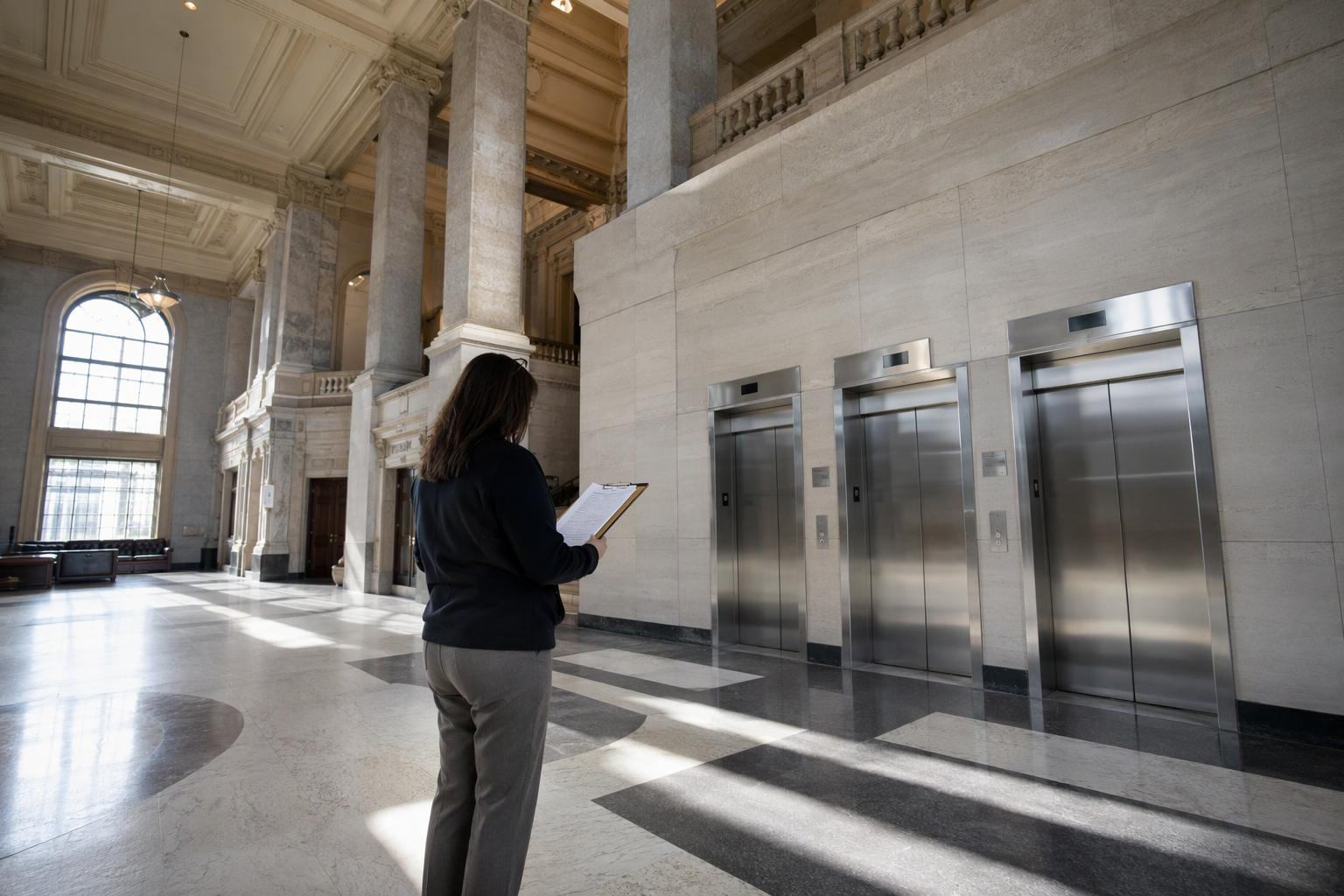
For courthouse facilities in particular, the building program matters. Courts operate on strict schedules, and judges, attorneys, jurors, and the public all depend on predictable vertical transportation. A contractor needs to understand peak-occupancy windows, secure floor access restrictions, and after-hours work limitations before scoping a multi-unit replacement project.
Identifying the authority having jurisdiction early is equally important. Jurisdictional requirements vary across the Quality Elevator Company service area: Maryland, the District of Columbia, Pennsylvania, and Virginia each maintain distinct regulatory frameworks that affect permitting timelines, inspection sequencing, and allowable construction hours.
How does jurisdiction affect the permitting and inspection process for a multi-elevator replacement?
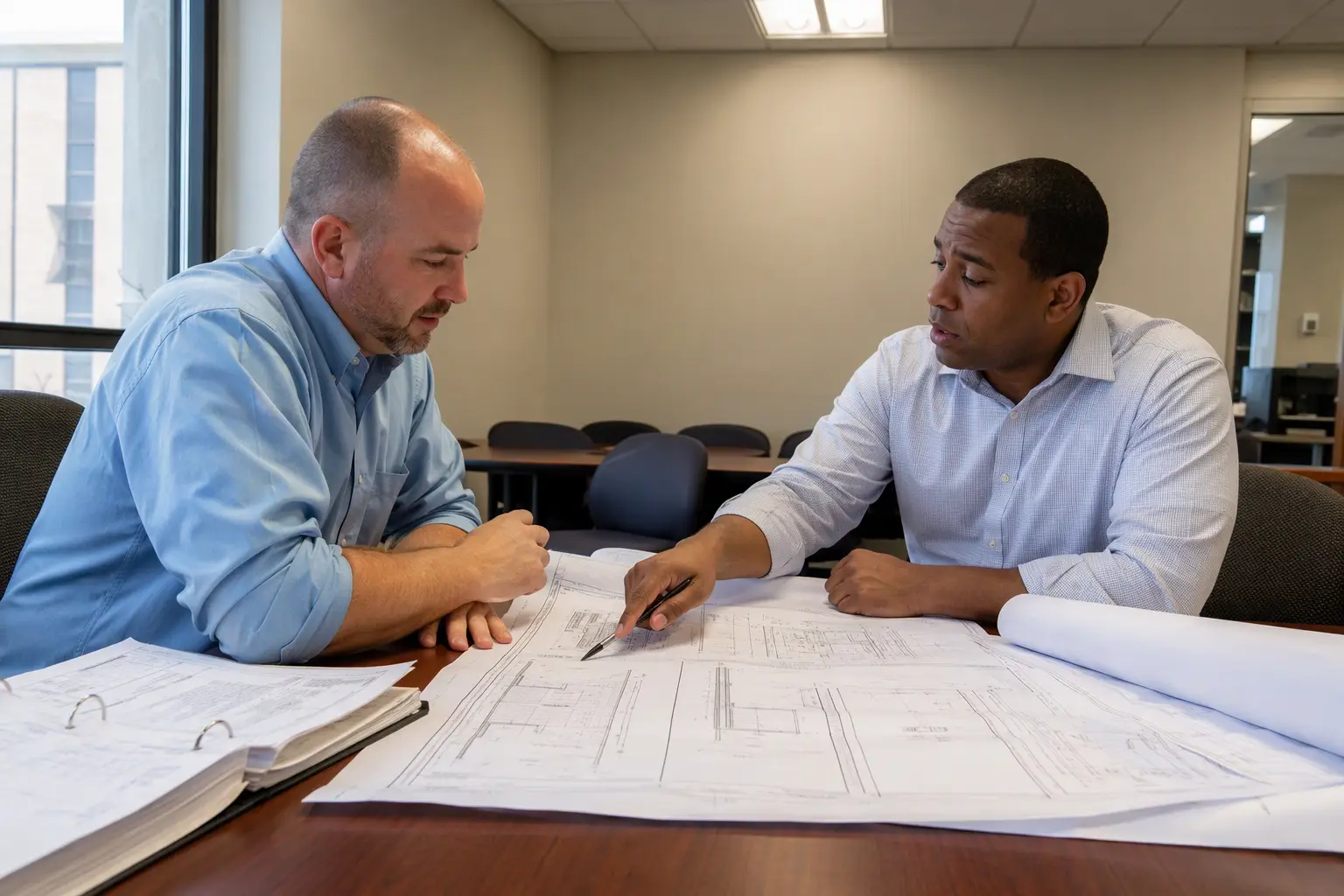
Each state and the District of Columbia in Quality Elevator Company’s service area has a separate regulatory body, adopted code edition, and inspection protocol that governs elevator replacement projects.
In Maryland, the Maryland Department of Labor, Division of Labor and Industry, Elevator and Escalator Safety oversees elevator regulation under the Annotated Code of Maryland, Public Safety Article, Title 12, Subtitle 8. The State conducts final acceptance inspections after installation or alteration before an elevator is placed back in service. Maryland adopted the ASME A17.1/CSA B44, 2022 edition (effective June 17, 2026), and the edition that applies to any specific project depends on the date the installation contract was signed. All work must be performed by mechanics and contractors licensed by the Maryland Elevator Safety Review Board.
In the District of Columbia, the DC Department of Buildings (DOB) issues elevator certificates and oversees permits under D.C. Official Code § 6-1409 and 12-A DCMR Chapter 30. DC adopted the ASME A17.1-2013/CSA B44-13 edition as referenced by the 2017 DC Building Code, effective May 29, 2020. DC requires a DOB-approved third-party inspection agency and ASME QEI-certified inspectors for all periodic and Category 5 testing. DOB permits for replacement work require copies of a master electrician license and an elevator contracting license. Notably, DC law requires that in buildings with passenger elevators, at least one elevator must remain in operation whenever the building is occupied — a critical scheduling constraint for courthouse projects.
In Pennsylvania, the Pennsylvania Department of Labor and Industry (L&I) has statewide jurisdiction over elevator construction, alteration, and inspection under 34 Pa. Code Chapter 405. For permit applications made before December 20, 2026, work must comply with ASME A17.1-2000 including the A17.1a-2002 addenda. For applications filed on or after December 20, 2026, the ASME A17.1-2016 edition with Pennsylvania modifications applies. No elevator may return to service after major replacement work until L&I inspects and passes it.
In Virginia, elevator inspection authority rests with the local building department under the Virginia Uniform Statewide Building Code (13VAC5-63) and Code of Virginia § 36-97 et seq. The 2021 USBC, which adopted ASME A17.1/CSA B44-2019, took effect January 18, 2024. In Richmond, the City of Richmond Department of Planning and Development Review, Bureau of Permits and Inspections, runs the local elevator program. Contractors must hold an Elevator/Escalator Contracting (EEC) specialty license through the Virginia Board for Contractors (DPOR), and mechanics must be state-certified.
What federal codes apply to elevator replacement in government buildings?
Federal requirements under the Americans with Disabilities Act (ADA) and the ASME A17.1 Safety Code for Elevators and Escalators apply to elevator replacement projects in public facilities, including courthouses.
The ADA establishes accessibility requirements for public entities and places of public accommodation. Courthouses are facilities of government entities and must comply with ADA Title II, which requires accessible routes including elevators in multi-story facilities. Any replacement project is an opportunity — and in many cases an obligation — to bring elevator accessibility into full compliance, including door widths, control panel heights, audible and visual floor indicators, and Braille and raised character signage.
The ASME A17.1 Safety Code for Elevators and Escalators sets the baseline technical standard for elevator design, construction, operation, inspection, and testing across the United States. While each state adopts a specific edition (see the jurisdiction-specific answers above), ASME A17.1 governs the core safety requirements for all equipment types involved in a courthouse replacement project, from traction hoisting machines to hydraulic power units to door-operator systems.
OSHA regulations govern construction-site safety during the replacement installation phase and apply to elevator mechanics and other trades working in hoistways and machine rooms on federally contracted or publicly funded projects.
What is a scope-of-work assessment, and why is it essential for multi-elevator projects?
A scope-of-work assessment is a systematic, unit-by-unit evaluation that documents the existing condition of each elevator, identifies code-compliance deficiencies, and defines the full replacement or modernization package required before pricing can be developed accurately.
For a courthouse with multiple elevators, a thorough scope-of-work assessment typically covers: the structural condition of each hoistway; the age, type, and condition of the hoisting machine, controller, and drive system; door operator performance and door-safety device functionality; buffer and safeties condition; pit and overhead clearances relative to the adopted code edition; existing ADA compliance gaps; emergency communication system status; and seismic bracing where applicable. Quality Elevator Company conducts site assessments across its service area in Maryland, the District of Columbia, Pennsylvania, and Virginia to develop accurate, project-specific proposals rather than relying on square-footage or per-unit averages that do not reflect a government facility’s actual conditions.
What does a multi-elevator replacement quote for a courthouse typically include?
A complete quote for a multi-elevator courthouse replacement should include itemized equipment costs, labor costs by trade, permit fees, inspection fees, phasing and scheduling plans, temporary elevator provisions, and a code-compliance summary for each unit.
Beyond the line-item cost breakdown, a government facility manager should expect the quote to address: the specific edition of ASME A17.1 that governs each unit’s replacement under the applicable jurisdiction; ADA compliance documentation; the contractor’s licensing and insurance credentials as required by the state; the inspection and acceptance testing sequence; a plan for maintaining minimum elevator service during construction (critical in courthouses); and any requirements for security clearances or badging for mechanics working in secure areas of the facility.
Quotes that omit phasing plans, permitting schedules, or code-compliance documentation are incomplete and create budget risk for government facilities managers who must justify expenditures through procurement processes.
How does phased scheduling work when replacing multiple courthouse elevators?
Phased scheduling staggers the replacement of individual elevator units so that a minimum number remain in service at all times, protecting building operations while work proceeds unit by unit.
For a courthouse, phasing must account for ADA-mandated accessible routes. Removing the only accessible elevator from service — even temporarily — may violate ADA Title II unless a compliant alternative route is provided. The phasing plan should identify which units serve which populations (public, judicial, prisoner transport, service), establish the sequence that minimizes operational disruption, and define exactly how many and which units must remain operational at each stage. In DC, for example, DOB requires that at least one passenger elevator remain in operation whenever the building is occupied, reinforcing the need for a formally documented phasing plan approved before work begins.
What is the step-by-step process for getting a multi-elevator replacement quote from a licensed contractor?
The process follows a logical sequence from document gathering through award and permitting, and understanding each step prevents delays in government procurement timelines.
- Compile the equipment inventory. List every elevator unit: unit number, location, floor stops, rated capacity, drive type, controller model, and installation or last-modernization date.
- Gather compliance documents. Collect current certificates of inspection, the most recent inspection reports, any outstanding violation notices, and maintenance and repair logs for at least the prior three years.
- Obtain building drawings. Secure hoistway, pit, and machine-room drawings. If originals are unavailable, a contractor may need to field-measure during the site assessment.
- Identify the authority having jurisdiction. Confirm whether the facility falls under Maryland, DC, Pennsylvania, or Virginia regulatory authority and identify the applicable ASME A17.1 edition and the responsible regulatory agency.
- Confirm procurement requirements. Determine whether the facility must follow formal sealed-bid, RFP, or sole-source procurement rules, and what documentation the contractor must provide with its proposal (licensing, insurance certificates, bonding).
- Schedule a site assessment. Invite qualified licensed contractors to conduct a walk-through of each hoistway, machine room, and pit. Quality Elevator Company provides site assessments for facilities across Maryland, DC, Pennsylvania, and Virginia as the first step toward a detailed proposal.
- Review draft scopes and ask clarifying questions. Confirm that each quote addresses phasing, permitting, inspection sequencing, and ADA compliance — not just equipment and labor.
- Evaluate proposals and select a contractor. Compare proposals on completeness, compliance documentation, phasing quality, and contractor qualifications — not price alone.
- Execute contract and initiate permitting. The contractor files permit applications with the AHJ. In Maryland, units must be registered with the Commissioner at least 60 days before planned completion. In Pennsylvania, L&I issues permits before work begins. In DC, DOB permits are required before taking an elevator out of service.
- Monitor construction, inspections, and acceptance testing. Coordinate with the AHJ for acceptance inspections before each unit returns to service.
How do Maryland’s insurance and licensing requirements affect contractor selection for a courthouse project?
Maryland requires elevator contractors to carry at least $1,000,000 in general liability insurance and at least $500,000 in property damage insurance, and both the contractor and mechanics must be licensed by the Maryland Elevator Safety Review Board.
For a government facility procurement, these minimums are baseline requirements. Many courthouse projects carry higher bonding and insurance thresholds under state procurement regulations or federal grant conditions. Facility managers should verify that every contractor submitting a proposal holds a current Maryland elevator contractor license and that the mechanics assigned to the project hold current Maryland elevator mechanic licenses, as unlicensed work invalidates inspection certificates and creates project-stopping compliance issues. Maintenance, repair, test, and inspection records must be kept at a readily accessible central location in the building.
What ADA requirements most commonly require upgrades during a courthouse elevator replacement?
The most common ADA deficiencies discovered during courthouse elevator replacements involve door width, control panel reach range, floor designation signage, and two-way emergency communication systems.
Under the ADA, elevators serving public facilities must provide accessible features including: a clear door opening width of at least 36 inches; hall call and car operating panel buttons at heights within reach range for wheelchair users; raised and Braille floor designations on jambs; audible and visual floor indicators; and a two-way communication system in the car that connects to a point outside the hoistway. A replacement project that installs new controllers, door operators, and cab interiors provides the ideal moment to bring all of these features into full compliance without the incremental cost of returning to a unit already in service. Quality Elevator Company incorporates ADA compliance verification into its site assessment process so that the quote addresses these requirements from the outset rather than as change orders.
How does the five-year comprehensive inspection requirement affect project timing in Maryland?
Maryland requires that elevators suspended by wire ropes, belts, chains, or similar means, and rack-and-pinion elevators, receive a comprehensive five-year inspection, which can influence both the timing of replacement decisions and the sequencing of post-replacement inspections.
If a unit is approaching its five-year inspection date, it may be more cost-effective to proceed with replacement before that test is due rather than incurring testing costs on equipment that will shortly be replaced. Conversely, if a unit has just passed its five-year inspection and is otherwise functioning safely, its replacement may reasonably be scheduled in a later phase. This kind of timing analysis is part of the multi-unit capital planning discussion that a qualified contractor should raise during the site assessment phase.
What is the difference between elevator modernization and full elevator replacement, and which is more appropriate for a courthouse?
Elevator modernization replaces selected components — typically the controller, drive, door operator, and cab interior — while retaining the existing hoistway structure, machine, and guide rails, whereas full replacement removes and replaces all equipment including the machine and structural components.
For courthouse facilities, the appropriate approach depends on the age and condition of the hoistway structure, the rated capacity relative to current occupancy demands, the drive system type, and the gap between existing equipment capability and current code requirements. Hydraulic elevators installed before the widespread adoption of modern environmental standards may require full replacement to address oil reservoir and hydraulic fluid containment concerns. Older traction elevators with original machines may benefit from full machine replacement where hoistway geometry permits modernization of the structural elements. A contractor’s site assessment should include a recommendation on modernization versus replacement for each unit, with technical justification.
How long does a multi-elevator courthouse replacement project typically take?
Project duration depends on the number of units, the scope of work per unit, permitting timelines in the applicable jurisdiction, and phasing constraints, and no accurate timeline can be provided without a site-specific assessment.
What can be stated generally is that permitting alone can add weeks or months to a project timeline. In Pennsylvania, for example, permit applications must be filed with L&I before work begins, and after major replacement work no elevator may return to service until L&I inspects and approves it. In DC, taking an elevator out of service requires a DOB permit under ASME A17.1 Section 8.11.1.4. Maryland requires registration of each elevator unit at least 60 days before its planned completion. Each of these regulatory milestones must be built into the project schedule from the outset, and any quote that does not account for permitting and inspection lead times will produce an unrealistic timeline.
What inspection and testing milestones occur between contract award and return-to-service for a replaced elevator?
Each replaced unit must pass a formal acceptance inspection conducted or witnessed by the AHJ before it may return to service, preceded by contractor-performed and mechanic-witnessed tests as required by the adopted code edition and jurisdiction.
In Maryland, the State conducts the final acceptance inspection after installation or alteration. In Pennsylvania, L&I conducts the acceptance inspection, and no elevator may return to service until it passes. In DC, the DOB-approved third-party inspection agency inspects the unit and submits its report to DOB through the Citizen Access Portal; a certificate of inspection is issued for two years once accepted. In Virginia, the local building department witnesses the acceptance inspection, and in Richmond specifically, the Bureau of Permits and Inspections handles final acceptance of new or modernized elevators. Building these inspection windows into the project schedule — including time for the AHJ to schedule its inspector — is essential for courthouse projects where delayed return-to-service has direct operational consequences.
What should a government facility include in an RFP for multi-elevator replacement services?
A well-structured RFP for courthouse elevator replacement should require proof of contractor licensing, insurance and bonding documentation, a proposed phasing plan, a code-compliance matrix, ADA compliance approach, references from comparable public facilities projects, and a detailed work schedule with inspection milestones.
The RFP should also specify the jurisdiction’s adopted ASME A17.1 edition and direct respondents to identify any variance or modernization rule that affects the scope. Requiring a code-compliance matrix — a document that maps each line of work to the applicable code requirement — reduces ambiguity during contract execution and simplifies the facility manager’s review of competing proposals. Bidders who cannot produce a code-compliance matrix may lack the technical depth needed for a complex multi-unit government project.
How does Pennsylvania’s December 2026 code transition affect courthouse elevator replacement projects?
Pennsylvania’s updated elevator regulation (Regulation #12-123) takes effect December 20, 2026, shifting new permit applications from ASME A17.1-2000 (with the A17.1a-2002 addenda) to ASME A17.1-2016 with Pennsylvania modifications, which affects equipment specifications and testing protocols for projects with applications filed on or after that date.
For courthouse facility managers in Pennsylvania planning a replacement project in 2026 or early 2027, the permit application date is a material decision. Equipment specified under ASME A17.1-2000 may differ from equipment required or optimized for ASME A17.1-2016 compliance. Additionally, starting December 20, 2026, Category 1 tests become a stand-alone annual requirement under the new rules, and periodic tests must follow ASME A17.1-2016 Table N-1 intervals witnessed by a construction code official. A qualified contractor should advise the facility on whether accelerating or deferring permit filing is advantageous given the project-specific equipment and budget factors. Elevators certified before December 20, 2026, may remain in use if maintained under their prior permit and continuing inspection requirements are met.
What comparison benchmarks should a facility manager use when evaluating multi-elevator replacement quotes?
Facility managers should evaluate quotes against a standardized set of scope, compliance, and scheduling criteria rather than price alone, because incomplete quotes that omit permitting, phasing, or ADA work create budget and schedule risk that exceeds any apparent cost savings.
| Evaluation Criterion | Minimum Acceptable Standard | Best Practice for Government Facilities |
|---|---|---|
| Contractor licensing | Licensed in state where work is performed (MD Elevator Safety Review Board; DC Board of Industrial Trades; VA DPOR EEC specialty; PA L&I contractor registration) | Verified license copy included with proposal; insurance certificates naming the facility as additional insured |
| Insurance (Maryland minimum) | $1,000,000 general liability; $500,000 property damage | Higher limits per facility procurement policy; bonding for full contract value |
| Code compliance documentation | Identifies applicable ASME A17.1 edition and ADA requirements | Unit-by-unit code-compliance matrix; ADA gap analysis included |
| Phasing plan | Identifies sequence of units to be replaced | Documents minimum units in service at each phase; addresses ADA accessible route continuity |
| Permitting and inspection schedule | Identifies AHJ and permit requirements | Includes estimated permit review and inspection wait times by jurisdiction |
| Inspection mechanic credentials | ASME QEI-certified inspector where required by jurisdiction (DC; MD) | Inspector credentials and certification numbers provided in proposal |
| References | At least one comparable courthouse or government facility project | Multiple public-sector references in the same state; scope and unit count comparable to project |
| Emergency / temporary service plan | Addresses how elevator service is maintained during construction | Specifies which units remain in service, ADA alternative route if needed, and after-hours work provisions |
What records must a facility retain after multi-elevator replacement is complete?
After replacement is complete, facility managers must retain current certificates of inspection, acceptance inspection reports, maintenance and repair logs, and test records in accordance with the requirements of the applicable jurisdiction.
In Maryland, maintenance, repair, test, and inspection records must be kept at a readily accessible central location in the building where the elevator is located. In DC, inspection reports for the prior two years must be submitted to DOB through the Citizen Access Portal to obtain or renew a certificate of inspection, and the current certificate must be conspicuously displayed in each elevator car. In Pennsylvania, the certificate of operation or a copy must be posted in the elevator car or attached to the controller in the machine room. In Virginia, the current certificate of inspection must be displayed in the elevator or kept available in the building operator’s office or another approved conspicuous location. For courthouse facilities, maintaining organized, complete records also supports future capital planning cycles and procurement documentation requirements.
How does DC’s requirement to keep at least one elevator in service affect courthouse replacement scheduling?
DC law requires that in buildings with passenger elevators, at least one elevator must be kept in operation whenever the building is occupied, which means a courthouse replacement project in DC must maintain continuous passenger elevator service throughout construction, with no period in which all units are simultaneously out of service.
This requirement directly shapes the phasing plan for any multi-unit DC courthouse project. The contractor must sequence the work so that at least one compliant elevator is always available to building occupants, and must secure a DOB permit before taking any elevator out of service under ASME A17.1 Section 8.11.1.4 or placing it in temporarily dormant status. Additionally, an elevator’s certificate may be temporarily suspended while it is under permit for alteration or modernization, which means the facility will be managing active certificates and suspended certificates simultaneously across a phased multi-unit project. This complexity underscores the importance of working with a contractor experienced in DC regulatory processes.
Can a courthouse use a maintenance agreement with the replacement contractor to simplify ongoing compliance?
Yes, a maintenance agreement with the replacement contractor is a common and practical approach for government facilities, as it assigns responsibility for ongoing inspection coordination, AHJ reporting, and certificate renewal to a single accountable party familiar with the installed equipment.
After replacement, each elevator enters the jurisdiction’s routine inspection cycle. In Maryland, annual periodic inspections and re-registration with the Commissioner occur together each year, and owners must hire a third-party qualified elevator inspector who is physically present for all witnessed tests. In DC, Category 1 inspections occur every 12 months and Category 5 inspections every 60 months, all by ASME QEI-certified inspectors. In Pennsylvania, electric and hydraulic elevators require periodic inspections at intervals of no more than six months. In Virginia, annual periodic inspections are required, and the local building department may require semi-annual inspections. A maintenance agreement that explicitly addresses inspection scheduling, test preparation, and certificate tracking removes the administrative burden from the facility manager and reduces the risk of lapses that could result in certificates being suspended or elevators being taken out of service. Quality Elevator Company provides ongoing maintenance and compliance support for facilities across Maryland, DC, Pennsylvania, and Virginia following completed replacement projects.
Who should a courthouse facility manager contact to begin the multi-elevator replacement quote process?
A courthouse facility manager should contact a licensed elevator contractor with demonstrated experience in multi-unit government facility projects in the applicable jurisdiction, beginning with a request for a no-cost site assessment.
The site assessment is the foundational step that makes every subsequent decision — scope, phasing, code compliance, procurement documentation — more accurate and defensible. Quality Elevator Company serves courthouse and government facility clients across Baltimore, MD; Washington, DC; Philadelphia, PA; and Richmond, VA, and works within each jurisdiction’s regulatory framework to develop complete, code-compliant replacement proposals. Facility managers who begin with a thorough site assessment receive a quote that reflects actual field conditions, not generic assumptions, and are better positioned to defend their capital request through the government procurement process.
Contact Quality Elevator Company for a free elevator assessment at 301-779-9116.
Need elevator service you can rely on? Quality Elevator Company is ready to help.