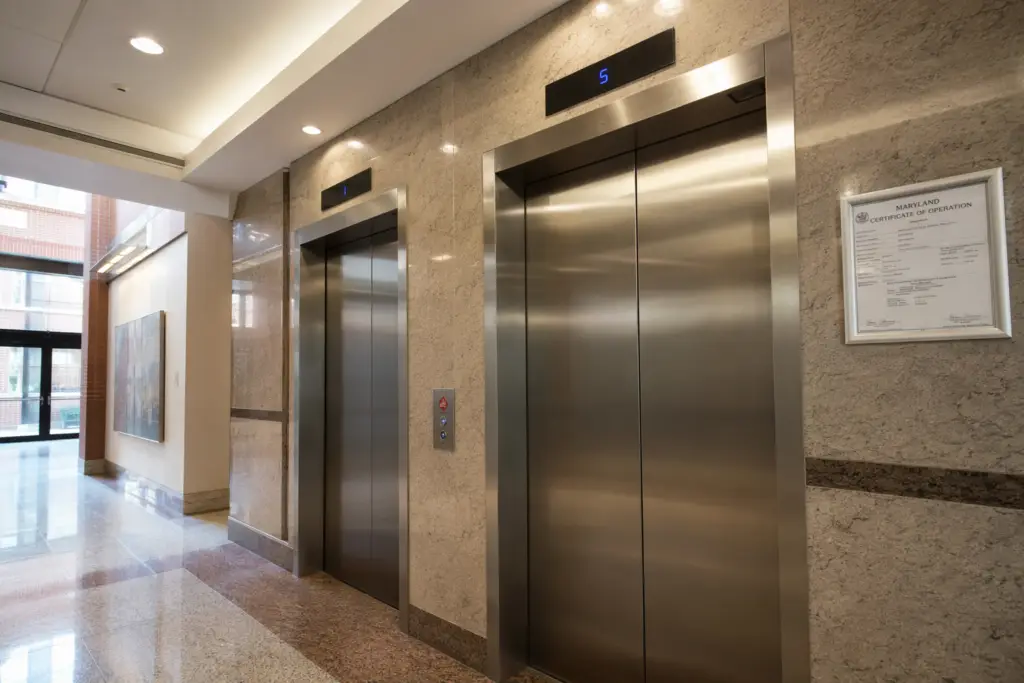
Who Is Allowed to Inspect Elevators in Maryland?
After 15+ years working in the elevator industry across Maryland, Washington DC, Philadelphia, and Virginia, I’ve seen firsthand how much confusion surrounds the question of who can legally sign off on an elevator inspection. Building owners get citations, elevators get shut down, and liability exposure skyrockets — all because the wrong person signed an inspection form. This comprehensive guide answers every question you need to know about elevator inspection authority in Maryland, including licensing requirements, inspection frequencies, costs, and compliance codes that apply in 2026.
Who Is Legally Authorized to Inspect Elevators in Maryland?

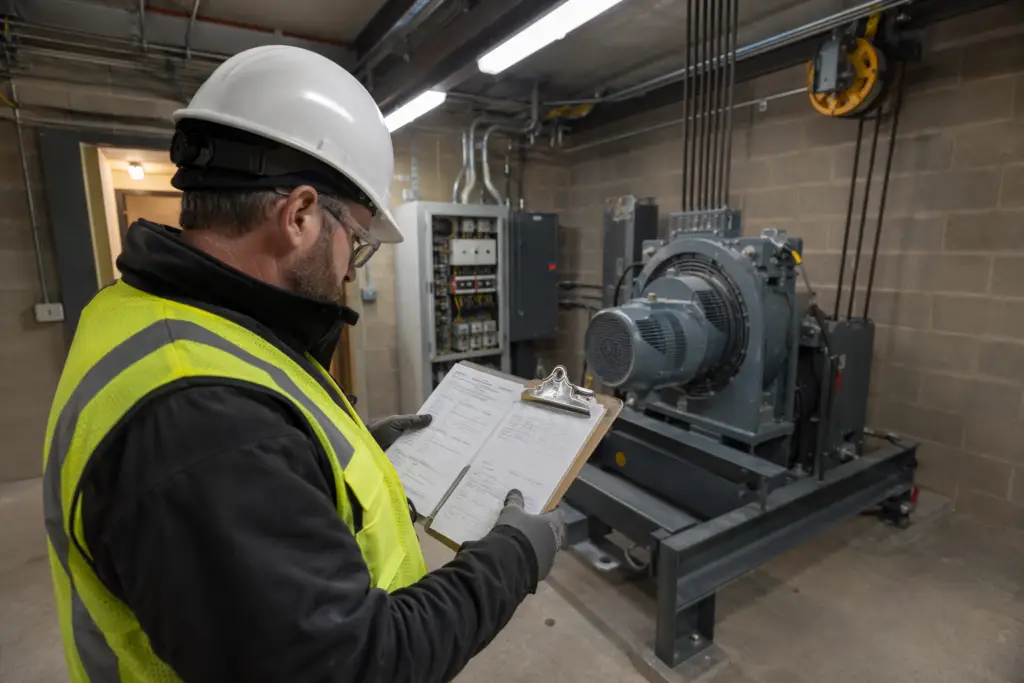
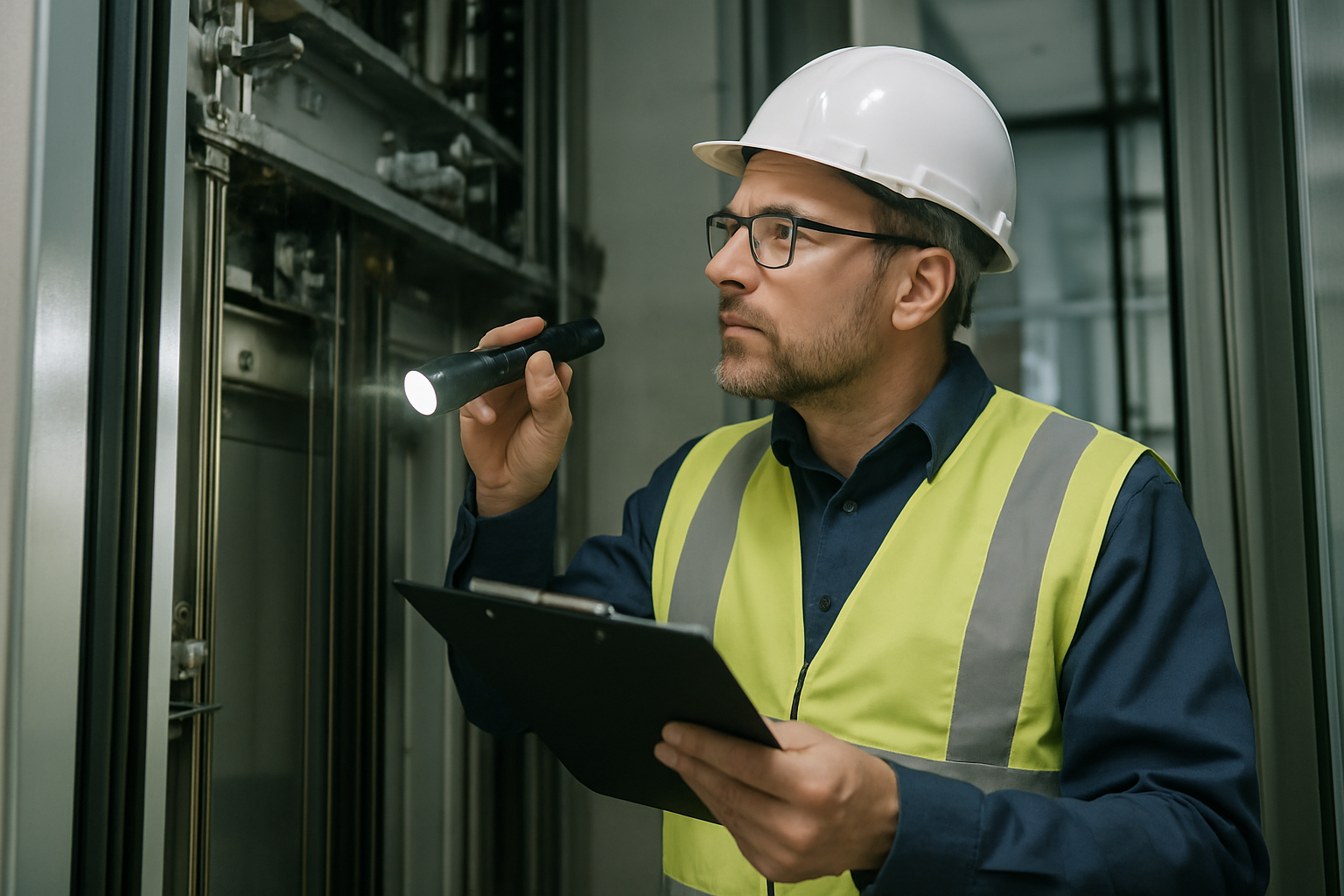
In Maryland, only a licensed elevator inspector credentialed by the Maryland Department of Labor, Division of Labor and Industry, or a QEI-certified inspector working under a licensed inspection agency, is legally authorized to conduct and certify elevator inspections.
Maryland’s elevator safety program falls under the jurisdiction of the Division of Labor and Industry (DLI), which enforces the state’s Elevator Safety Law (Maryland Code, Labor and Employment Article §12-801 through §12-823). The DLI maintains a roster of approved elevator inspectors and inspection agencies. When an inspector visits your building, they must carry valid Maryland credentials — not just a national certification.
There are three categories of authorized inspectors in Maryland:
- State Inspectors: Employed directly by Maryland’s Division of Labor and Industry.
- Special Inspectors: Private inspectors licensed by the state and authorized to conduct third-party inspections on behalf of the state.
- Insurance Inspectors: Inspectors employed by an insurance carrier that is licensed to conduct elevator inspections in Maryland, provided they hold the required QEI credentials and state authorization.
Inspectors must demonstrate knowledge of ASME A17.1/CSA B44, the Safety Code for Elevators and Escalators, which Maryland has adopted as its technical standard. As of 2026, Maryland references the 2019 edition of ASME A17.1 for compliance purposes, though updates are reviewed periodically by the DLI.
What Qualifications Must a Maryland Elevator Inspector Hold?
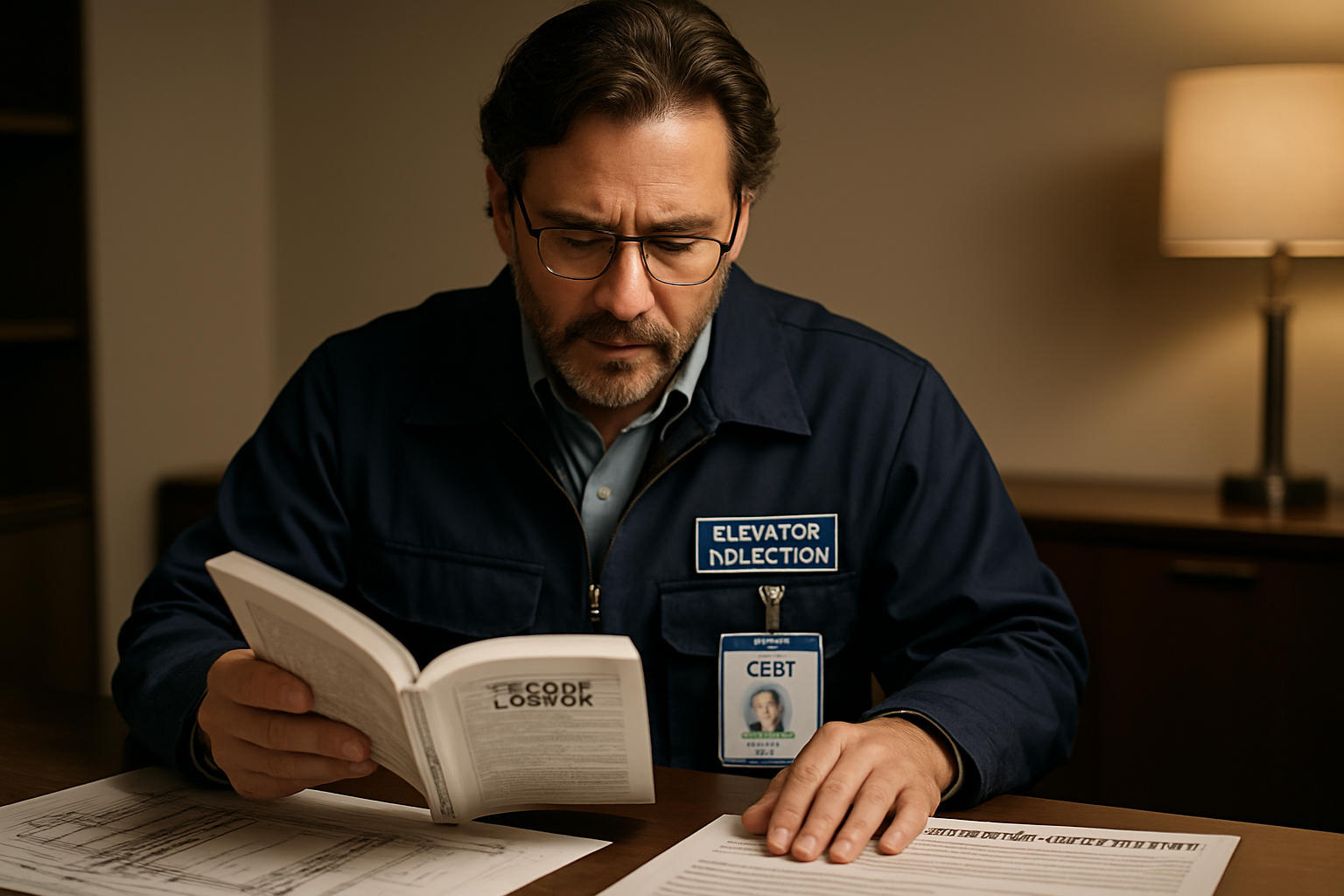
Maryland elevator inspectors must hold a QEI (Qualified Elevator Inspector) certification from NEIEP or NAESA International, plus a state-issued inspector’s license from the Maryland Division of Labor and Industry.
The QEI certification is the baseline credential recognized nationally. To earn it, a candidate must complete a combination of technical education and field experience — typically a minimum of 3 years of hands-on elevator work — and pass a rigorous written examination covering ASME A17.1, ASME A17.3 (existing installations), and ADA accessibility standards found at ADA Title III regulations.
Beyond QEI certification, Maryland-specific licensing requires:
- Submission of a completed application to the Maryland Division of Labor and Industry
- Proof of QEI certification in good standing
- Background verification
- Payment of applicable licensing fees (currently $150–$200 per renewal cycle)
- Continuing education to maintain QEI status (12 CEUs per 3-year cycle)
Can a Building Owner or Property Manager Inspect Their Own Elevator in Maryland?
No — Maryland law prohibits building owners, property managers, or in-house maintenance staff from conducting or certifying the official annual safety inspection of an elevator, regardless of their technical knowledge.
This is one of the most common misconceptions I encounter in the field. A maintenance technician employed by a building can perform routine lubrication, minor adjustments, and visual checks as part of a maintenance program, but they cannot sign an official inspection certificate. Maryland requires that the certifying inspector be entirely independent and properly licensed. Any inspection report signed by an unlicensed person is legally invalid, and the elevator would be treated as uninspected — exposing the owner to fines, mandatory shutdown, and significant liability.
How Often Are Elevators Required to Be Inspected in Maryland?
Maryland requires that most elevators and escalators undergo a full safety inspection at least once every 12 months, with additional periodic inspections depending on equipment category and use.
Under Maryland’s Elevator Safety Law and ASME A17.1, inspection frequency is tied to equipment classification:
| Equipment Type | Required Inspection Frequency | Applicable Standard | Typical Maryland Compliance Timeline |
|---|---|---|---|
| Traction Elevators (Passenger) | Annual (every 12 months) | ASME A17.1, Rule 8.6 | Certificate expires 12 months from last inspection date |
| Hydraulic Elevators | Annual (every 12 months) | ASME A17.1, Rule 8.6 | Certificate expires 12 months from last inspection date |
| Escalators & Moving Walks | Annual (every 12 months) | ASME A17.1, Rule 8.6 | Certificate expires 12 months from last inspection date |
| Dumbwaiters | Annual (every 12 months) | ASME A17.1, Rule 8.6 | Certificate expires 12 months from last inspection date |
| Platform Lifts / Wheelchair Lifts | Annual (every 12 months) | ASME A18.1 | Certificate expires 12 months from last inspection date |
| Material Lifts | Annual (every 12 months) | ASME A17.1, Rule 8.6 | Certificate expires 12 months from last inspection date |
| New Installations (Acceptance) | Before first use / one-time | ASME A17.1, Rule 8.10 | Required prior to certificate of occupancy |
| Major Modernizations | Before return to service | ASME A17.1, Rule 8.10 | Required following DLI permit completion |
In addition to the annual inspection, Maryland’s adoption of ASME A17.1 requires a Category 5 (full-load, full-speed safety test) for traction elevators every 5 years. This test must also be conducted under the supervision of a licensed inspector and requires a licensed elevator mechanic to perform the physical testing procedure.
What Is the Difference Between a Category 1 and Category 5 Elevator Test in Maryland?
In Maryland, a Category 1 test is an annual no-load safety test, while a Category 5 test — required every 5 years — is a full-load, full-speed test that verifies the elevator’s governor, safeties, and buffers can perform under real operating conditions.
Most building owners only hear about Category 5 tests when the 5-year window arrives and the costs surprise them. Here’s a plain-English breakdown:
- Category 1 (Annual): Performed with no load, tests electrical safety devices, doors, and basic mechanical function. Must be witnessed by a licensed inspector.
- Category 3 (Every 3 years, if applicable): Applies to certain hydraulic units, testing the pressure relief valve and lowering speed.
- Category 5 (Every 5 years): Full-load safety test. Tests governor tripping speed, safety engagement, and buffer performance under maximum rated load and speed. This is the most comprehensive — and most expensive — test required under ASME A17.1.
Quality Elevator Company performs all category tests across Maryland, Baltimore, Washington DC, Philadelphia, and Richmond — coordinating licensed inspectors and certified mechanics so building owners have a single point of accountability.
Does Maryland Require a Permit Before Elevator Work Can Begin?
Yes — Maryland requires a permit from the Division of Labor and Industry before any new elevator installation, major alteration, or modernization project can begin.
The permit process involves submitting plans, specifications, and engineering documentation to the DLI for review. Only licensed elevator contractors (not just mechanics) can pull permits in Maryland. The permit fees vary based on project scope, typically ranging from $200 to over $1,000 for major installations as of 2026. Work performed without a permit is a violation of Maryland’s Elevator Safety Law and can result in immediate shutdown orders and civil penalties.
Who Is Allowed to Perform Elevator Repairs and Maintenance in Maryland?
In Maryland, elevator maintenance and repairs must be performed by a licensed elevator mechanic who holds a valid Maryland Elevator Mechanic License issued by the Department of Labor.
This is distinct from the inspection credential. A licensed elevator mechanic can fix, adjust, and maintain equipment — but they cannot legally certify their own work through an official inspection. Maryland requires the mechanic and inspector roles to be separated to ensure objectivity. Mechanics must be members of the International Union of Elevator Constructors (IUEC) or demonstrate equivalent training and pass a state examination.
As of 2026, Maryland requires mechanics to hold:
- Completion of a state-approved apprenticeship program (typically 4–5 years)
- Passage of the Maryland elevator mechanic licensing exam
- Ongoing continuing education credits
What Happens If an Elevator in Maryland Fails Its Inspection?
If an elevator fails its Maryland inspection, the inspector will issue a violation notice and the elevator must be taken out of service immediately until the cited deficiencies are corrected and a follow-up inspection confirms compliance.
Common reasons elevators fail inspection in Maryland include:
- Faulty or non-responsive door safety edges
- Expired or malfunctioning emergency lighting
- Non-compliant pit depth or headroom clearances
- Defective governor or safety mechanisms
- Missing or expired fire service recall certification
- ADA non-compliance (floor designations, Braille buttons, audible signals) per 2010 ADA Standards for Accessible Design
- Lubrication deficiencies or visible wear on ropes or chains
Correction timelines depend on severity. Immediately dangerous conditions require shutdown until repair. Less critical deficiencies may allow continued operation with a compliance deadline — typically 30 to 90 days. A re-inspection fee applies upon follow-up.
What Are the Penalties for Operating an Uninspected Elevator in Maryland?
Maryland building owners who operate an elevator without a valid inspection certificate can face civil penalties up to $1,000 per day per violation, mandatory shutdown orders, and potential personal liability for any injuries that occur.
Beyond the financial penalties, operating without a current certificate voids most commercial property insurance policies’ coverage for elevator-related incidents. In 2026, Maryland’s Division of Labor and Industry has increased enforcement activity, including unannounced compliance checks in commercial buildings with three or more elevating devices. Don’t let an overlooked inspection date turn into a six-figure liability exposure.
How Much Does an Elevator Inspection Cost in Maryland?
In Maryland, a routine annual elevator inspection typically costs between $200 and $600 per unit when performed by a private licensed inspection agency, while state-performed inspections may carry lower direct fees but involve longer scheduling timelines.
Cost factors that influence pricing include:
- Equipment type (traction vs. hydraulic vs. escalator)
- Inspection category (Category 1 vs. Category 5)
- Building location within Maryland (Baltimore city buildings may have additional local permit requirements)
- Number of units inspected simultaneously (volume discounts apply)
- Emergency or expedited scheduling fees
Category 5 tests are significantly more expensive — typically $800 to $2,500 per unit — because they require additional equipment, a full maintenance crew, and extended inspector time. Buildings with multiple elevators should negotiate bundled inspection pricing. Quality Elevator Company offers competitive flat-rate inspection coordination packages for property managers with five or more units across Maryland and the Mid-Atlantic region.
Does Maryland Accept Inspections Conducted Under ASME A17.3 for Older Elevators?
Yes — Maryland references ASME A17.3 (Safety Code for Existing Elevators and Escalators) for pre-existing installations, which allows some older equipment to remain compliant under grandfather provisions rather than being required to meet all current A17.1 standards immediately.
ASME A17.3 provides a separate compliance pathway for equipment installed before the current code cycle. However, Maryland inspectors are empowered to require upgrades when safety-critical deficiencies are identified, regardless of grandfather status. Modernization triggers — such as replacing the control system, adding new doors, or significantly modifying the drive — can void grandfather protections and require full A17.1 compliance. This nuance is where having an experienced service partner matters enormously.
Are Residential Home Elevators Subject to Inspection Requirements in Maryland?
Private residence elevators in Maryland that serve only one single-family dwelling are generally exempt from the mandatory annual state inspection requirement, though they must still comply with ASME A17.1 upon installation and are strongly recommended to undergo voluntary periodic inspections.
The exemption applies only to true single-family private use. If a residential elevator serves a multi-unit building — even a two-family duplex — it falls under Maryland’s full inspection and licensing requirements. Platform lifts and stair lifts installed in residential settings under ASME A18.1 follow similar exemption rules, but commercial applications of these devices are fully regulated.
How Do Maryland’s Elevator Inspection Requirements Compare to Washington DC and Virginia?
Maryland, Washington DC, and Virginia each enforce elevator safety under separate jurisdictional authorities, with DC and Virginia having distinct licensing bodies, inspection frequencies, and code adoption schedules from Maryland’s Division of Labor and Industry.
- Maryland: Regulated by the Division of Labor and Industry; annual inspections required; ASME A17.1 (2019 edition) adopted; QEI certification required for inspectors.
- Washington DC: Regulated by the DC Department of Consumer and Regulatory Affairs (DCRA); annual inspections required; ASME A17.1 adopted; inspectors must hold DC-specific licensing through DCRA.
- Virginia: Regulated by the Virginia Department of Labor and Industry (DOLI); annual inspections required; ASME A17.1 adopted; Virginia maintains its own certified inspector program under the Elevator Safety Law (Code of Virginia §36-98.3 et seq.).
- Pennsylvania (Philadelphia): Regulated by the PA Department of Labor and Industry and local Philadelphia L&I; annual inspections required; Philadelphia has an additional municipal inspection layer requiring City of Philadelphia elevator permits.
Quality Elevator Company holds contractor licenses and works with certified inspectors across all four of these jurisdictions — Maryland, DC, Virginia, and Pennsylvania — giving multi-market property owners a single compliance partner who understands every local regulatory nuance.
What Should a Building Owner Do to Prepare for an Elevator Inspection in Maryland?
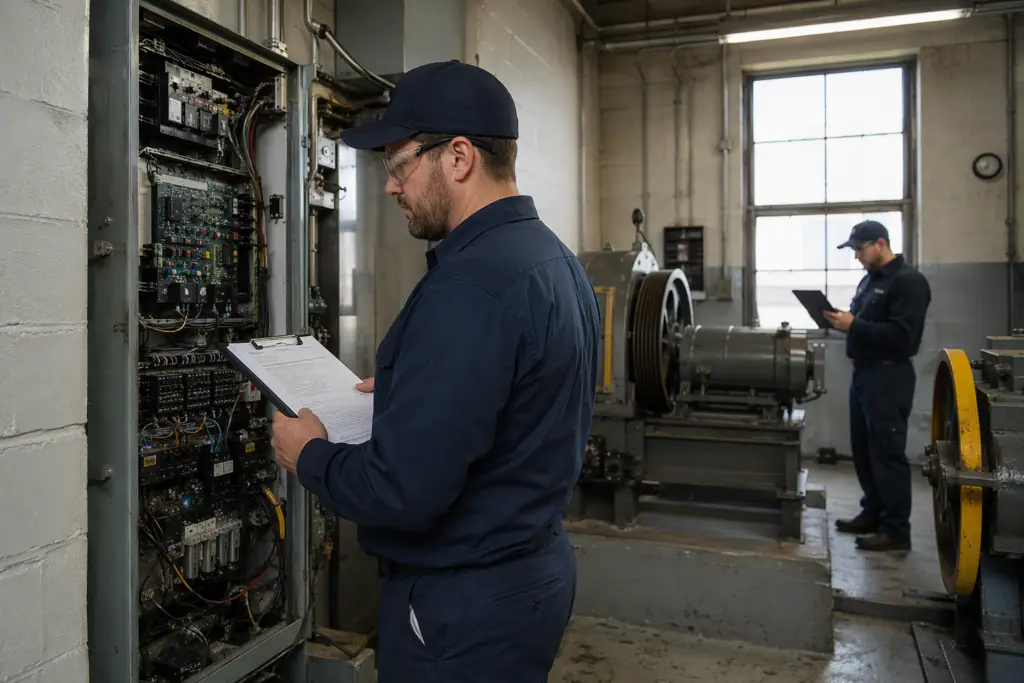
Before a scheduled Maryland elevator inspection, building owners should ensure the machine room is clean and accessible, all logbooks and prior inspection certificates are available, the pit is dry and properly lit, and all known deficiencies have been addressed by a licensed mechanic.
A pre-inspection checklist that I recommend to every building manager includes:
- Verify current inspection certificate is posted in the elevator cab
- Confirm machine room access — locks, lighting, and temperature compliance
- Check that the pit emergency stop switch and lighting are functional
- Review the maintenance log for outstanding items
- Test emergency communication (phone/intercom) — required by ASME A17.1 Rule 2.27.1
- Verify fire service recall (Phase I and Phase II) is operational
- Confirm all Braille button signage meets ADA requirements
- Ensure all door restrictors are properly installed and functional
How Long Does a Maryland Elevator Inspection Take?
A standard annual elevator inspection in Maryland typically takes 1.5 to 3 hours per unit, while a Category 5 five-year test can take 4 to 6 hours per elevator due to the full-load testing requirements.
Timeline factors include elevator type, number of floors served, age and complexity of the control system, and whether any deficiencies are discovered during the inspection that require immediate documentation. Building managers should plan for brief elevator downtime during the inspection and notify tenants in advance, particularly in occupied residential or hospital buildings where elevator access disruption has significant operational impact.
Can a Maryland Elevator Inspector Shut Down an Elevator on the Spot?
Yes — a licensed Maryland elevator inspector has the legal authority to immediately condemn and lock out an elevator that presents an imminent danger to public safety, without prior notice to the building owner.
This authority is granted under Maryland’s Elevator Safety Law and mirrors the powers granted to OSHA inspectors for workplace safety hazards. In my 15 years of field experience, immediate shutdowns are relatively rare but do occur when inspectors find conditions like a non-functional door interlock, a car that is leveling improperly (creating a tripping hazard), or evidence of rope deterioration beyond safe operating limits. When a shutdown order is issued, the building owner must contract a licensed elevator mechanic immediately — delays only compound the liability.
How Do I Find a Licensed Elevator Inspector in Maryland?
Building owners can find licensed elevator inspectors in Maryland through the Maryland Division of Labor and Industry’s official approved inspector list, or by working with a licensed elevator service company that coordinates inspections as part of a comprehensive maintenance contract.
The Maryland DLI maintains an updated list of authorized inspection agencies on its website. Property owners who work with a full-service elevator maintenance company often find this process easier — the service company coordinates the inspection scheduling, prepares the equipment, and manages the paperwork. Quality Elevator Company arranges inspection coordination for all properties we service in Baltimore, DC, Philadelphia, and Richmond, ensuring our clients never miss a compliance deadline.
What Records Must Maryland Building Owners Keep After an Elevator Inspection?
Maryland building owners must retain the current elevator inspection certificate in the elevator cab at all times, and must maintain a logbook of all inspections, tests, and maintenance work in or immediately adjacent to the machine room.
Record-keeping requirements under Maryland’s Elevator Safety Law include:
- Current inspection certificate posted inside the elevator cab (visible to passengers)
- Maintenance logbook retained in the machine room with entries for every service visit
- Copies of all inspection reports retained for a minimum of 3 years
- Documentation of all Category 1, 3, and 5 test results
- Permit documentation for any installation or modernization work
During an audit or incident investigation, incomplete records are treated the same as non-compliance. Digital maintenance logs are acceptable provided they are readily accessible on-site.
What Is the Difference Between an Elevator Inspection and an Elevator Maintenance Contract?
An elevator inspection is a periodic safety compliance verification performed by a licensed inspector under state authority, while a maintenance contract is an ongoing service agreement with a licensed elevator company that keeps equipment in safe, code-compliant operating condition between inspections.
These two services are complementary, not interchangeable. A maintenance contract does not replace the annual inspection — it ensures the elevator is in optimal condition so it passes that inspection without violations. A well-structured maintenance contract typically includes:
- Monthly or quarterly preventive maintenance visits by a licensed mechanic
- 24/7 emergency entrapment response
- Parts coverage for normal wear items
- Pre-inspection readiness checks
- Compliance documentation support
When evaluating maintenance contracts, ask specifically whether the contractor is licensed in Maryland, whether their mechanics are IUEC-certified, and whether the contract covers coordination with a licensed inspector for your annual certification.
Why Should Maryland Building Owners Choose Quality Elevator Company for Elevator Compliance?
Quality Elevator Company brings 15+ years of hands-on experience navigating Maryland’s elevator safety regulations, holding active contractor licenses across Maryland, Washington DC, Philadelphia, and Richmond, with a team of IUEC-certified mechanics and established relationships with licensed inspectors in every market we serve.
Here’s what sets us apart for Maryland property owners:
- Full compliance management: We track inspection expiration dates and proactively schedule your annual certification so you never receive a notice of violation.
- Licensed across all jurisdictions: One partner for properties spanning Maryland, DC, Virginia, and Pennsylvania.
- Category 5 test specialists: We coordinate and execute full-load five-year tests with licensed inspectors and certified mechanics — no need to manage multiple vendors.
- Code expertise: Our team stays current on ASME A17.1, ASME A17.3, ASME A18.1, and ADA accessibility requirements as they apply to Maryland in 2026.
- Emergency response: 24/7 response for entrapments and critical failures across all service territories.
Is Your Maryland Elevator Inspection Up to Date?
Don’t wait for a violation notice or a shutdown order. Whether you manage one elevator or a portfolio of 50 units across Maryland, Washington DC, Philadelphia, or Richmond — Quality Elevator Company delivers complete compliance, from maintenance to certified inspection coordination.
Contact Quality Elevator Company for a free elevator assessment.
Call us today: 301-307-5363
Licensed elevator contractor serving Baltimore MD • Washington DC • Philadelphia PA • Richmond VA