
An ongoing elevator service contract defines the full scope of maintenance, inspection, testing, and compliance support a licensed contractor provides for your elevator equipment over a set term. The contract typically specifies visit frequency, covered components, inspection witnessing responsibilities, recordkeeping obligations, and the process for handling repairs outside routine maintenance. Building owners in Baltimore MD, Washington DC, Philadelphia PA, and Richmond VA should establish a contract before their current certificate of operation or certificate of inspection lapses.
What Is Included in a Standard Elevator Service Contract?
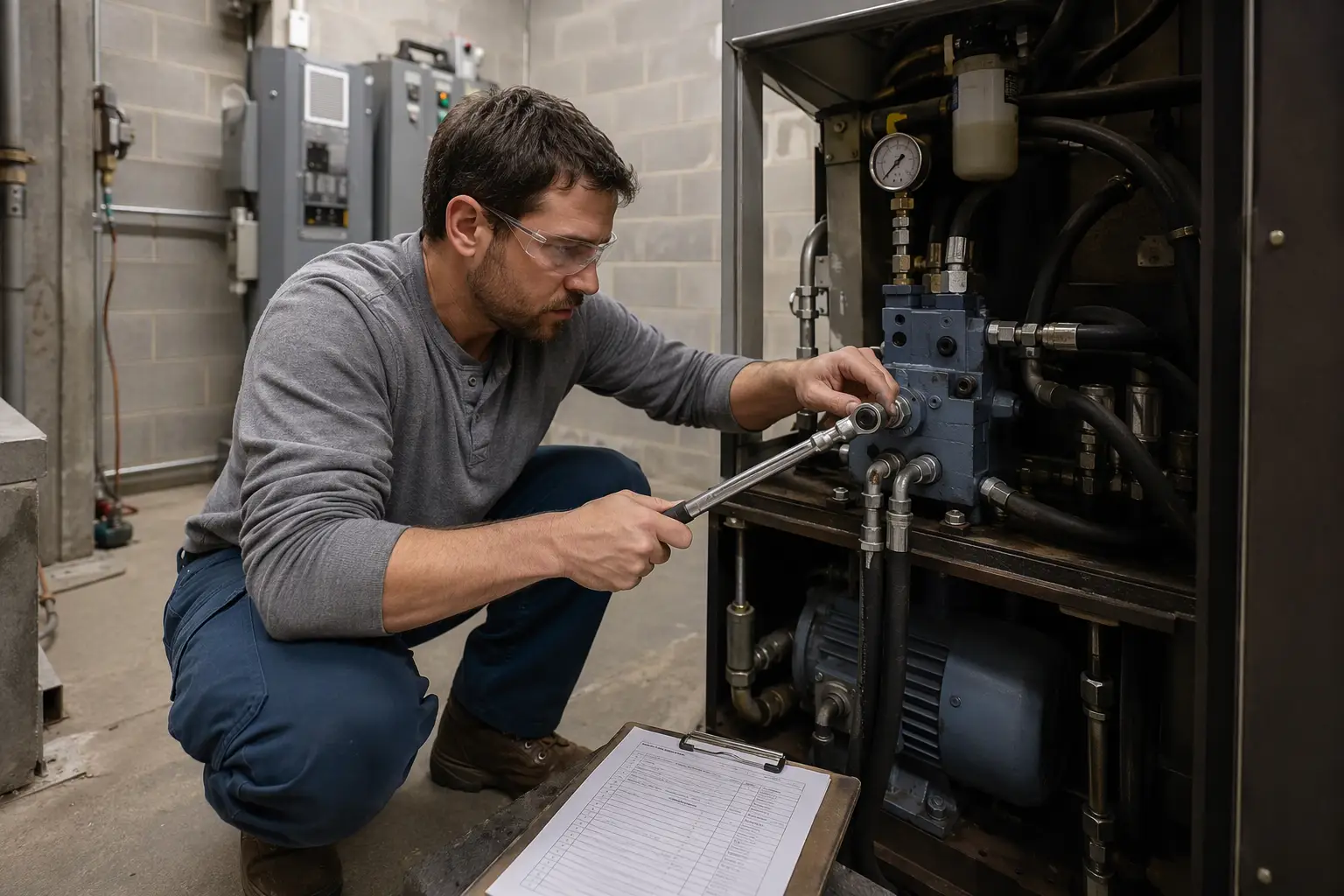
A standard elevator service contract covers scheduled preventive maintenance visits, lubrication and adjustment of mechanical and hydraulic components, safety device testing, witnessing of required periodic tests, and regulatory documentation for the authority having jurisdiction (AHJ).
Beyond those core elements, a well-structured contract also defines the boundary between routine maintenance and billable repairs. Consumable parts — lubricants, brake linings, minor contactors — are often included. Major components such as drive machines, controllers, and hydraulic cylinders are typically listed as repair items billed separately. The contract should specify which components are covered, what triggers an additional work order, and how the owner is notified before extra charges are incurred. Recordkeeping provisions are equally important: under Maryland’s COMAR 09.12.81, maintenance, repair, test, and inspection records must be kept at a readily accessible central location in the building, so the contract should obligate the contractor to supply complete documentation after every visit.
Why Do Building Owners Need a Service Contract Instead of On-Call Repairs Only?
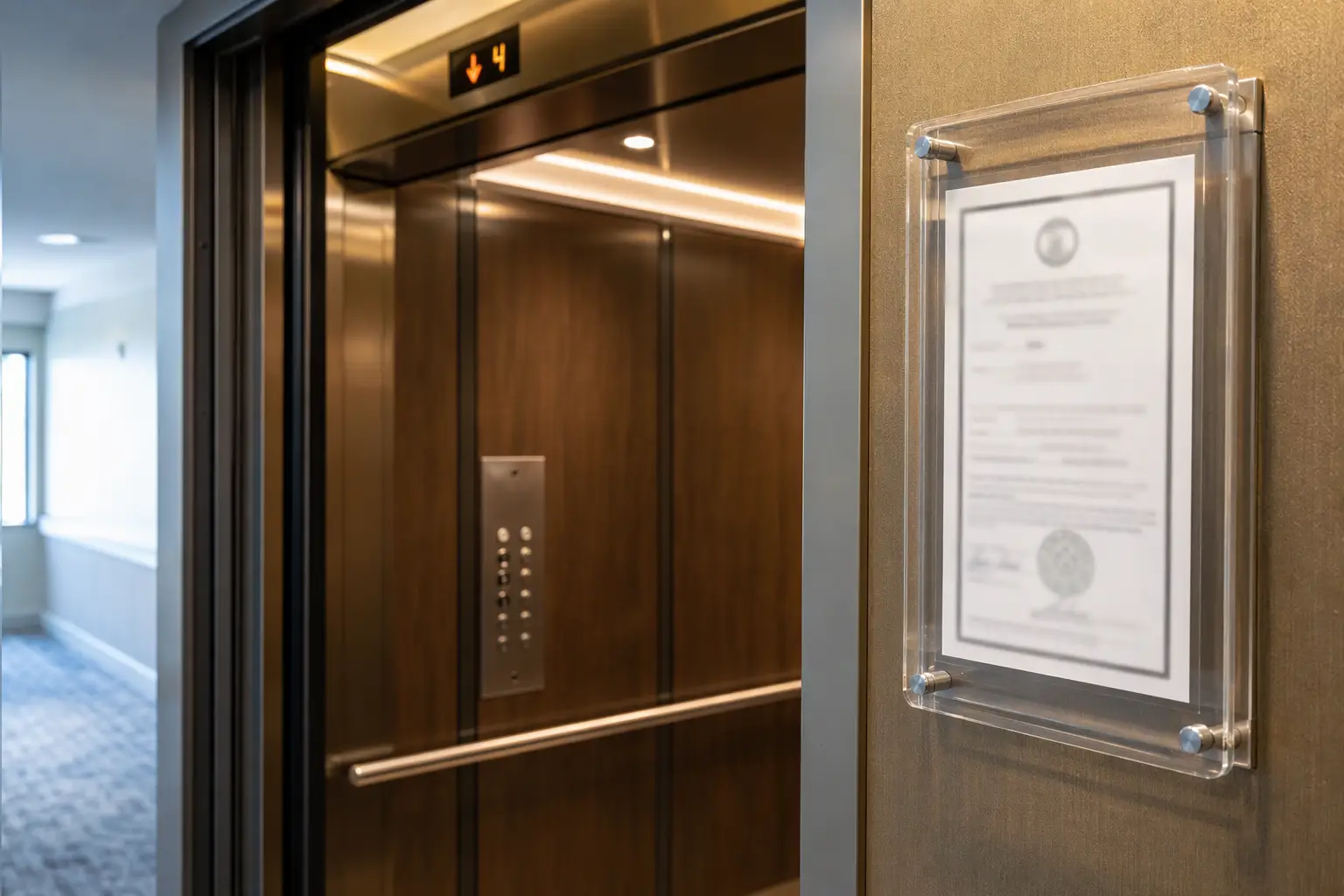
Relying solely on reactive on-call repairs leaves elevator equipment without the scheduled lubrication, adjustment, and safety checks that prevent premature component failure and keep the unit in compliance with mandatory inspection cycles.
Each jurisdiction served by Quality Elevator Company mandates periodic inspections at defined intervals. Maryland requires an annual periodic inspection and a comprehensive five-year inspection for elevators suspended by wire ropes or similar means, as stated in the Maryland Department of Labor, Division of Labor and Industry, Elevator and Escalator Safety rules under Annotated Code of Maryland, Public Safety Article, Title 12, Subtitle 8. Virginia requires at minimum an annual periodic inspection, and localities may require six-month intervals, per 13VAC5-63, Virginia Uniform Statewide Building Code. Pennsylvania requires inspections at intervals of no more than six months for electric elevators, hydraulic elevators, and escalators, per Pennsylvania Department of Labor and Industry (L&I) under 34 Pa. Code Chapter 405. The District of Columbia requires a Category 1 inspection every 12 months and a Category 5 inspection every 60 months by an ASME QEI-certified inspector, coordinated through a DOB-approved third-party inspection agency, per the DC Department of Buildings (DOB).
A proactive service contract aligns preventive maintenance visits with these mandated schedules so that equipment arrives at inspection in top operating condition.
How Often Do Elevator Maintenance Visits Typically Occur Under a Service Contract?
Visit frequency under a service contract is set by the complexity and usage of the equipment, the minimum inspection intervals required by the AHJ, and the contractor’s recommended maintenance schedule based on the ASME A17.1 Safety Code for Elevators and Escalators.
Lightly used residential or small commercial elevators may be maintained on a quarterly schedule, while high-use commercial and institutional elevators in office towers, hospitals, and transit-adjacent buildings often warrant monthly or bi-monthly visits. Hydraulic elevators require attention to fluid levels, cylinder seals, and power unit filters on a cadence that the contractor should specify in writing. The service contract should state the minimum number of visits per year, what tasks are completed at each visit, and how documentation is delivered to the building owner after each visit.
What Regulatory Requirements Must a Service Contract Address in Maryland?
In Maryland, a service contract must ensure that only licensed elevator mechanics perform maintenance and testing, that a licensed elevator contractor holds the contract, and that all required annual and five-year inspection records are kept on-site at a readily accessible central location.
Under Annotated Code of Maryland, Public Safety Article, Title 12, Subtitle 8, a person must be licensed by the Maryland Elevator Safety Review Board as an elevator mechanic before working on elevator units in the state. The contracting business must also hold a Maryland elevator contractor license and carry at least $1,000,000 in general liability insurance and at least $500,000 in property damage insurance. Tests required for the periodic inspection must be performed by a licensed elevator mechanic, and when a third-party qualified elevator inspector is required to witness a test, that inspector must be physically present for the entire test. Owners must re-register their elevator units with the Commissioner every year at the time of the periodic annual inspection, so the service contract should include administrative support for annual re-registration. All details are governed by COMAR 09.12.81. See the Maryland Department of Labor, Division of Labor and Industry, Elevator and Escalator Safety page for current licensing and registration requirements.
What Regulatory Requirements Must a Service Contract Address in the District of Columbia?
In DC, a service contract must coordinate with a DOB-approved third-party inspection agency, ensure ASME QEI-certified inspectors witness required tests, and support the owner’s submission of inspection reports to DOB through the Citizen Access Portal every two years to maintain a valid certificate of inspection.
Under DC Department of Buildings (DOB) rules codified in 12-A DCMR Chapter 30, all elevators must be inspected and certified for operation. The certificate of inspection is valid for two years, with periodic inspections and tests conducted during that two-year window. Elevator contractor and mechanic licensing in DC falls under the DC Board of Industrial Trades, and inspector applicants must meet ASME QEI-1 or an equivalent standard. The service contract should also confirm that at least one passenger elevator remains in operation whenever the building is occupied, as required when the building contains passenger elevators. If elevator alterations or modernization are planned, the service contract should address the temporary suspension of the certificate of inspection while a permit is active, as permitted under DC code.
What Regulatory Requirements Must a Service Contract Address in Pennsylvania?
In Pennsylvania, a service contract must ensure semi-annual periodic inspections are conducted by a UCC-certified elevator inspector, that any major repair or alteration triggers a permit application and acceptance inspection by the Pennsylvania Department of Labor and Industry before the elevator returns to service, and that the certificate of operation remains current.
Under 34 Pa. Code Chapter 405 and the Pennsylvania Construction Code Act (35 P.S. § 7210.101 et seq.), electric elevators, hydraulic elevators, and escalators must receive periodic inspections at intervals of no more than six months. A certificate of operation for equipment on a six-month inspection cycle is valid for 24 months; on a 12-month cycle, it is valid for 48 months. Beginning December 20, 2026, Pennsylvania’s updated elevator regulation (Regulation #12-123) takes effect, requiring stand-alone annual Category 1 tests and aligning periodic test intervals with ASME A17.1-2016 Table N-1. Building owners whose equipment was permitted before December 20, 2026, remain under ASME A17.1-2000 (with A17.1a-2002 addenda). The service contract should specifically address which code edition applies to each unit and plan for the transition. The Pennsylvania Department of Labor and Industry (L&I) oversees all elevator certification statewide, including Philadelphia.
What Regulatory Requirements Must a Service Contract Address in Virginia?
In Virginia, a service contract must be held by a licensed elevator contractor holding the Elevator/Escalator Contracting (EEC) specialty, performed by state-certified elevator mechanics, and timed to support at minimum the annual periodic inspection required by the local building department.
Virginia’s elevator inspection program is administered by local building departments, not a state labor agency, under the Virginia Uniform Statewide Building Code (13VAC5-63), which adopted ASME A17.1/CSA B44-19 effective January 18, 2024. The local code official may require six-month inspections at their discretion, so the service contract should allow for that possibility. In Richmond specifically, the Bureau of Permits and Inspections within the City of Richmond’s Department of Planning and Development Review handles final acceptance inspections, annual elevator inspections, and certificates. Virginia elevator mechanic certification requires at least three years of industry experience and passing an approved examination; certified mechanics must complete at least eight hours of Board-approved continuing education for each renewal cycle. The service contract should reference these licensing standards to confirm the contractor’s workforce qualifies to perform work in the Commonwealth.
How Do I Set Up an Elevator Service Contract Step by Step?
Setting up an elevator service contract involves auditing existing equipment, confirming the AHJ’s current requirements, soliciting proposals from licensed contractors, reviewing contract scope and exclusions, and executing the agreement before any existing service arrangement lapses.
- Compile an equipment inventory listing every elevator unit by type (traction, hydraulic, MRL), age, rated capacity, and current certificate or registration number.
- Identify the AHJ for each unit — the Maryland Department of Labor, DC Department of Buildings, Pennsylvania Department of Labor and Industry, or the local building department in Virginia — and confirm current inspection intervals and licensing requirements.
- Gather existing maintenance records, inspection reports, and repair history for each unit to share with prospective contractors during the proposal process.
- Issue a written request for proposal to at least two or three licensed elevator contractors, specifying equipment list, required visit frequency, inspection witnessing needs, and documentation expectations.
- Compare proposals using the criteria in the contractor comparison table below, paying particular attention to covered components, exclusions, insurance levels, and licensing documentation.
- Request copies of the contractor’s state elevator contractor license, proof of insurance meeting or exceeding the jurisdictional minimum, and confirmation of ASME QEI certification for any in-house inspectors.
- Negotiate contract terms covering notice periods, emergency response procedures, escalation clauses for multi-year agreements, and dispute resolution.
- Execute the contract and schedule the first maintenance visit before the current certificate of operation or certificate of inspection expires.
- Establish an on-site recordkeeping folder or digital log in the building to receive all maintenance visit reports, test records, and inspection documentation as required by your jurisdiction.
What Should I Look for When Comparing Elevator Service Contractors?
Prospective service contractors should be evaluated on licensing status, insurance coverage, the qualifications of their mechanics and inspectors, the scope of their maintenance visits, their recordkeeping practices, and their familiarity with the AHJ’s specific requirements in your market.
The table below provides a comparison framework for evaluating elevator service proposals across the key criteria that matter most for compliance and equipment longevity.
| Evaluation Criterion | Minimum Acceptable Standard | What to Look For in a Strong Proposal |
|---|---|---|
| Contractor Licensing | Licensed elevator contractor in the applicable jurisdiction | License number verifiable with the AHJ; EEC specialty license in Virginia; Maryland Elevator Safety Review Board license in MD |
| Mechanic Certification | Licensed elevator mechanic (MD); certified elevator mechanic (VA); QEI-certified inspector where required (DC) | All field technicians hold current state credentials; DC contractors coordinate with DOB-approved third-party inspection agencies |
| General Liability Insurance | $1,000,000 per occurrence (MD statutory minimum for contractors) | Certificate of insurance naming building owner as additional insured; property damage coverage of at least $500,000 (MD minimum) |
| Inspection Support | Coordination with AHJ and scheduling of required periodic tests | Documented process for scheduling, witnessing, and filing inspection reports; DC contractors work with DOB-approved third-party agencies |
| Maintenance Visit Frequency | Aligned with AHJ inspection cycle (6-month in PA; annual minimum in MD and VA; DC requirements per 12-A DCMR Chapter 30) | Visit frequency matched to equipment usage and AHJ requirements; written task list for each visit type |
| Recordkeeping | Written records provided after each visit; kept at the building (required in MD) | Digital and paper records; organized binder for AHJ review; test reports signed by qualified inspector |
| Covered Components | Major mechanical and safety components listed by name in the contract | Explicit inclusion/exclusion list; no broad “wear and tear” exclusions that undermine coverage |
| Contract Term and Exit Provisions | Clear term length with defined renewal and termination notice | Reasonable notice period (90 days or fewer); no auto-renewing multi-year lock-in without owner consent |
| ADA Compliance Review | Awareness of ADA requirements for accessible routes | Proactive identification of ADA-related issues during maintenance visits; documented findings |
| Emergency Procedures | Written emergency protocol included in contract | Defined escalation procedure; clear process for passenger entrapment situations |
How Does ADA Compliance Factor Into an Elevator Service Contract?
The Americans with Disabilities Act requires that elevators serving public accommodations and commercial facilities remain accessible and operational, making ongoing maintenance directly relevant to ADA compliance obligations.
An elevator that is out of service due to deferred maintenance may disrupt the accessible route for people with disabilities, which can trigger ADA liability for building owners. While ADA compliance is ultimately the building owner’s responsibility, a well-structured service contract should include a provision requiring the contractor to flag any observed conditions that could compromise accessibility — worn door reopening devices, failing cab door operators, or non-functional control panel elements — and to document those findings in writing. This documentation supports the building owner’s ability to demonstrate due diligence in maintaining accessibility.
What Is the Difference Between a Full-Service Contract and a Lubrication-Only Contract?
A full-service contract covers both preventive maintenance and repair labor for listed components, while a lubrication-only contract covers only routine lubrication, adjustment, and cleaning, leaving all repair costs entirely to the building owner on a time-and-materials basis.
Lubrication-only contracts are common in lower-volume residential settings and can be appropriate for newer equipment still under manufacturer warranty. However, they expose building owners to unpredictable repair costs for aging equipment. Full-service contracts spread those costs across the contract term and incentivize the contractor to maintain equipment proactively, since the contractor absorbs covered repair costs. Building owners with high-use commercial elevators, hospital or institutional elevators, or older traction or hydraulic systems generally benefit from the broader coverage and budget predictability of a full-service arrangement.
What Types of Elevator Equipment Are Typically Covered Under a Service Contract?
Service contracts can be written to cover traction elevators, hydraulic elevators, machine-room-less (MRL) traction elevators, escalators, moving walkways, platform lifts, and dumbwaiters, with the scope and cost varying by equipment type.
Each equipment type carries different maintenance requirements. Hydraulic elevators require attention to the power unit, cylinder seals, and hydraulic fluid — including monitoring for underground cylinder leaks on single-bottom cylinders, which is a common concern in older installations. Traction elevators require rope inspection, sheave groove condition assessment, and brake adjustment. MRL elevators use compact machine designs that require specific lubricants and tools. Escalators have moving step chains and comb plates that need regular adjustment and cleaning. Any service contract covering multiple equipment types should specify distinct maintenance protocols for each type rather than applying a single generic checklist.
What Happens If an Elevator Fails Inspection While Under a Service Contract?
If an elevator fails a periodic inspection, the building owner and contractor must address the cited deficiencies before the AHJ will issue or renew the certificate of operation or certificate of inspection, and the elevator may not remain in service if the AHJ orders it out of service.
In Pennsylvania, after a major repair, replacement, or alteration, the elevator may not return to service until the Pennsylvania Department of Labor and Industry inspects and passes it. In Maryland, the Commissioner of Labor and Industry must have issued a certificate before an elevator unit may be operated. In DC, an elevator’s certificate may be temporarily suspended when it is under permit for alteration or modernization. The service contract should clearly define which party is responsible for remediation costs when deficiencies arise — whether from deferred maintenance that the contractor was responsible for addressing or from pre-existing conditions that were present at contract inception. A good contract includes a pre-contract condition assessment to establish a documented baseline.
What Records Must Be Maintained Under an Elevator Service Contract?
Under applicable regulations, maintenance, inspection, and test records must be kept on-site and available to the AHJ, with Maryland explicitly requiring that records be kept at a readily accessible central location in the building.
Maryland’s requirement under COMAR 09.12.81 is the most explicit: records must be at a central location in the building. Virginia requires that third-party inspection reports include the name and certification number of the elevator mechanic who performed the witnessed tests. In DC, inspection reports for the past two years must be submitted to DOB through the Citizen Access Portal to obtain a certificate of inspection. In Pennsylvania, the certificate of operation must be posted in the elevator car or attached to the controller in the machine room. Building owners should work with their contractor to establish a physical binder or digital recordkeeping system that satisfies all applicable requirements simultaneously and can be produced immediately on request during an inspection or audit.
How Long Does an Elevator Service Contract Typically Last?
Elevator service contracts are most commonly written for one-year, three-year, or five-year initial terms, with renewal provisions that may include automatic rollover clauses and annual price escalation tied to defined indices.
Short-term contracts provide flexibility but may limit the contractor’s willingness to invest in equipment familiarization and may result in higher per-visit pricing. Longer-term contracts offer cost predictability and encourage the contractor to plan maintenance strategically across the full term. Building owners should pay close attention to termination clauses: a contract that requires 180 days’ written notice for termination can effectively lock an owner in for another full year if they miss the window. The contract should also define what happens to documentation, keys, and access credentials when the contract ends.
What Is a Pre-Contract Elevator Assessment and Why Does It Matter?
A pre-contract elevator assessment is a documented inspection of the equipment’s current condition, maintenance history, and compliance status conducted before a service agreement is signed, establishing a baseline that protects both the building owner and the contractor from disputes about pre-existing deficiencies.
Without a baseline assessment, it is impossible to determine whether a deficiency discovered during the contract period results from deferred maintenance under the new contractor’s watch or was present before the contract began. The assessment should document the condition of all major components, any outstanding violations or open inspection items, the age and approximate remaining useful life of key components, and the current status of the AHJ certificate. Quality Elevator Company includes a comprehensive pre-contract assessment as part of its service setup process for new clients in Baltimore MD, Washington DC, Philadelphia PA, and Richmond VA, ensuring that expectations are aligned from day one.
How Does Elevator Modernization Affect an Existing Service Contract?
Modernization — replacing a controller, drive system, cab fixtures, or other major components — typically requires a new permit from the AHJ, may temporarily affect the validity of the existing certificate of operation, and usually triggers a renegotiation or amendment of the service contract to reflect the modernized equipment’s different maintenance requirements.
In DC, an elevator’s certificate of inspection may be temporarily suspended while it is under permit for alteration or modernization, and the owner must obtain a new DOB permit that includes a copy of the master electrician license and the elevator contracting license. In Pennsylvania, construction, alteration, replacement, or repair of an elevator requires a permit application to the Pennsylvania Department of Labor and Industry, and the elevator may not return to service until the department inspects and passes it. After modernization, the service contract should be reviewed to confirm that covered components, maintenance intervals, and documentation requirements reflect the upgraded equipment. A contractor unfamiliar with the new controller or drive platform may not be able to service it effectively.
What Is the Role of ASME A17.1 in Defining Service Contract Requirements?
The ASME A17.1 Safety Code for Elevators and Escalators defines the minimum maintenance, inspection, and testing requirements that form the technical foundation of any compliant elevator service contract in Maryland, the District of Columbia, Pennsylvania, and Virginia.
Each jurisdiction adopts a specific edition of ASME A17.1 as its reference standard. Maryland adopted ASME A17.1-2022/CSA B44:22 (with Maryland changes), effective June 17, 2026, under COMAR 09.12.81. DC operates under ASME A17.1-2013/CSA B44-13 as referenced by the 2017 DC Building Code, effective May 29, 2020. Pennsylvania currently applies ASME A17.1-2000 with A17.1a-2002 addenda, transitioning to ASME A17.1-2016 for new permit applications from December 20, 2026. Virginia’s 2021 USBC (effective January 18, 2024) incorporates ASME A17.1/CSA B44-19. Because each state’s adopted edition differs, a service contractor must know which edition governs each unit in a multi-jurisdiction portfolio. Quality Elevator Company’s service team is familiar with the edition differences and their practical implications for maintenance schedules and testing protocols across all four markets.
What Questions Should I Ask Before Signing an Elevator Service Contract?
Before signing an elevator service contract, building owners should ask about the contractor’s licensing status, the qualifications of the mechanics assigned to the building, how inspections are coordinated with the AHJ, what is explicitly covered and excluded, how repair costs are authorized, and what happens to the contract and records if the company is acquired or goes out of business.
Additional questions worth asking include: Does the contractor carry errors-and-omissions coverage in addition to general liability? Who holds the inspection scheduling relationship with the DOB, L&I, or local building department? How will the owner be notified if a safety deficiency is discovered during a maintenance visit? What is the written protocol for passenger entrapments? How are records delivered — paper, email, or through a client portal? A contractor who cannot answer these questions in writing during the proposal process is unlikely to perform to a high standard once the contract is signed.
How Can Building Owners in Multiple Cities Manage Elevator Service Contracts Efficiently?
Building owners with elevator equipment across multiple jurisdictions — such as a portfolio spanning Baltimore, Washington DC, Philadelphia, and Richmond — can simplify compliance by working with a single licensed elevator contractor that holds the necessary licenses and has demonstrated knowledge of AHJ requirements in each city.
Multi-property portfolio management under a single service provider reduces the administrative burden of tracking different inspection calendars, managing multiple insurance certificates, and coordinating with different regulators. A consolidated contract can establish uniform recordkeeping standards across the portfolio while still meeting each jurisdiction’s specific requirements. Quality Elevator Company serves all four of these markets — Baltimore MD, Washington DC, Philadelphia PA, and Richmond VA — and can structure service agreements that account for the distinct regulatory requirements of each AHJ while delivering consistent maintenance standards and documentation across the entire portfolio.
Contact Quality Elevator Company for a free elevator assessment at 301-779-9116.
Need elevator service you can rely on? Quality Elevator Company is ready to help.