What makes an elevator maintenance company the best choice in Falls Church, VA?
The best elevator maintenance company in Falls Church, VA is one that employs Virginia-certified elevator mechanics, holds a contractor license with the Elevator/Escalator Contracting (EEC) specialty issued through the Virginia Board for Contractors, and delivers documented compliance with the ASME A17.1/CSA B44-2019 Safety Code for Elevators and Escalators as incorporated by the 2021 Virginia Uniform Statewide Building Code, effective January 18, 2024.
Falls Church sits within the Northern Virginia corridor, where elevator inspections are enforced by local building departments under the Virginia Uniform Statewide Building Code (13VAC5-63). That local-authority structure means a maintenance provider must understand not just the statewide code but also the specific inspection and certificate workflows used by the city or county where a building sits. Beyond licensure, the best provider combines preventive maintenance programs, documented testing protocols, and a thorough understanding of ADA accessibility obligations under the Americans with Disabilities Act.
Quality Elevator Company serves the Northern Virginia and DC-metro market and brings the technical depth, licensed workforce, and compliance documentation that Falls Church building owners need to keep elevators safe, legal, and running reliably.
Who regulates elevator maintenance in Virginia, and how does that affect Falls Church buildings?
In Virginia, elevator inspection and enforcement are handled by the local building department — not a state labor agency — under the authority of the Virginia Uniform Statewide Building Code.
Virginia Code § 36-97 et seq. establishes the Uniform Statewide Building Code (USBC) framework, and 13VAC5-63 (the USBC Part III Virginia Maintenance Code) governs elevator inspections statewide. The Virginia Board of Housing and Community Development adopts and amends the USBC. For Falls Church specifically, the local building official is the authority having jurisdiction (AHJ) who schedules periodic inspections, witnesses required tests, and issues certificates of inspection.
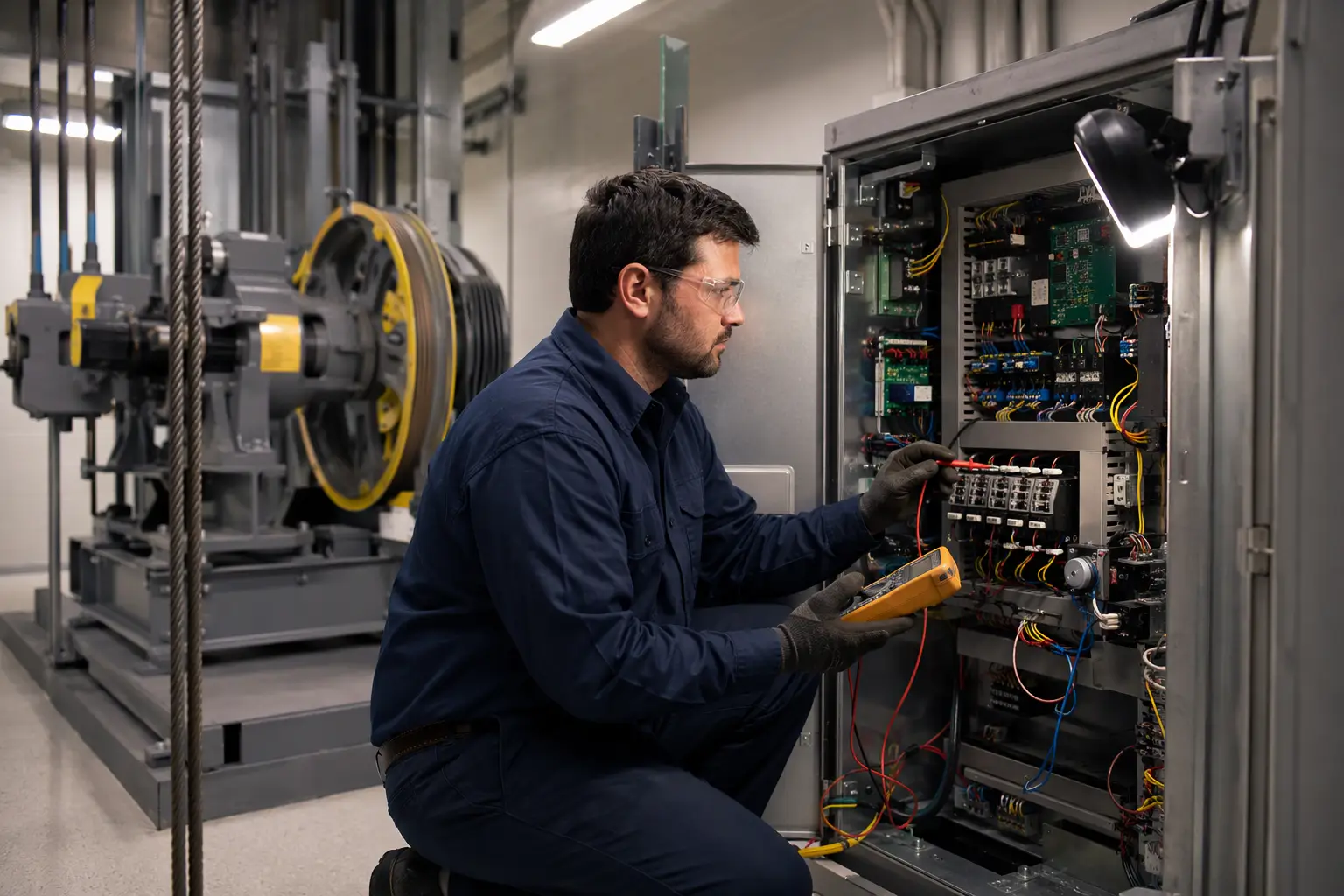
Elevator mechanics working in Virginia must hold state certification from the Virginia Board for Contractors (DPOR), which requires at least three years of experience in the elevator industry and passing a Board-approved examination. Certified mechanics must also complete at least eight hours of Board-approved continuing education at each renewal. Installing, repairing, improving, or removing elevators or escalators requires a contractor license with the Elevator/Escalator Contracting (EEC) specialty. Any company without that EEC license operating in Falls Church is out of compliance with Virginia law, regardless of how experienced its technicians may be.
How often do elevators in Falls Church, VA need to be inspected?
All elevators and escalators in Virginia require at least an annual periodic inspection, and a locality may require a six-month periodic inspection at its discretion.
Under the 2021 USBC and ASME A17.1/CSA B44-2019, periodic tests follow the intervals set out in ASME A17.1 Appendix N and must be witnessed by the local code official. The code official may designate an approved agency or certified elevator inspector to witness tests on its behalf. Beyond the standard annual periodic inspection, Virginia’s adoption of ASME A17.1-2019 triggers additional Category testing at multi-year intervals specified in Appendix N — including five-year comprehensive tests for applicable equipment types. Third-party inspection reports submitted to the local authority must include the name and certification number of the elevator mechanic who performed the witnessed tests.
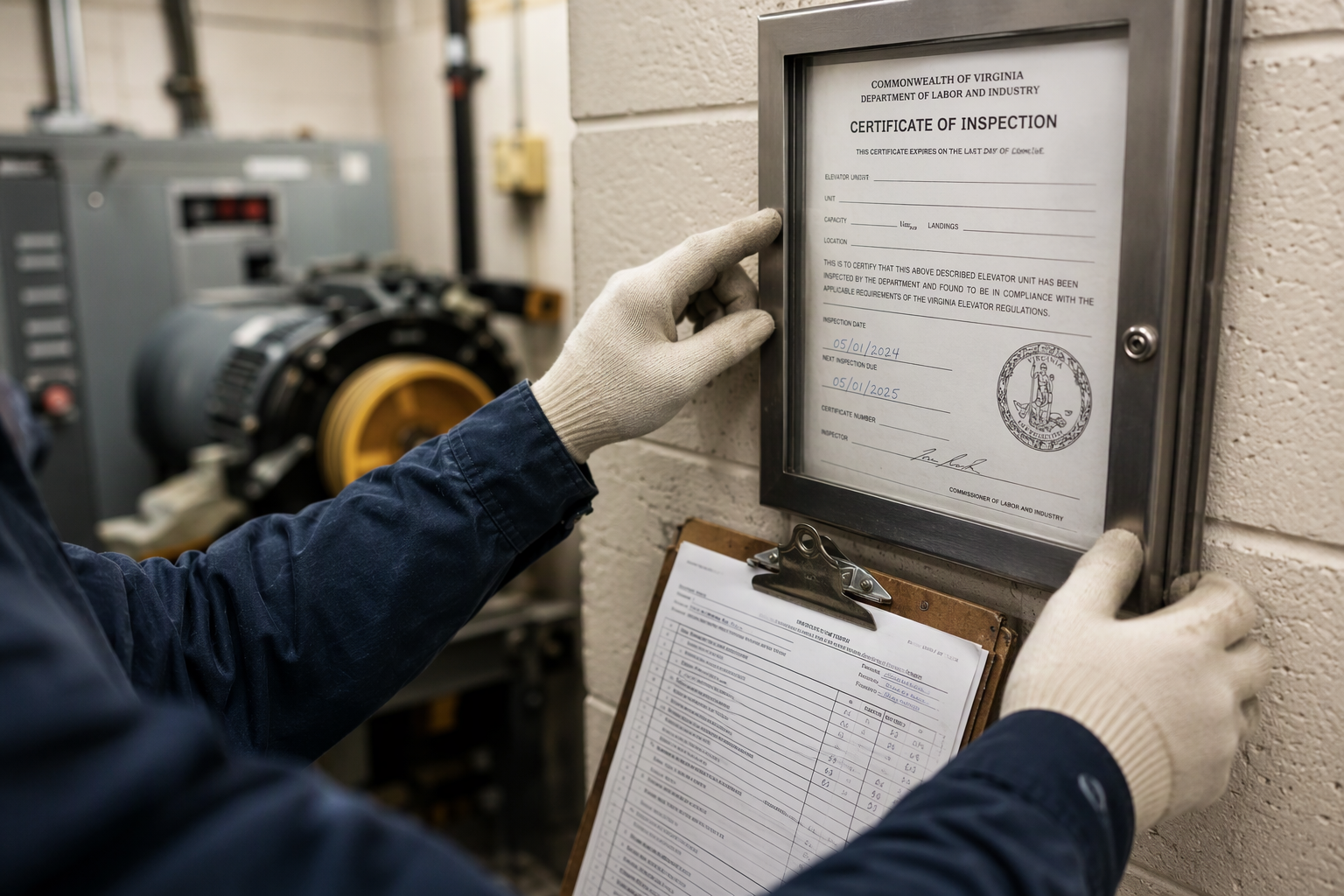
The current certificate of inspection must be displayed in the elevator car, kept in the building operator’s office, or posted in another approved conspicuous location. Failure to maintain a current certificate is a code violation enforceable by the local building department.
What does a comprehensive elevator maintenance program include?
A comprehensive elevator maintenance program covers all mechanical, electrical, and safety systems required by the ASME A17.1 Safety Code for Elevators and Escalators to keep equipment safe and compliant between inspections.
At minimum, a compliant maintenance program addresses the following system categories on a scheduled basis:
- Drive system: Motor, drive sheave, governor, and associated rope or belt components checked for wear, alignment, and lubrication.
- Door systems: Door operators, rollers, gibs, clutch mechanisms, and door restrictors inspected and adjusted to prevent entrapment.
- Safety devices: Safeties, buffers, and speed governors tested and confirmed functional.
- Control systems: Microprocessor controllers, relay logic panels, and all associated wiring checked for faults, ground conditions, and code compliance.
- Hydraulic systems (where applicable): Cylinder, power unit, oil lines, and pit conditions inspected for leaks and pressure integrity.
- Cab and fixtures: Operating buttons, emergency lighting, emergency communication devices, and ventilation verified functional.
- Pit and machine room: Cleanliness, lighting, clearances, stop switches, and fire suppression compatibility confirmed.
- ADA compliance elements: Control height, tactile markings, audible signals, and two-way emergency communication verified against ADA requirements.
Maintenance records must be kept at a readily accessible central location in the building — a requirement in neighboring Maryland under the Maryland Department of Labor, Division of Labor and Industry, and a best practice across the entire region. Quality Elevator Company structures its maintenance agreements to produce the documentation that inspectors and building owners need at audit time.
What is the difference between preventive maintenance and reactive repair?
Preventive maintenance involves scheduled, documented service performed at regular intervals to identify and correct wear before a failure occurs, while reactive repair is unplanned work done after a component has already failed and the elevator has gone out of service.
The distinction matters significantly for building owners. Reactive repair typically involves higher labor urgency, unplanned parts procurement, and — most critically — an elevator that is out of service and potentially causing compliance issues if the building is required to maintain operational elevator access. The ADA requires that accessible routes remain available to people with disabilities; an extended outage on a building’s only accessible vertical means of travel can create legal exposure beyond the immediate repair cost.
Preventive maintenance, by contrast, allows parts with known service lives — such as ropes, roller guides, and door contacts — to be replaced during scheduled downtime. It also creates the written maintenance log that Virginia’s AHJ may review during annual inspections. The ASME A17.1 Safety Code is built on the assumption that compliant maintenance is ongoing; inspections are a verification of that ongoing care, not a substitute for it.
What are the most common elevator code violations found during Virginia inspections?
The most frequently cited elevator deficiencies during Virginia periodic inspections involve door safety systems, emergency communication devices, and missing or outdated documentation.
Based on the requirements of ASME A17.1/CSA B44-2019 as adopted by Virginia, common deficiency categories include:
- Door reopening devices: Safety edges or light curtains that have degraded and no longer meet response specifications.
- Emergency lighting: Cab emergency lighting that fails to illuminate or battery backup that no longer holds charge.
- Emergency communication: Two-way communication devices that are non-functional or not connected to a monitoring service.
- Governor and safety condition: Governors that have not been trip-tested at the required ASME A17.1 Appendix N intervals.
- Pit conditions: Accumulation of water, debris, or oil — a fire hazard and a code violation.
- Certificate display: Expired or missing certificate of inspection posted in the cab or operator’s office.
- Missing maintenance records: Inability to produce a maintenance log at the building during inspection.
A proactive maintenance relationship with a licensed contractor like Quality Elevator Company addresses each of these categories before the annual inspection, reducing the risk of violations, re-inspection fees, and elevator shutdowns.
How do I evaluate and compare elevator maintenance companies in Northern Virginia?
Evaluating elevator maintenance companies in Northern Virginia requires checking licensure, verifying mechanic certifications, and comparing the scope and documentation standards of their maintenance programs.
Use the following comparison framework when reviewing proposals:
| Evaluation Criterion | Minimum Acceptable Standard | What to Confirm |
|---|---|---|
| Contractor License | Virginia EEC specialty license via DPOR Board for Contractors | License number and current status on DPOR public lookup |
| Mechanic Certification | Virginia state-certified elevator mechanics on all service calls | Certification numbers included in work orders and inspection reports |
| Code Familiarity | ASME A17.1/CSA B44-2019 (2021 USBC, effective Jan. 18, 2024) | Confirm provider knows current adopted edition and Appendix N test intervals |
| Maintenance Documentation | Written maintenance log kept at the building | Sample maintenance log format provided before contract signing |
| Inspection Support | Coordination with local AHJ for annual and Category tests | Confirm provider attends or supports inspection witnessing |
| ADA Compliance Review | Verification of cab controls, signage, and communication devices | ADA checklist included in annual maintenance scope |
| Market Coverage | Active operations in Virginia | Confirm physical presence and service history in Northern Virginia |
A provider that cannot produce a current Virginia EEC contractor license number or cannot name the specific ASME A17.1 edition adopted by Virginia’s 2021 USBC should raise immediate concern about their regulatory competence.
What ASME codes apply to elevator maintenance in Virginia in 2026?
As of 2026, Virginia elevator maintenance is governed by the ASME A17.1/CSA B44-2019 Safety Code for Elevators and Escalators, incorporated by the 2021 Virginia Uniform Statewide Building Code, which took effect on January 18, 2024.
The 2021 USBC adoption of ASME A17.1-2019 means that elevators installed or modernized under permits issued after January 18, 2024 must meet the 2019 edition’s construction and equipment requirements. For existing elevators, the Virginia Existing Building Code’s referenced-standards table lists ASME A17.1/CSA B44-2016, which governs maintenance and alteration of equipment installed under prior code cycles. This distinction is important: a building that installed its elevator under an earlier permit cycle is maintained to a different referenced standard than one installed after the 2021 USBC took effect.
All periodic tests under either edition must follow ASME A17.1 Appendix N intervals and be witnessed by the local code official or its designee. The 13VAC5-63 Virginia Maintenance Code is the statewide regulatory vehicle that makes these ASME requirements enforceable.
How do ADA requirements affect elevator maintenance obligations?
The Americans with Disabilities Act requires that elevators serving public accommodations and commercial facilities remain accessible and operational, which creates ongoing maintenance obligations that go beyond the ASME A17.1 safety code.
ADA Standards for Accessible Design specify requirements for elevator cab dimensions, door clear width and timing, floor designations in Braille and raised characters, audible and visual floor signals, and two-way emergency communication. Maintenance failures — such as a door that closes too quickly, a floor announcement system that stops working, or tactile markings that have worn off — can constitute ADA violations even if the elevator otherwise passes its annual safety inspection. For buildings that serve the public or employ workers, those violations carry legal exposure under Title II and Title III of the ADA.
A thorough maintenance provider will include an ADA compliance check as a standing component of periodic maintenance visits, not just at annual inspection time. This includes verifying that emergency two-way communication devices are functional and monitored, that cab lighting meets visibility standards, and that all accessible features are intact and working.
What should building owners do if an elevator fails inspection in Virginia?
When a Virginia elevator fails its periodic inspection, the building owner must immediately engage a licensed elevator contractor to correct the cited deficiencies before the elevator returns to service, since operating a non-compliant elevator exposes the building owner to code enforcement action by the local building department.
- Secure the elevator: Place the elevator out of service immediately if the AHJ has identified a safety-critical deficiency. Do not operate equipment with open safety violations.
- Obtain the inspection report: Request the full written inspection report from the AHJ or the third-party inspector who conducted the inspection. The report will specify each deficiency and the applicable code reference.
- Contact a licensed EEC contractor: Engage a Virginia-licensed Elevator/Escalator Contracting specialty contractor to review the report and develop a correction plan.
- Obtain any required permits: Determine whether the correction work requires a permit from the local building department. Alterations and significant repairs generally require a permit under the USBC.
- Perform the corrective work: Have Virginia-certified elevator mechanics complete all repairs documented in the correction plan.
- Schedule re-inspection: Coordinate with the local AHJ to schedule a follow-up inspection or witnessing of corrective tests before returning the elevator to service.
- Update maintenance records: Ensure the building’s central maintenance log reflects all corrective work performed, including dates, mechanic names, and certification numbers.
Building owners who appeal a code official’s decision in Pennsylvania have a formal process under that state’s Elevator Safety Board, but in Virginia, the appropriate path is through the local building department’s appeal process under the USBC. Working with an experienced contractor from the outset shortens the correction timeline significantly.
What elevator maintenance records must be kept in Virginia?
Virginia’s AHJ may require production of maintenance records during inspections, and third-party inspection reports must include the certification number of the mechanic who performed witnessed tests — making a complete, organized building-based record essential.
Virginia’s 13VAC5-63 Maintenance Code and the referenced ASME A17.1 Safety Code together establish that elevators must be maintained in accordance with the code and that records support that demonstration. Best practice — and an explicit statutory requirement in neighboring Maryland under Maryland Department of Labor regulations — is to maintain all maintenance, repair, test, and inspection records at a readily accessible central location in the building where the elevator is installed. Quality Elevator Company structures service documentation to meet both the Virginia AHJ’s expectations and the cross-jurisdictional standards that regional building owners often need.
Records that should be maintained on-site include: the current certificate of inspection, all periodic inspection reports, test reports with mechanic certification numbers, maintenance visit logs with dates and work performed, and any permits or acceptance inspection reports for modernization or repair work.
How does elevator maintenance in Virginia compare to neighboring DC and Maryland requirements?
Virginia, the District of Columbia, and Maryland each adopt different editions of the ASME A17.1 Safety Code and use different regulatory agencies, making cross-jurisdictional compliance a meaningful challenge for regional building portfolios.
Virginia’s 2021 USBC adopts ASME A17.1/CSA B44-2019 with local building department enforcement. The District of Columbia Department of Buildings (DOB) enforces the 2017 DC Building Code, which references ASME A17.1-2013, with DC requiring a periodic inspection and Category 1 test every 12 months and a Category 5 test every 60 months — each by an ASME QEI-certified inspector and a DOB-approved third-party inspection agency. DC elevator certificates are valid for two years, issued after submission of two years of third-party inspection reports through the Citizen Access Portal. Maryland’s Division of Labor and Industry, Elevator and Escalator Safety now operates under ASME A17.1-2022/CSA B44:22 with Maryland changes (effective June 17, 2026), and requires annual periodic inspections, a comprehensive five-year inspection for rope-suspended equipment, and both a licensed elevator mechanic to perform tests and a third-party qualified inspector physically present to witness them.
For building owners with properties across all three jurisdictions, a maintenance provider that understands all three regulatory frameworks eliminates the risk of applying the wrong standard to the wrong property — a common and costly mistake.
What elevator modernization triggers apply under Virginia’s building code?
Modernization work on existing elevators in Virginia must comply with the Virginia Existing Building Code, which references ASME A17.1/CSA B44-2016, and any new installation or major alteration requires a permit and acceptance inspection by the local building department before the elevator returns to service.
Common modernization triggers include controller replacement, drive system upgrades, cab renovations that alter structural or electrical elements, door operator replacements, and installation of new safety devices. Each of these categories can constitute an “alteration” under the USBC, requiring permit submission to the local building department. The local code official then conducts or designates an acceptance inspection before the modernized elevator is placed back in service. No elevator may return to service after a major alteration without passing that acceptance inspection.
ADA-driven upgrades — such as adding accessible cab controls to an older building or upgrading emergency communication equipment — may also require permits depending on the scope of work. Building owners planning modernization projects benefit from engaging a licensed EEC contractor early in the planning process to identify which USBC and ASME requirements apply before design decisions are finalized.
What role does OSHA play in elevator maintenance safety?
The Occupational Safety and Health Administration (OSHA) governs the workplace safety of elevator mechanics and technicians while they perform maintenance, testing, and repair work — separate from the building code requirements that govern the elevator equipment itself.
OSHA’s General Industry and Construction standards apply to elevator mechanics working in machine rooms, pits, and hoistways. Relevant OSHA requirements address lockout/tagout procedures when de-energizing elevator equipment, fall protection in hoistways, confined space protocols for pits that meet confined space criteria, and electrical safety during control system work. A maintenance contractor whose mechanics do not follow OSHA protocols creates liability for both the contractor and, potentially, the building owner as the controlling employer at the worksite.
When evaluating a maintenance provider, building owners should ask about the company’s written safety program, lockout/tagout procedures, and pit entry protocols. A provider with strong OSHA compliance practices is demonstrating the same operational discipline that produces quality maintenance outcomes.
What are the ADA emergency communication requirements for elevators?
Under ADA Standards for Accessible Design, elevators must have a two-way communication system that connects passengers with emergency personnel, with controls located at or below 54 inches above the cab floor and usable without tight grasping, pinching, or twisting.
The ADA emergency communication requirement is distinct from — but complementary to — the ASME A17.1 requirement for a two-way means of communication in elevator cabs. Both requirements must be satisfied simultaneously. A telephone or intercom system that meets ASME A17.1’s functional requirements but fails to meet ADA’s reach range, operability, or audibility standards is non-compliant with the ADA. Maintenance visits should verify that the communication device is functioning, that the answering service or monitoring center responds appropriately, and that all hardware meets the physical accessibility criteria.
The ASME A17.1/CSA B44-2019 adopted by Virginia’s 2021 USBC includes requirements for the emergency communication system that are incorporated into the periodic inspection checklist. Ensuring both ASME and ADA compliance simultaneously is part of a complete maintenance program.
How should a building owner prepare for an annual elevator inspection in Virginia?
Preparation for a Virginia annual elevator inspection involves confirming that all maintenance has been performed and documented, that the elevator’s physical condition meets ASME A17.1 requirements, and that the building has the administrative records ready for the inspector.
- Review the maintenance log: Confirm that all scheduled maintenance visits have been completed and logged since the last inspection, with mechanic names and certification numbers recorded.
- Conduct a pre-inspection walk-through: Walk the pit, machine room, and cab with the maintenance contractor to identify and correct any visible deficiencies before the official inspection date.
- Verify certificate display: Ensure the current certificate of inspection is properly posted in the elevator cab or the building operator’s office in an approved conspicuous location.
- Confirm test scheduling: Coordinate with the licensed EEC contractor to schedule any Category tests due under ASME A17.1 Appendix N at the same time as the annual inspection.
- Prepare documentation: Gather all prior inspection reports, test reports, and permits for any modernization or repair work completed since the last inspection.
- Notify the AHJ: Confirm the inspection date and time with the local building department, and ensure a certified elevator mechanic will be present to perform any required witnessed tests.
- Confirm ADA items: Verify that emergency communication is functional, cab controls are properly marked, and all accessible features are intact.
What should a building owner look for in an elevator maintenance contract?
A sound elevator maintenance contract defines the specific scope of maintenance tasks, inspection support obligations, documentation standards, and the licensure credentials of the mechanics who will perform the work.
Key contract provisions to review include the specific list of systems and components covered in each maintenance visit, the frequency of visits, whether the contractor coordinates with and attends annual inspections by the local AHJ, how maintenance records are delivered and stored, and what constitutes a chargeable repair versus a covered maintenance task. The contract should also specify that only Virginia-certified elevator mechanics with the certification numbers on record will perform work in Virginia, and that the contractor holds a current EEC specialty license.
Contracts that describe maintenance only in general terms — without specifying which systems are examined at which intervals — make it difficult for building owners to verify that the work is actually being done. The best maintenance contracts mirror the structure of the ASME A17.1 maintenance requirements closely enough that an AHJ reviewing the maintenance log can readily confirm compliance.
How does elevator age affect maintenance needs and compliance obligations?
Older elevators generally require more intensive maintenance attention because their components operate closer to end-of-life, their control systems may rely on discontinued technology, and they were designed to earlier editions of the ASME A17.1 Safety Code that did not include all current safety requirements.
Virginia’s regulatory framework addresses this through the existing building provisions: elevators installed under prior permit cycles are maintained to the referenced standards in effect at the time of installation, but they are still subject to annual periodic inspections and must meet any retroactive requirements that have been adopted by the state or local AHJ. The ASME A17.3 Safety Code for Existing Elevators and Escalators provides guidance on the minimum requirements that apply to equipment in service, regardless of original installation date.
For building owners with aging elevator equipment, the maintenance relationship is particularly important: a contractor familiar with older drive technologies, relay logic control systems, and hydraulic cylinders from earlier design eras can identify deterioration patterns that a technician focused solely on modern equipment may overlook. Major component failures in aging equipment can also trigger modernization permit requirements, making early identification critical to planning and budgeting.
Why choose Quality Elevator Company for elevator maintenance in the DC-metro and Virginia region?
Quality Elevator Company is a certified elevator service company serving the Washington DC metro area, Virginia, Maryland, and Pennsylvania, with the licensed workforce and compliance expertise to manage elevator maintenance across all relevant code jurisdictions.
For building owners in Falls Church and the broader Northern Virginia market, regional expertise matters. The Virginia regulatory framework requires coordination between the licensed EEC contractor, Virginia-certified elevator mechanics, and the local building department AHJ — a workflow that differs from the DOB-approved third-party inspection model used in the District of Columbia, and from the state-agency inspection model used by the Maryland Department of Labor, Division of Labor and Industry, Elevator and Escalator Safety. Quality Elevator Company understands all three frameworks and can manage compliance documentation for building portfolios that span jurisdictions.
The company’s maintenance programs are built around the documentation standards that AHJs actually review: written maintenance logs kept at the building, inspection reports with mechanic certification numbers, and test records that align with ASME A17.1 Appendix N intervals. That documentation discipline protects building owners at inspection time and creates an auditable record that demonstrates ongoing compliance.
Contact Quality Elevator Company for a free elevator assessment at 301-779-9116.
Need elevator service you can rely on? Quality Elevator Company is ready to help.