How Does Cold Weather Affect Elevator Performance? Complete Winter Maintenance Guide
Cold weather and winter conditions create a range of mechanical, hydraulic, and electrical challenges for elevator systems. Hydraulic oil viscosity increases dramatically in low temperatures, door operators struggle against contracted metal frames and frozen hardware, machine room condensation corrodes control boards, and pit flooding from snowmelt can trigger safety shutdowns. A structured pre-winter maintenance protocol — performed by a licensed elevator service provider — addresses each of these failure points before the heating season begins. The sections below answer the most common questions building owners and facility managers in Baltimore, Washington DC, Philadelphia, and Richmond ask about winter elevator care.
1. How does cold weather specifically affect elevator hydraulic systems?
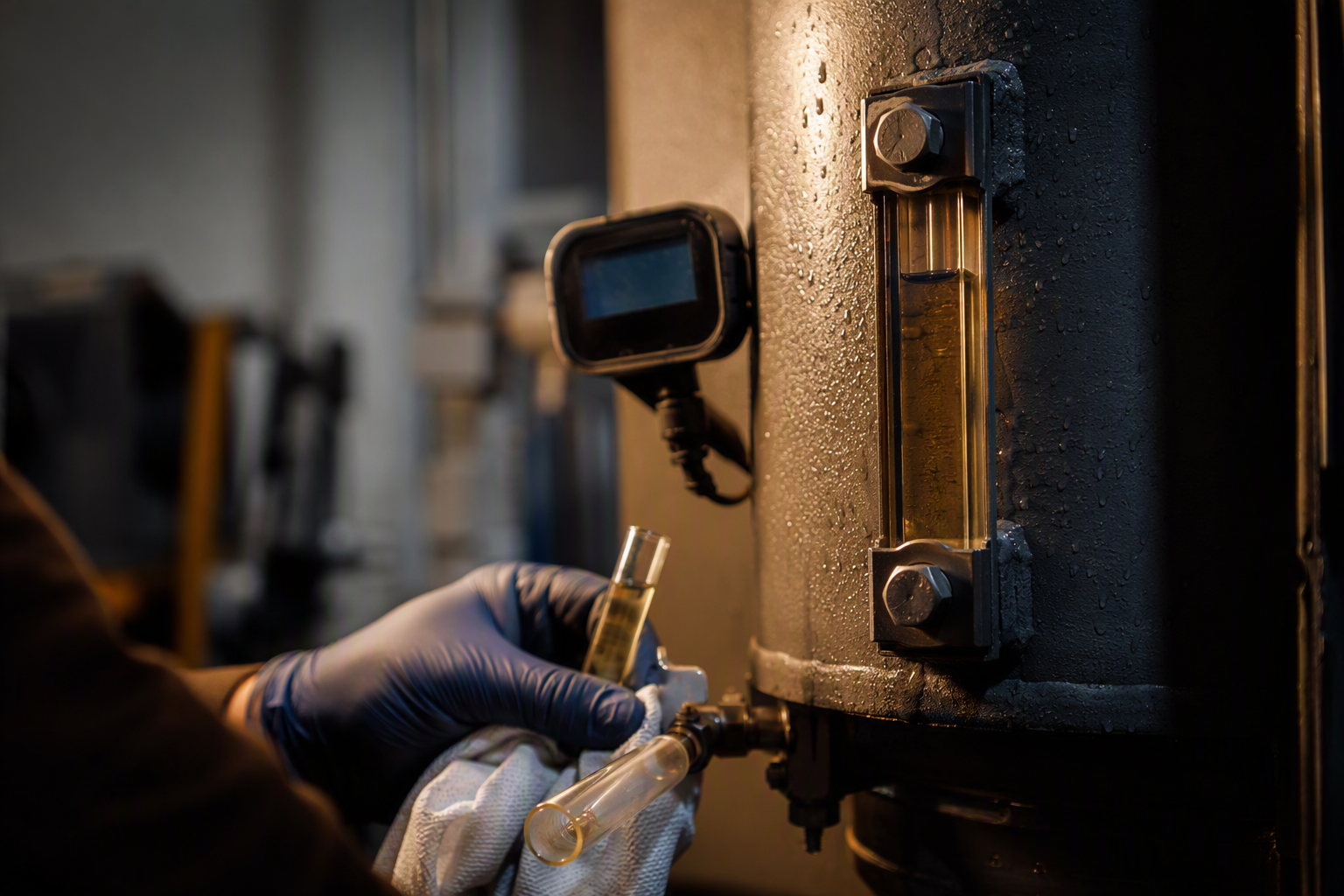
Cold weather thickens hydraulic fluid, slowing pump response, reducing leveling accuracy, and in extreme cases preventing the elevator from operating at all.
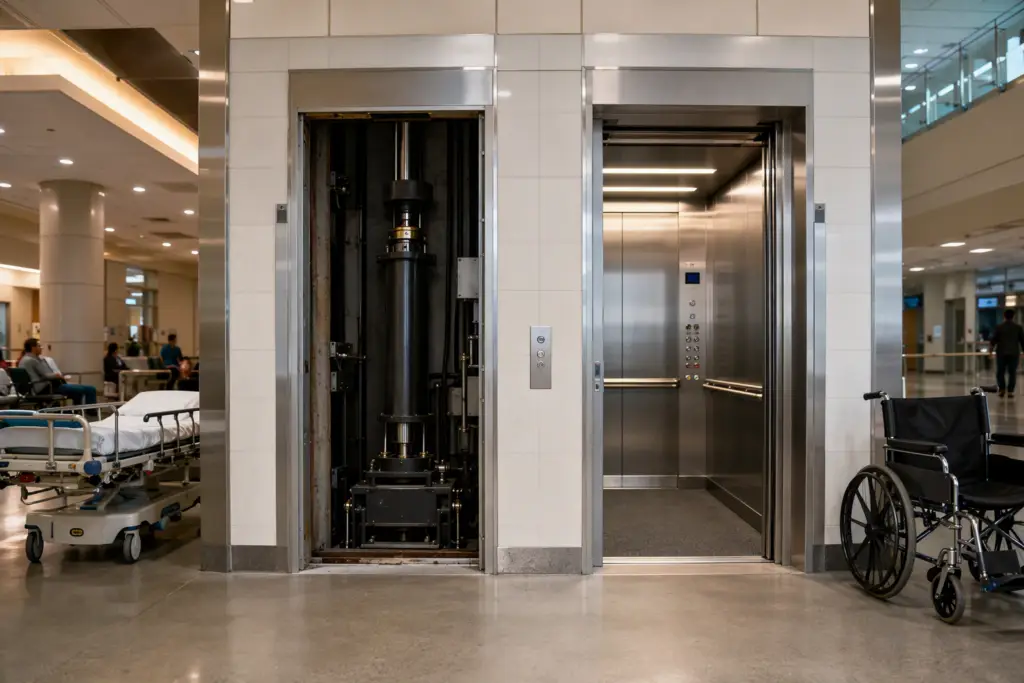
Hydraulic elevators rely on fluid being pumped at a consistent viscosity to move the jack and hold the cab level with each floor. When ambient temperatures in a machine room or underground pit drop significantly, the oil’s viscosity index works against performance. The pump motor labors harder, the valve response slows, and passengers may notice the cab stopping above or below floor level — a condition called mis-leveling. Persistent mis-leveling is not only a nuisance but a tripping hazard that implicates ADA accessibility requirements under the Americans with Disabilities Act.
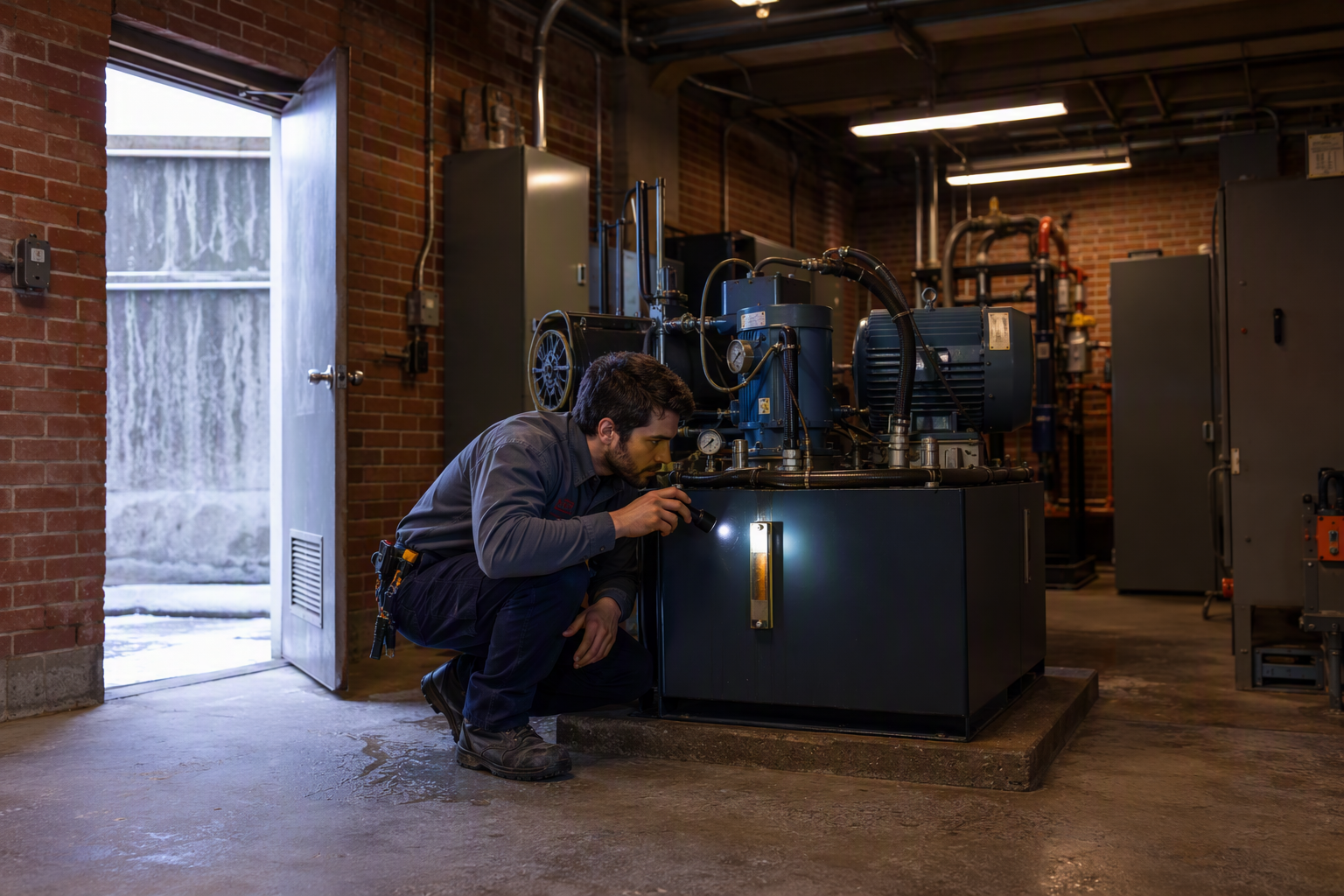
Technicians address this in two ways: by verifying that the machine room is adequately heated (typically above 50°F) before winter arrives, and by confirming that the hydraulic fluid grade installed is appropriate for the minimum expected ambient temperature in that specific installation. Some older buildings in Baltimore and Philadelphia have machine rooms in partially conditioned spaces that are adequate in summer but borderline in a cold January. Fluid sampling can also identify whether the existing oil has degraded and is more susceptible to cold-weather viscosity shifts than fresh fluid.
2. What happens to elevator door systems in winter?
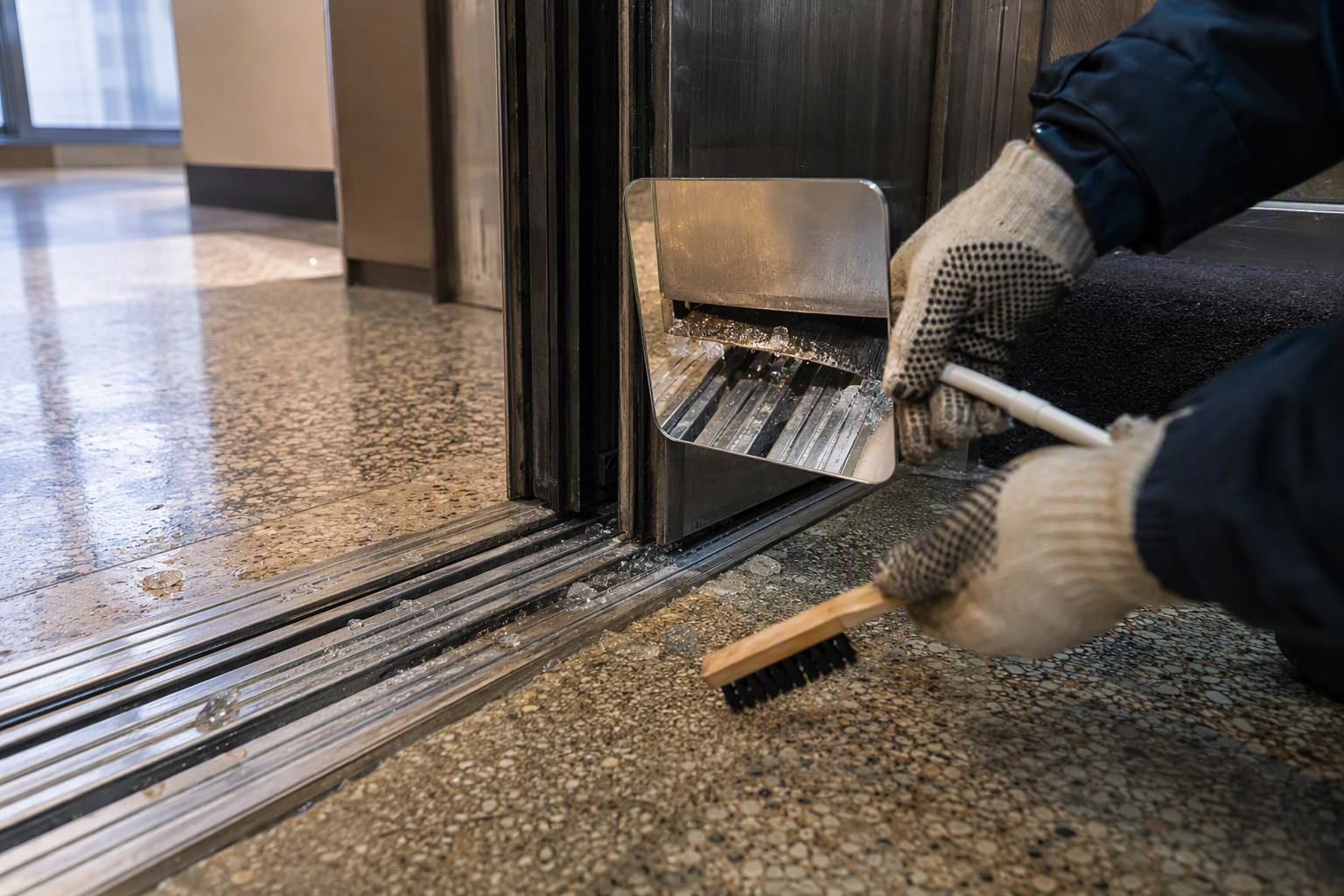
Metal expansion and contraction from temperature swings cause door frames, sills, and hangers to shift out of alignment, increasing door strikes, nuisance reversals, and entrapment risk.
Elevator doors are precisely adjusted at installation, but steel contracts measurably as temperatures fall. Door sill gaps can tighten, causing the door to drag; hanger rollers wear faster when running on a warped or contracted track; and door operator clutch and vane assemblies can mis-engage when the interlock geometry drifts. Moisture is an additional factor — freezing rain and tracked-in snow turn into ice in lobby sill grooves, jamming doors mid-cycle. Pre-winter maintenance should include cleaning and inspecting door sills, verifying door open and close forces, confirming safety edge and light curtain function, and lubricating door hanger components per manufacturer specifications.
3. How does cold weather affect traction elevator cables and sheaves?
Low temperatures reduce lubricant effectiveness in wire ropes and sheave grooves, accelerating wear and increasing the risk of rope slippage on the drive sheave.
Wire rope lubricants are formulated to penetrate strand interstices and reduce internal wire-on-wire abrasion. Cold weather increases lubricant viscosity, reducing penetration and leaving inner wires under-lubricated. Traction sheave grooves can also accumulate condensation that, in freeze-thaw cycles, accelerates groove wear. A pre-winter inspection should include wire rope condition assessment, lubrication of ropes per the ASME A17.1 Safety Code for Elevators and Escalators, and sheave groove measurement to confirm adequate traction geometry.
4. Why is the elevator machine room temperature so critical in winter?
Machine rooms must remain within the temperature range specified by the elevator manufacturer and required by code, because control electronics, hydraulic power units, and motor insulation all degrade when exposed to cold beyond their design limits.
The ASME A17.1 Safety Code for Elevators and Escalators contains requirements for machine room environmental conditions. Solid-state drive controllers, variable-frequency drives (VFDs), and programmable logic controllers are particularly sensitive — condensation forming on circuit boards when a cold machine room warms up during the day can cause shorts, nuisance faults, and, in severe cases, permanent board damage. Building owners should verify that machine room HVAC or dedicated space heaters are operational before the first hard freeze. A simple thermostat-controlled unit heater is often all that is needed, but it must be inspected annually to confirm it functions reliably.
5. What pre-winter elevator inspection checklist should building owners follow?
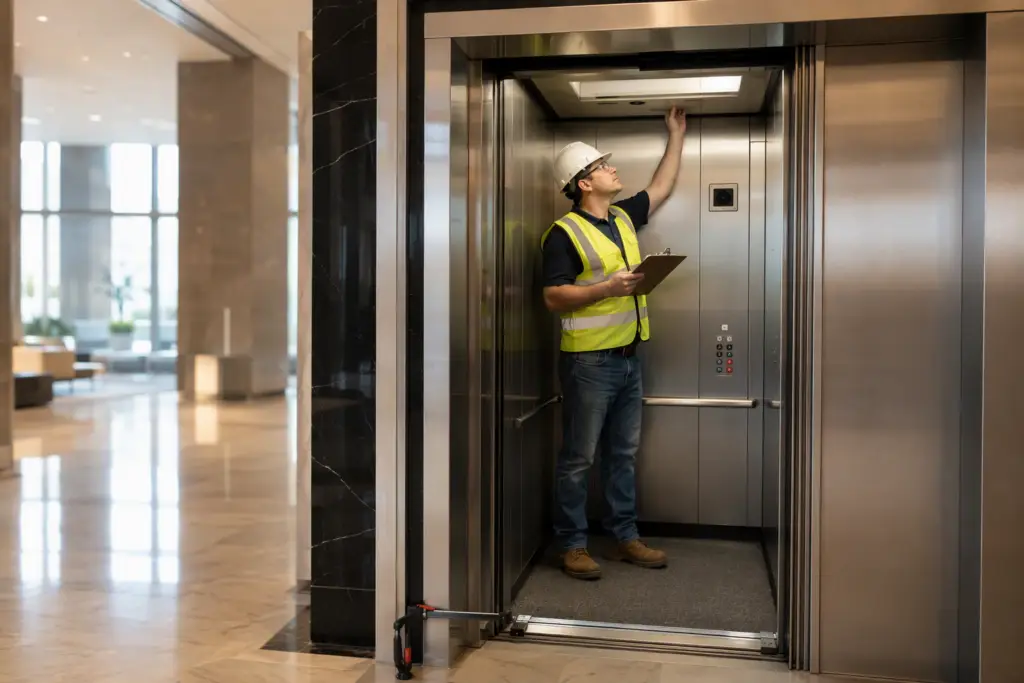
A thorough pre-winter elevator inspection covers at minimum: machine room heating, hydraulic fluid, lubrication, door systems, pit drainage and heaters, safety devices, ropes or chains, and control system condition.
Below is the recommended pre-winter protocol that Quality Elevator Company performs for commercial and residential properties across its service area:
- Inspect and test machine room heating equipment — confirm the thermostat activates the heater at the proper setpoint and that heat output is adequate for the room’s volume and insulation level.
- Sample or inspect hydraulic fluid — check fluid level, color, and water content; replace if degraded; confirm the fluid grade is rated for expected low temperatures.
- Verify pit sump pump and pit heater operation — test the sump pump float switch, confirm the pit heater (if installed) energizes, and inspect pit walls for cracks that allow groundwater infiltration in spring thaw.
- Lubricate wire ropes, guide rails, and sheaves (traction units) — apply manufacturer-approved lubricants rated for winter temperatures.
- Clean and inspect door sills and tracks — remove compacted debris, confirm sill grooves are clear, test door open/close forces, and verify safety edge and light curtain response times.
- Test all safety devices — governor, safeties, buffers, and final limit switches per ASME A17.1 periodic test requirements.
- Inspect electrical connections and control boards — look for corrosion caused by prior-season condensation; tighten terminals and replace suspect components before cold weather returns.
- Verify cab and hoistway lighting — cold temperatures accelerate fluorescent ballast failure; confirm emergency lighting battery backup functions.
- Check traveling cables — inspect for cracking or stiffening in rubber-jacketed cables that run through the hoistway, which are more prone to cracking in cold.
- Document and report findings — provide a written report to the building owner or facility manager noting any deficiencies requiring correction before winter operation.
6. How does moisture and condensation damage elevator control systems in winter?
Temperature swings between cold nights and heated daytime operation cause condensation to form on control boards and electrical components, leading to corrosion, short circuits, and intermittent faults.
This is one of the most insidious forms of winter elevator damage because it is cumulative and invisible. A control board that has experienced repeated condensation cycles may appear functional until a relay contact corrodes enough to fail under load. Buildings with unheated or poorly insulated machine rooms in Philadelphia or Baltimore, where winter temperature swings are significant, are particularly vulnerable. The corrective strategy is consistent machine room heating — maintaining temperature above the dew point of the ambient air — rather than allowing the room to cycle between cold and heated.
7. What elevator problems are most commonly reported in winter months?
The most frequently reported winter elevator problems are slow or erratic door operation, mis-leveling in hydraulic units, nuisance fault shutdowns, and pit flooding triggering safety switches.
Field experience across the industry consistently surfaces these four categories as the dominant winter complaint patterns. Slow doors are often traced to either contracted hardware or a failing door operator motor that lacks the torque margin to overcome increased friction. Mis-leveling in hydraulics is directly attributable to fluid viscosity changes. Nuisance shutdowns frequently originate from moisture on control boards or condensation in safety circuit wiring. Pit flooding, while sometimes a year-round issue, intensifies in winter due to snowmelt and frozen ground redirecting surface water toward building foundations.
8. Does cold weather affect elevator safety code compliance?
Yes — winter-related degradation in door performance, mis-leveling, and safety device function can create code violations under ASME A17.1 and ADA accessibility standards that result in required shutdown of the unit.
Under the ASME A17.1 Safety Code for Elevators and Escalators, elevators must be maintained in a safe operating condition at all times. An elevator that consistently mis-levels more than a specified tolerance, or whose door reopening devices fail to respond correctly, is operating outside code compliance. Additionally, mis-leveling creates a gap or step at the landing that violates ADA accessibility requirements, exposing building owners to civil liability. In Maryland, the District of Columbia, Pennsylvania, and Virginia, the authority having jurisdiction (AHJ) can order an elevator out of service if an inspection reveals safety code violations — including those caused by winter maintenance neglect.
9. What are the required elevator inspection intervals in Maryland, DC, Pennsylvania, and Virginia?
Each jurisdiction in Quality Elevator Company’s service area mandates periodic inspections by a licensed inspector, typically annually or semi-annually depending on elevator type and use.
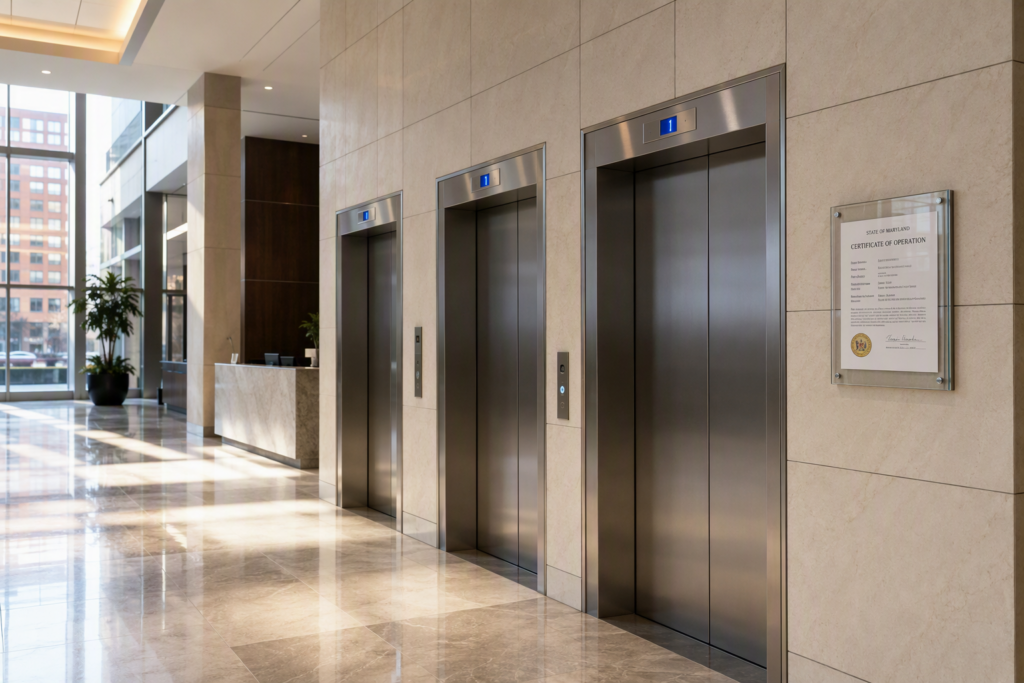
While specific statutory inspection intervals are set by each jurisdiction’s elevator safety authority and subject to revision, all four markets Quality Elevator Company serves operate under frameworks aligned with ASME A17.1 (new installations) and ASME A17.3 (existing installations) as adopted by each state or district. Building owners are responsible for ensuring their unit holds a current operating certificate before winter adds stress to aging equipment. Scheduling pre-winter maintenance alongside the required periodic inspection is an efficient approach that minimizes downtime and ensures compliance documentation is current.
10. How does winter affect elevator performance differently by elevator type?
Hydraulic, traction, and MRL (machine-room-less) elevators each have distinct winter vulnerabilities — hydraulic systems are most sensitive to fluid and pit temperature, while traction and MRL units are more susceptible to rope lubrication and control electronics issues.
| Elevator Type | Primary Winter Risk | Secondary Winter Risk | Critical Pre-Winter Action |
|---|---|---|---|
| Hydraulic (In-Ground) | Fluid viscosity / mis-leveling | Pit flooding / sump pump failure | Fluid inspection, pit heater test, sump pump test |
| Hydraulic (Holeless) | Fluid viscosity / machine room temperature | Seal degradation from cold | Machine room heat verification, seal inspection |
| Geared Traction | Gearbox lubricant viscosity | Rope lubrication degradation | Gearbox oil inspection, rope lubrication |
| Gearless Traction | Rope/sheave lubrication | Motor bearing lubrication | Sheave inspection, rope lubrication |
| MRL (Machine-Room-Less) | Control board condensation in hoistway | Rope lubrication access difficulty | Control enclosure inspection, hoistway temperature check |
11. How does pit flooding in winter affect elevator safety systems?
Water accumulation in the elevator pit can trip pit stop switches, corrode safety device components, and create electrical hazards that trigger automatic shutdown or pose risk to maintenance personnel.
Elevator pits are designed to collect small amounts of incidental water, but winter snowmelt and frozen ground conditions can overwhelm drainage capacity. When water contacts pit electrical components — stop switches, traveling cable terminations, or buffer foundations — the result ranges from nuisance trips to genuine electrical hazards. OSHA electrical safety standards apply to elevator maintenance personnel working in flooded or wet pits, requiring the equipment to be de-energized before entry. A functioning sump pump with a tested float switch is the primary defense; secondary measures include sealing pit wall penetrations and ensuring pit drain lines are not frozen.
12. What lubricants should be used on elevators in winter, and does the type matter?
Winter elevator lubrication requires products specifically rated for low-temperature performance, as standard lubricants can congeal or lose film strength at temperatures common in unheated machine rooms and hoistways.
Elevator lubricants span several categories: hydraulic oil, gear oil, wire rope lubricant, guide rail lubricant, and various greases for bearings and pivot points. Each has a published viscosity-temperature curve, and a product that performs correctly at 70°F may be inadequate at 35°F. Manufacturers specify approved lubricants in their maintenance manuals, and deviating from those specifications can void equipment warranties and create liability under ASME A17.1 maintenance obligations. A licensed elevator contractor will carry lubricants appropriate for the specific equipment they service and the ambient conditions expected in that installation.
13. When should pre-winter elevator maintenance be scheduled?
Pre-winter elevator maintenance should be completed before sustained ambient temperatures drop below 40°F — in the Baltimore, DC, Philadelphia, and Richmond markets, this typically means completing the work between September and mid-November.
Scheduling ahead of the first cold snap is important because some corrective work — such as machine room heater replacement or hydraulic fluid change — requires ordering parts that may have lead times. Waiting until a cold-weather breakdown occurs means the elevator is out of service during the period of highest mechanical stress. Building owners and facility managers should build pre-winter elevator service into their annual maintenance calendar with the same priority as boiler and HVAC seasonal startup. Quality Elevator Company serves customers across Baltimore, Washington DC, Philadelphia, and Richmond and can coordinate pre-season inspections as part of a planned maintenance agreement.
14. Can cold weather cause an elevator to fail a state inspection?
Yes — winter-induced deficiencies such as degraded door performance, mis-leveling, inoperative safety devices, and pit water accumulation are all grounds for a failed inspection in Maryland, DC, Pennsylvania, and Virginia.
State and district elevator inspectors are trained to identify conditions that fall outside code-compliant operating parameters, and seasonal deterioration does not exempt a building from compliance. A failed inspection in any of these jurisdictions typically results in a correction order with a compliance deadline; continued operation with an expired or failed certificate can expose the building owner to fines and civil liability. Pre-winter maintenance that identifies and corrects deficiencies before the scheduled inspection is far less disruptive and costly than responding to a shutdown order.
15. What should building staff do immediately if an elevator malfunctions during a cold weather event?
If an elevator malfunctions during cold weather, building staff should place the unit out of service, notify passengers, and contact a licensed elevator service provider immediately — never attempt to restore operation by manually overriding safety devices.
- Place the elevator out of service — use the in-cab or machine room switch to prevent further calls and display an out-of-service notice at every landing.
- Confirm no passengers are trapped — communicate via the emergency phone in the cab; if passengers are trapped, contact the fire department for entrapment response per local protocol.
- Document the fault code or symptom — note any error codes displayed on the controller, the time of failure, and recent weather conditions (temperature, precipitation) to assist the technician.
- Do not attempt manual operation or bypass safety circuits — cold-weather faults often originate in safety devices; bypassing them creates an uncontrolled hazard.
- Contact a licensed elevator service provider — relay the fault information and weather conditions so the technician arrives prepared with the appropriate parts and tools.
- Secure the machine room — ensure the machine room remains locked and accessible only to authorized service personnel.
- Log the incident — record the event in the building’s elevator maintenance log, noting time, symptoms, and service response, as regulators may request this documentation.
16. How do variable-frequency drives (VFDs) behave differently in cold weather?
VFDs are sensitive to cold because their capacitors, bus bars, and cooling systems are rated for specific temperature ranges, and cold starts after prolonged inactivity can cause fault trips or component damage.
Modern traction elevators increasingly use variable-frequency drives to provide smooth acceleration and deceleration and improve energy efficiency. These drives contain large electrolytic capacitors that can be damaged by cold-temperature charging cycles and internal bus components whose insulation may crack if the drive enclosure drops below the manufacturer’s minimum storage temperature. VFD manufacturers typically specify a minimum operating temperature, commonly 32°F to 41°F depending on the unit. Ensuring that the machine room remains above that threshold is essential. A pre-winter inspection should include confirming VFD cooling fans operate correctly, verifying enclosure integrity, and reviewing any fault logs from the prior heating season for cold-weather-related trips.
17. Are there specific building code requirements for elevator machine room heating?
ASME A17.1 requires that elevator machine rooms be maintained at temperatures within the range required by the equipment installed, and local building codes in Maryland, DC, Pennsylvania, and Virginia reinforce this through mechanical and electrical code adoptions.
The ASME A17.1 Safety Code for Elevators and Escalators establishes that machine rooms must be protected from the elements and maintained at conditions suitable for the equipment. Individual elevator manufacturers narrow this further by specifying minimum and maximum ambient operating temperatures in their installation manuals. Building owners who cannot document that machine room conditions meet these requirements are, in effect, operating outside the maintenance standard required by the code. A qualified elevator contractor can assess whether the existing heating infrastructure is adequate and recommend upgrades where it is not.
18. What is the cost impact of skipping winter elevator maintenance?
Deferred winter maintenance typically leads to reactive repair costs that are substantially higher than preventive service, in addition to elevator downtime, potential code violations, and liability exposure from passenger incidents.
While specific repair costs vary by equipment type, component, and market, the cost differential between scheduled preventive maintenance and emergency breakdown service is consistently unfavorable for owners who defer maintenance. A hydraulic fluid change performed as scheduled preventive maintenance is a fraction of the cost of a power unit replacement caused by operating degraded, water-contaminated fluid through a winter season. Door operator replacement is similarly more expensive than the seasonal door adjustment and lubrication that extends operator life. Beyond direct repair costs, elevator downtime in a commercial building affects tenant satisfaction and, in residential properties, may trigger fair housing or ADA complaints if the building’s only accessible vertical access is unavailable. Quality Elevator Company offers planned maintenance agreements that structure pre-winter service as part of a year-round program, helping building owners budget predictably and avoid reactive expenditures.
19. How does winter weather affect outdoor or partially exposed elevator installations?
Outdoor and semi-exposed elevators — such as those in parking structures, loading docks, or exterior platforms — face accelerated corrosion, ice formation on guide rails, and seal failure that requires additional protective measures beyond standard indoor winterization.
Parking structure elevators in Baltimore, Philadelphia, and Washington DC are exposed to road salt-laden air, freeze-thaw cycling on concrete hoistway walls, and direct precipitation infiltration. Guide rails in these environments require more frequent lubrication with corrosion-inhibiting compounds, and hoistway enclosures must be inspected for cracks that allow water infiltration. Sill heaters — low-wattage heating elements embedded in or attached to door sills — are a standard protective measure for outdoor and exposed installations and should be tested each fall. Safety device components such as governors and buffers must also be inspected for corrosion that could impair their function under the load conditions tested per ASME A17.1.
20. How do I choose a qualified elevator service provider for winter maintenance in Baltimore, DC, Philadelphia, or Richmond?
A qualified elevator service provider in this region should hold the appropriate state or district contractor license, employ certified elevator mechanics, and demonstrate familiarity with the specific equipment types and local code requirements in Maryland, DC, Pennsylvania, and Virginia.
Building owners evaluating elevator service providers should confirm that the company holds an active elevator contractor license in the relevant jurisdiction — Maryland, the District of Columbia, Pennsylvania, and Virginia each maintain licensing requirements for elevator contractors. Technicians should be qualified under standards recognized by the industry, and the company should be able to provide references for similar building types in the service area. A provider that offers a documented, written pre-winter inspection report — rather than a verbal assurance — gives the building owner the documentation needed to demonstrate due diligence to insurers, regulators, and tenants. Quality Elevator Company serves Baltimore MD, Washington DC, Philadelphia PA, and Richmond VA, and provides structured pre-winter maintenance programs aligned with ASME A17.1 and local regulatory requirements across all four markets.
Schedule Your Pre-Winter Elevator Assessment Today
Winter elevator failures are largely preventable. A properly scheduled pre-season inspection catches hydraulic fluid degradation, door system misalignment, machine room heating deficiencies, and safety device wear before cold temperatures turn minor issues into costly breakdowns and code violations.
Quality Elevator Company provides comprehensive pre-winter elevator inspections and maintenance for commercial, residential, and industrial properties throughout Baltimore MD, Washington DC, Philadelphia PA, and Richmond VA. Service is performed in alignment with ASME A17.1 Safety Code for Elevators and Escalators and applicable local regulatory requirements.
Contact Quality Elevator Company for a free elevator assessment: 301-307-5363
Need elevator service you can rely on? Quality Elevator Company is ready to help.