Elevator inspection certificates are legal documents confirming that a conveyance has passed all required periodic inspections and tests. Building owners and property managers in Baltimore, Washington DC, Philadelphia, and Richmond frequently need copies for insurance renewals, lease audits, due-diligence reviews, and regulatory compliance. This hub answers the most commonly asked questions about obtaining, displaying, storing, and replacing those certificates across every jurisdiction Quality Elevator Company serves.
How do I get copies of my elevator inspection certificates?
Contact your state or local elevator regulatory agency directly, retrieve records from your elevator service contractor, or check the building’s on-site maintenance file — all three sources are required by law to maintain these records.
The specific agency depends on where the building is located. In the District of Columbia, certificates are issued by the DC Department of Buildings (DOB) after a DOB-approved third-party inspection agency submits reports through the Citizen Access Portal. In Maryland, the Maryland Department of Labor, Division of Labor and Industry, Elevator and Escalator Safety issues certificates and requires that they be posted conspicuously in or on the elevator unit. In Pennsylvania, the Pennsylvania Department of Labor and Industry (L&I) issues a certificate of operation that must be posted in the car or attached to the controller in the machine room. In Virginia, the local building department for the city or county where the elevator is located issues and maintains inspection records.
Your licensed elevator service contractor should also maintain copies of all inspection reports and certificates as part of the service record for each unit. Maryland law specifically requires that maintenance, repair, test, and inspection records be kept at a readily accessible central location in the building. Owners who work with Quality Elevator Company can request documentation support as part of their ongoing service relationship.
Where should elevator inspection certificates be physically displayed?
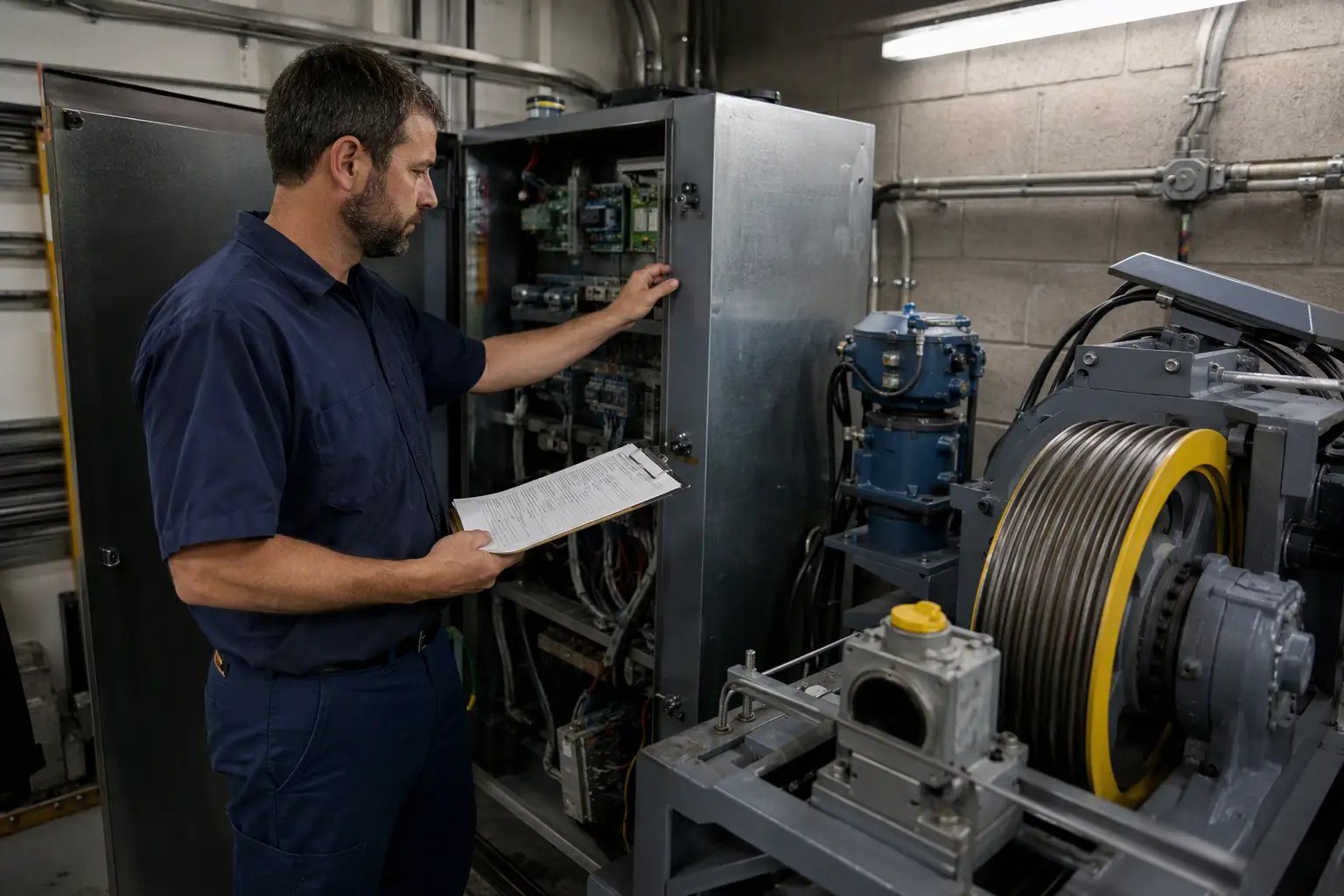
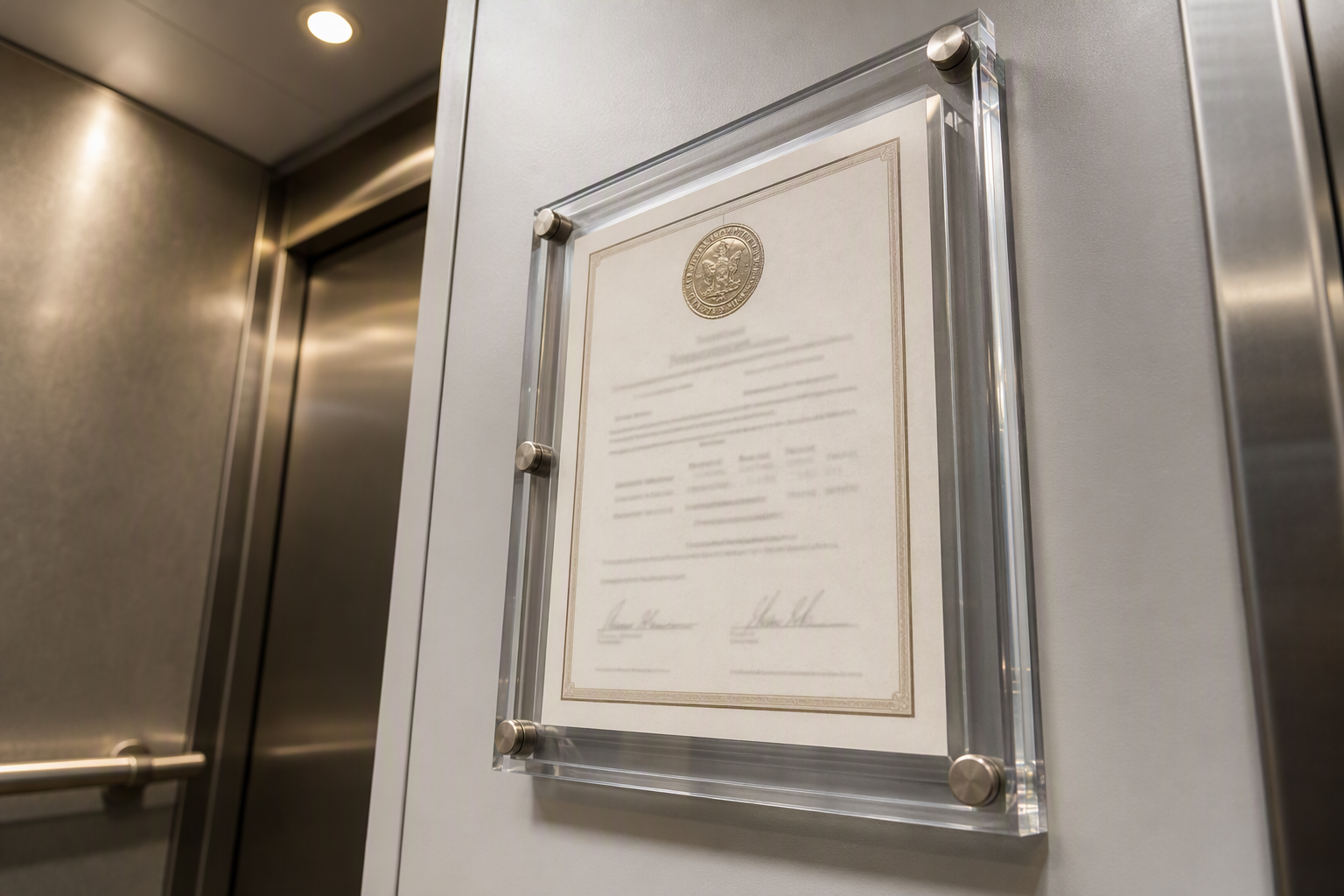
Each jurisdiction requires the certificate to be conspicuously displayed in or near the elevator, though specific placement rules vary by location.
In the District of Columbia, a copy of the current certificate must be conspicuously displayed in the elevator car or attached to the conveyance, unless the building operator has an office in the same building, in which case the certificate may be kept available for public inspection there instead. In Maryland, the certificate must be posted conspicuously in or on the elevator unit with no alternative location permitted. In Pennsylvania, the certificate of operation — or a copy — must be posted in the elevator car or attached to the controller in the machine room for equipment that has a machine room. In Virginia, the current certificate must be displayed in the elevator, attached to the escalator, kept available in the building operator’s office, or posted in an approved conspicuous location as directed by the local code official.
How long is an elevator inspection certificate valid?
Certificate validity periods differ by jurisdiction and, in Pennsylvania, by inspection cycle.
| Jurisdiction | Certificate Validity | Inspection Frequency | Governing Authority |
|---|---|---|---|
| District of Columbia | 2 years | Category 1 every 12 months; Category 5 every 60 months | DC Department of Buildings |
| Maryland | Until next annual inspection (re-registration required each year) | Annual periodic inspection; comprehensive 5-year inspection for wire-rope/belt/chain-suspended and rack-and-pinion elevators | Maryland Department of Labor, Division of Labor and Industry |
| Pennsylvania (6-month cycle) | 24 months | Every 6 months (electric, hydraulic, escalators) | Pennsylvania Department of Labor and Industry |
| Pennsylvania (12-month cycle) | 48 months | Every 12 months | Pennsylvania Department of Labor and Industry |
| Virginia | Until next annual inspection | Annual; local authority may require semi-annual | Local building department (13VAC5-63 USBC) |
What is the step-by-step process to obtain a replacement or duplicate certificate?
The process for retrieving a replacement certificate follows a consistent sequence across all four jurisdictions Quality Elevator Company serves.
- Identify the elevator unit by its registration or certificate number, which should appear on the original certificate, your building’s maintenance records, or the elevator car data plate.
- Contact the authority having jurisdiction: the DC Department of Buildings Citizen Access Portal for DC elevators; the Maryland Department of Labor, Division of Labor and Industry, Elevator and Escalator Safety unit for Maryland elevators; the Pennsylvania Department of Labor and Industry Elevator Section for Pennsylvania elevators; or the local building department for your Virginia city or county for Virginia elevators.
- Provide the agency with the building address, the elevator unit identification number, and proof of ownership or authorized management authority — agencies will not release certificates to unauthorized parties.
- Submit any required request form and applicable fee if the agency charges for duplicate documents (fee schedules vary; contact the agency directly for current amounts).
- Contact your licensed elevator service contractor and request a copy of the most recent inspection report, which your contractor is required to maintain as part of the service record.
- Check the building’s on-site maintenance file — Maryland law requires records to be kept at a readily accessible central location in the building; similar record-keeping expectations exist under the inspection programs in DC, Pennsylvania, and Virginia.
- If the certificate has lapsed or was suspended, schedule a new inspection with a qualified inspector before requesting a new certificate, because agencies will not reissue a certificate for equipment that is overdue for inspection.
What codes govern elevator inspection certificates in DC, Maryland, Pennsylvania, and Virginia?
All four jurisdictions adopt versions of the ASME A17.1/CSA B44 Safety Code for Elevators and Escalators, but each has adopted a different edition with local amendments.
The District of Columbia’s 2017 DC Building Code references ASME A17.1-2013/CSA B44-13, with District amendments, effective May 29, 2020, and governed by 12-A DCMR Chapter 30. Maryland adopted ASME A17.1-2022/CSA B44:22 with Maryland changes, effective June 17, 2026, under COMAR 09.12.81. Pennsylvania currently requires compliance with ASME A17.1-2000 including the A17.1a-2002 addenda under 34 Pa. Code Chapter 405; a new regulation (Regulation #12-123) takes effect December 20, 2026, which will apply ASME A17.1-2016 with Pennsylvania modifications to permit applications made on or after that date. Virginia’s 2021 Uniform Statewide Building Code, effective January 18, 2024, incorporates ASME A17.1/CSA B44-2019 under 13VAC5-63.
Because each jurisdiction is on a different edition cycle, a single property portfolio spanning multiple states can face differing test categories, inspection intervals, and documentation requirements. Quality Elevator Company tracks these edition differences for clients operating across its four-market service area.
Who is authorized to conduct an elevator inspection and issue a certificate?
Only inspectors meeting jurisdiction-specific qualifications may conduct the inspections that lead to certificate issuance.
In the District of Columbia, inspections must be performed by a DOB-approved third-party elevator inspection agency, and each inspector must hold ASME QEI certification. The DC Board of Industrial Trades (within the DC Department of Licensing and Consumer Protection) licenses elevator inspectors, mechanics, and contractors. In Maryland, periodic inspections must be performed by a third-party qualified elevator inspector, and tests must be performed by a licensed elevator mechanic; the Maryland Elevator Safety Review Board, within the Maryland Department of Labor, licenses both mechanics and contractors. In Pennsylvania, any UCC-certified elevator inspector may conduct a periodic inspection, and third-party agencies must be certified by the Department of Labor and Industry. In Virginia, the local code official manages inspection authority and may have inspections performed by an approved agency or other locally certified elevator inspectors; no one may work as an elevator mechanic in Virginia without state certification from the Virginia Board for Contractors (DPOR), which requires at least three years of industry experience and a passing examination score.
What happens if my elevator certificate has expired?
Operating an elevator without a valid certificate is a legal violation in every jurisdiction Quality Elevator Company serves, and the unit should be taken out of service until a new inspection and certificate are completed.
In Maryland, an elevator unit may not be operated unless the Commissioner of Labor and Industry has issued a certificate for it — there is no grace period implied in the statute. Pennsylvania law similarly prohibits operation without a certificate of operation issued by the Department of Labor and Industry. DC requires that all elevators and escalators be inspected and certified for operation, and taking an elevator out of service requires a DOB permit under ASME A17.1 Section 8.11.1.4. In Virginia, the local building department enforces the annual inspection requirement and has authority to order a unit out of service.
Building owners who discover an expired certificate should immediately notify their elevator service contractor, schedule the required inspection and any outstanding tests, and coordinate with the relevant agency to restore the certificate before returning the unit to service. Quality Elevator Company recommends tracking certificate expiration dates proactively rather than waiting for a regulatory notice.
Does my elevator certificate cover all equipment in the building?
No — each elevator unit, escalator, or conveyance receives its own individual certificate, and each unit must be separately registered, inspected, and certified.
In Maryland, each elevator unit must be registered with the Commissioner, and owners must re-register each unit every year at the time of the periodic annual inspection. In DC, the Citizen Access Portal submissions are made per unit based on the third-party inspection reports for each conveyance. Pennsylvania’s L&I issues a certificate of operation per equipment unit. Virginia’s local building departments issue certificates per conveyance. Building owners with multiple units — whether a mid-rise with two passenger elevators or a commercial complex with elevators, escalators, and a freight lift — must maintain separate documentation for every piece of equipment.
What records must be kept on-site beyond the posted certificate?
The posted certificate is only one component of the documentation an elevator owner is required to maintain; underlying inspection and maintenance records must also be preserved on-site.
Maryland law explicitly requires that maintenance, repair, test, and inspection records be kept at a readily accessible central location in the building where the elevator is located. Virginia’s inspection rules require that third-party elevator inspection reports include the name and certification number of the elevator mechanic who performed witnessed tests, and those reports become part of the building’s inspection record. In DC, owners must retain third-party inspection reports for at least two years because those reports are submitted to DOB when applying to renew a certificate. Pennsylvania requires accident reports to be submitted to the Department when an elevator accident causes a fatality or requires professional medical care, making incident documentation another layer of required recordkeeping.
Best practice — and the approach Quality Elevator Company applies for clients — is to maintain a centralized digital file for each elevator unit that includes the current certificate, all periodic inspection reports, all test reports, maintenance logs, and any permit documentation for repairs or alterations.
How do I obtain elevator inspection records during a property sale or lease audit?
During a transaction, the seller or landlord should provide copies of all current certificates, the most recent inspection reports, and any open violation notices as part of due-diligence disclosure.
If those documents are missing, the buyer or tenant’s representative should request them directly from the AHJ using the building address and unit identification numbers. In DC, the Citizen Access Portal may allow owners and their authorized representatives to access submitted inspection records. In Maryland, the Division of Labor and Industry Elevator and Escalator Safety unit can confirm registration and certificate status for a given unit. Pennsylvania’s L&I Elevator Section can verify certificate of operation status. Virginia buyers and tenants should contact the local building department for the relevant city or county.
An elevator compliance review — confirming certificate status, outstanding violations, upcoming test deadlines, and permit history — is a valuable component of commercial real estate due diligence. Gaps in elevator documentation can affect property valuation, insurance underwriting, and lease negotiations.
Can a building owner lose an elevator certificate, and how is it reinstated?
Yes — certificates can be suspended or effectively voided by inspection failures, outstanding violations, or permit actions, and reinstatement requires correcting the underlying deficiency before a new certificate is issued.
In DC, an elevator’s certificate may be temporarily suspended while the unit is under a permit for alteration or modernization, and a new permit is required to take an elevator out of service under ASME A17.1 Section 8.11.1.4 or to place it in temporarily dormant status. In Pennsylvania, after a major repair, replacement, or alteration, an elevator may not return to service until the Department inspects and passes it — meaning the acceptance inspection must occur before the certificate is reinstated. In Maryland, the State conducts a final acceptance inspection after any modification or alteration before the unit is placed back in service. In Virginia, the local building department conducts final acceptance inspections of new or modernized elevators before they may operate — for Richmond, this is handled by the City of Richmond Department of Planning and Development Review, Bureau of Permits and Inspections.
What is the difference between a periodic inspection and a Category 5 test, and do both affect my certificate?
A periodic inspection is an annual (or more frequent) examination of elevator components and operation, while a Category 5 test is a full-load safety test performed on a longer cycle — both are required to maintain a valid certificate in jurisdictions that mandate them.
The ASME A17.1 Safety Code for Elevators and Escalators defines inspection and test categories in its Appendix N. A Category 1 test evaluates the safety device and involves running the elevator; a Category 5 test involves a full-load test of the car and safety. DC specifically requires a Category 1 inspection every 12 months and a Category 5 inspection every 60 months, each by an ASME QEI-certified inspector, as part of the certificate renewal cycle. Virginia requires periodic tests at the intervals in ASME A17.1 Appendix N, witnessed by the code official. Pennsylvania’s rules effective December 20, 2026, will require Category 1 tests every year as a stand-alone requirement and will align periodic tests with ASME A17.1-2016 Table N-1 intervals, witnessed by a construction code official. Maryland requires a comprehensive five-year inspection for elevators suspended by wire ropes, belts, chains, or similar means, and for rack-and-pinion elevators.
Failing to complete a required Category test on schedule can prevent certificate renewal even if the annual periodic inspection was completed on time.
How does the ADA interact with elevator inspection certificate requirements?
The Americans with Disabilities Act (ADA) imposes accessibility requirements for elevators in public accommodations and commercial facilities that are separate from — but must coexist with — state inspection certificate requirements.
ADA Title III requires that elevators in facilities subject to its provisions be accessible and operational. A building that keeps an elevator out of service for extended periods may face ADA compliance concerns independent of whether the certificate is current. Conversely, a certificate confirms the elevator is safe and mechanically compliant with the adopted edition of ASME A17.1, but it does not certify ADA compliance of car dimensions, door timing, control height, or communication systems. Building owners should ensure both sets of requirements are addressed in their elevator maintenance and modernization planning.
What should I do if my elevator has never been registered or inspected?
An unregistered elevator is operating illegally in every jurisdiction Quality Elevator Company serves, and the owner should proactively contact the relevant agency and a licensed elevator contractor immediately to bring the unit into compliance.
- Cease operation of the elevator until its safety status is confirmed by a qualified inspector.
- Identify the unit’s original installation records, if available, including the installation permit, acceptance inspection report, and any prior certificates.
- Contact the appropriate agency: DC DOB, Maryland Division of Labor and Industry Elevator and Escalator Safety, Pennsylvania L&I Elevator Section, or the local Virginia building department for your city or county.
- Engage a licensed elevator contractor — such as Quality Elevator Company — to assess the unit’s current condition and identify any deficiencies relative to the applicable edition of ASME A17.1.
- In Maryland, register the elevator unit with the Commissioner of Labor and Industry at least 60 days before the unit is placed in service; for an already-operating unregistered unit, contact the agency to determine the corrective process.
- Schedule and complete all required inspections and tests with a qualified inspector and licensed mechanic.
- Submit all required documentation to the agency and obtain the certificate before resuming operation.
Are there different certificate requirements for freight elevators, escalators, and other conveyances?
Yes — the inspection and certification requirements under ASME A17.1 and each jurisdiction’s regulations apply broadly to elevators, escalators, dumbwaiters, moving walks, and similar conveyances, though specific test categories and intervals vary by equipment type.
DC requires that all elevators and escalators be inspected and certified for operation. Maryland’s inspection law covers elevator units broadly, including escalators and chairlifts under COMAR 09.12.81. Pennsylvania’s 34 Pa. Code Chapter 405 covers elevators and other lifting devices; electric elevators, hydraulic elevators, and escalators all require periodic inspections at intervals of no more than six months under current rules. Virginia’s USBC applies to all conveyances regulated under ASME A17.1/CSA B44-2019, with local building departments issuing certificates for each type. Freight elevators, limited-use/limited-application elevators, and construction hoists may have different applicable sections of ASME A17.1, which affects the specific tests and documentation required for their certificates.
How do I know if my elevator contractor is qualified to support the inspection certificate process?
A qualified elevator contractor must hold the licenses and certifications required by the jurisdiction where the work is performed, and should be able to produce evidence of those credentials on request.
In DC, the DC Board of Industrial Trades licenses elevator contractors, and DOB elevator permits require a copy of both the master electrician license and the elevator contracting license. In Maryland, the Maryland Elevator Safety Review Board licenses elevator contractors, who must carry at least $1,000,000 in general liability insurance and at least $500,000 in property damage insurance; tests for required inspections must be performed by a licensed Maryland elevator mechanic. In Virginia, installing, repairing, improving, or removing elevators requires a contractor license with the Elevator/Escalator Contracting (EEC) specialty from the Virginia Board for Contractors (DPOR). In Pennsylvania, owners should confirm that any third-party inspection agency is certified by the Department of Labor and Industry under the Uniform Construction Code.
Building owners should verify contractor credentials before engaging any elevator service company, and should ask specifically whether the contractor is authorized to coordinate with the AHJ for inspection scheduling and certificate submission in their jurisdiction.
What are the most common reasons an elevator fails inspection and loses its certificate?
Common inspection failures that can result in a failed inspection report — preventing or delaying certificate issuance — fall into several recurring categories.
Safety device deficiencies are among the most serious findings under ASME A17.1, including governor and safety system failures, buffer deficiencies, and door interlock problems. Documentation gaps — such as missing maintenance logs, incomplete test records, or expired mechanic certifications — can cause a failed inspection even when the equipment itself is functional, because inspectors in Maryland must be physically present for the entire witnessed test and Virginia requires inspection reports to name the certified mechanic who performed the tests. Deferred maintenance issues, including worn hoist ropes, hydraulic seal leaks, and deteriorated car interiors, can also result in violations that prevent certificate renewal. In Pennsylvania, after a major repair or alteration, the elevator may not return to service until L&I inspects and passes it, meaning any unpermitted work discovered during inspection can trigger a hold on the certificate.
How do elevator inspection certificates relate to building permits for repairs or modernization?
Repair and modernization work requires separate permits in all four jurisdictions, and those permits must be closed out with an acceptance inspection before a new or updated certificate is issued.
In DC, a DOB permit is required for alterations and repairs, and an elevator’s certificate may be temporarily suspended during permitted modernization work. DC elevator permits require copies of both the master electrician license and the elevator contracting license. In Maryland, the State conducts a final acceptance inspection after installation, modification, or alteration before the unit is placed back in service, and each new unit must be registered at least 60 days before its planned completion. In Pennsylvania, construction, alteration, replacement, or repair of an elevator requires a permit application to L&I, and after a major repair the unit may not return to service until L&I inspects and passes it. In Virginia, the local building department oversees final acceptance inspections for new or modernized elevators; in Richmond, this is the City of Richmond Department of Planning and Development Review, Bureau of Permits and Inspections.
What should a building manager do if an elevator certificate is lost or destroyed?
A lost or destroyed certificate should be replaced promptly, because the posting requirement in each jurisdiction is a legal obligation that building managers and inspectors will verify.
- Check on-site maintenance records first — the required building file should contain copies of all certificates and inspection reports.
- Contact the elevator service contractor for the unit — the contractor’s service records should include copies of all certificates issued during the contractor’s service period.
- Contact the AHJ: DC DOB via the Citizen Access Portal; Maryland Division of Labor and Industry Elevator and Escalator Safety; Pennsylvania L&I Elevator Section; or the local Virginia building department.
- Provide the building address, elevator unit identification number, and ownership documentation to the agency.
- Request a certified copy or a printed duplicate of the most recently issued certificate.
- Post the replacement certificate in the required location immediately upon receipt.
- Establish a document management protocol — either physical binders in the building’s maintenance office or a digital recordkeeping system — to prevent future losses.
How can Quality Elevator Company help building owners manage the inspection certificate process?
Quality Elevator Company supports building owners throughout the inspection and certification cycle, from coordinating qualified inspections to maintaining the documentation record required by each jurisdiction’s regulations.
Operating across Baltimore MD, Washington DC, Philadelphia PA, and Richmond VA, Quality Elevator Company works within the specific regulatory framework of each market — the DC Department of Buildings process, the Maryland Department of Labor inspection program, Pennsylvania L&I’s Elevator Section requirements, and Virginia’s local building department programs. Services include coordinating with approved third-party inspection agencies, ensuring that licensed elevator mechanics perform required tests, maintaining on-site and digital copies of inspection reports and certificates, tracking Category 1 and Category 5 test deadlines, and supporting permit applications for repairs and modernizations that require acceptance inspections before certificate reinstatement.
For building owners managing multiple units across jurisdictions — a common scenario for portfolio operators in the Baltimore-Washington-Philadelphia corridor — having a single service partner familiar with the differing edition cycles, agency portals, and documentation requirements across all four states significantly reduces compliance risk.
Are there exemptions from elevator inspection certificate requirements?
Yes — each jurisdiction provides limited exemptions, primarily for residential units in private single-family homes, but commercial and multi-tenant residential buildings are generally not exempt.
Maryland’s elevator inspection and certificate law generally does not apply to units in privately owned single-family homes or in buildings under federal control. Pennsylvania’s UCC elevator rules do not apply to lifting devices used only by the occupants of a single dwelling unit. Virginia’s local government inspection program does not apply to elevators in single-family homes, two-family homes, and townhouses. DC’s code requires all elevators and escalators in the District to be inspected and certified, with the main operational exception being that buildings with only one elevator are not subject to the requirement to keep at least one elevator in service at all times — the inspection and certificate requirement itself still applies. Owners who believe their equipment may qualify for an exemption should confirm that interpretation directly with the relevant agency before suspending inspections, because operating without a certificate based on an incorrect exemption assumption creates significant legal exposure.
Contact Quality Elevator Company for a free elevator assessment at 301-779-9116.
Need elevator service you can rely on? Quality Elevator Company is ready to help.